26 East Vol. 1 |
 |
Released: May 22, 2020 Peak: -- US, -- UK, -- CN, -- AU Sales (in millions): -- US, -- UK, -- world (includes US and UK) Genre: veteran classic rock |
Tracks: Song Title [time] (date of single release, chart peaks) Click for codes to singles charts.
|
Rating:  3.269 out of 5.00 (average of 6 ratings)
|
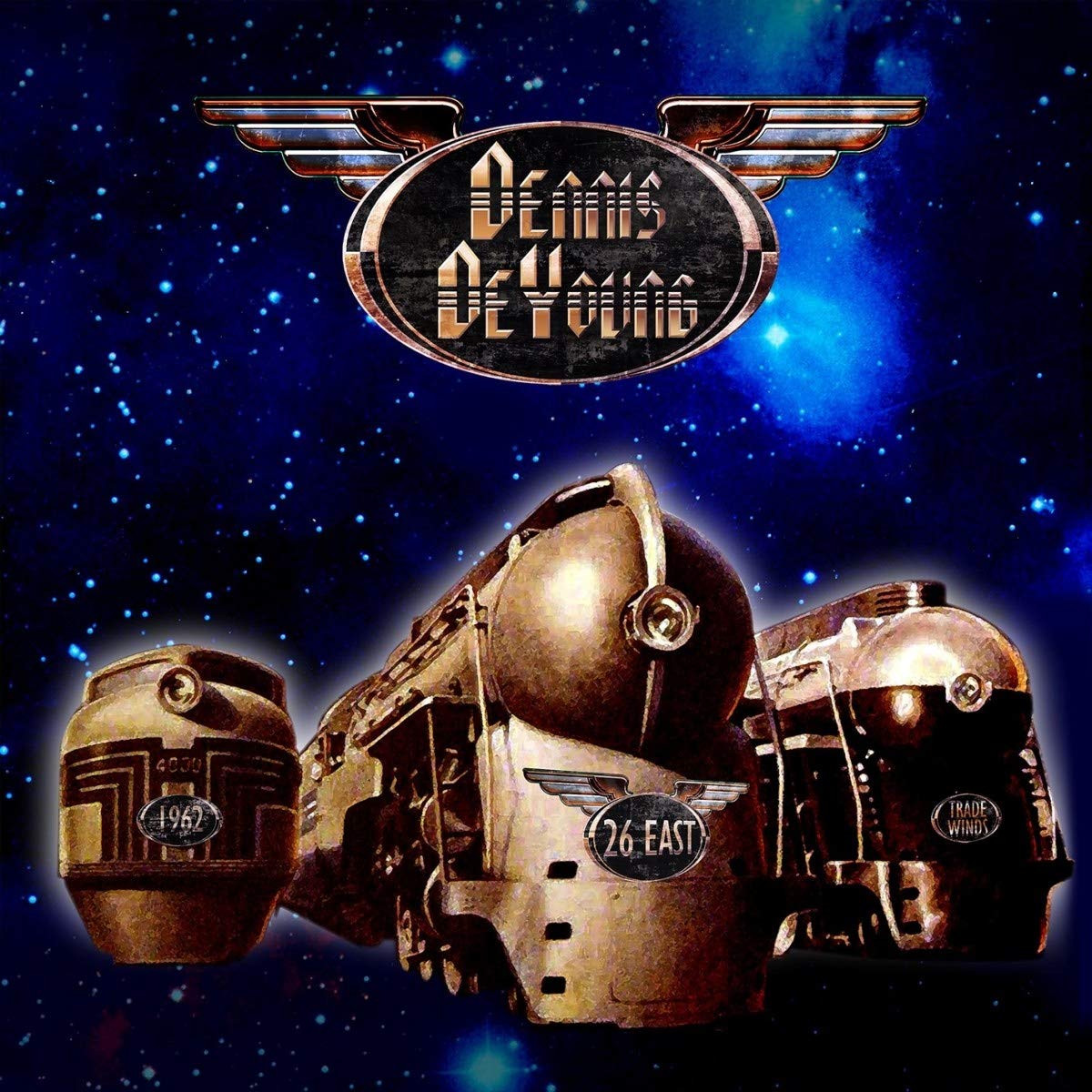
About the Album: Dennis DeYoung grew up on the south side of Chicago in Roseland at 26 East, hence the name for his sixth solo studio album. DeYoung formed the band Styx in the basement of his house at 26 East in 1962 with the twins John and Chuck Panozzo, who lived across the street. AZ The three locomotives on the album cover are a reference to the three of them “leaving Chicago on their journey to the stars.” AZ Thematically, this album is DeYoung’s reflections on his past rock-and-roll life and a look at “the somewhat bleak state of the world. It all comes laced with his singular sense of humor and willingness to go for grand musical gestures, a welcome respite from the age of musical irony.” AS This was DeYoung’s first studio endeavor in more than a decade. He “couldn’t see the point in working so hard on something that might have fallen on deaf ears.” AS He noted how his “blood, sweat and tears goes into the creative process” AS but the audience wants to hear the old stuff. It took encouragement from Jim Peterik, a fellow Chicagoan and former band member of Survivor, to light the spark. DeYoung said, “He once told me the world needed my music; to which I replied, ‘Have the world text me for verification.’” AZ The pair ended up writing nine songs together, five of which show up on Volume 1. With his band Pride of Lions, Peterik’s “writing style…tends toward the theatrical in places so this…is a pretty good pairing.” MP DeYoung “certainly doesn’t sound as though his voices has suffered over the years.” MP He sounds good for a man of 73! MP In addition, the songs “are very well-constructed” MP and stand out as more than “the typical and generic AOR/melodic hard rock style.” MP “However, if Broadway musicals are not to your liking and…you like your music to rock hard, you’ll probably struggle with much of this album.” MP “East of Midnight” The first single and opening cut “is a stunning throwback to early Styx. With more pomp and circumstance than a dozen trooping the colour ceremonies, glorious 70’s prog-style keyboard sounds and with twists and turns galore in its 5 minutes and 5 seconds, this is classic pomp rock of the very highest order.” MP
“With All Due Respect” The second song and single “doesn’t maintain the quality level.” MP It is “a searing direct hit on the polarizing nature of television news” AS but comes across a little silly. It finds DeYoung “ranting at the world over a fairly pedestrian rock backing track. He might well have a lot to rant about given the state of the world and America right now, but this track doesn’t quite cut it somehow.” MP
“A Kingdom Ablaze” The longest song on the album isn’t “as overtly Styx-like as the opener.” MP It is “more akin to what Styx were doing…on Edge of the Century,” MP their 1990 album after a seven-year absence. It’s “a real slow burner” MP with excellent production and “many different guitar and keyboard parts popping in and out of the mix.” MP “You My Love” This is “a stunning piece of keyboard dominated theatrical balladry” MP which “recalls the great Styx ballads, but…also sounds like it could be in a Broadway show.” MP It “might alienate the traditional rock audience…but DeYoung’s vocal is superb throughout.” MP This is a rare “downbeat look at romance from DeYoung, who’s been happily married for 50 years to wife Suzanne. Watching his daughter go through a divorce, however, gave him the impetus for the track.” AS “Run for the Roses” Based on his interview with American Songwriter, it sounds like this is the song that kicked off the collaboration between Peterik and DeYoung. Peterik sent DeYoung the sketch for the song and DeYoung said, “OK, let’s get together and see what we come up with.” AS This “has all the hallmarks of the more theatrical tracks on any of Pride of Lions albums, but with DeYoung’s superb voice elevating it to be better than any any similar tracks on any of that band’s work.” MP “Damn the Dream” This is “a good uptempo rocker” MP which “storms out of the speakers with more Peterik influence in the writing and arrangement.” MP It is “slightly reminiscent of the more rocking tracks…from Styx’s back catalogue.” MP In it, DeYoung “finds both the bitter and the better.” AS He told American Songwriter “We’re all chasing that dream because we think it will fill a hole inside us…We think it will change us. It won’t.” AS “Unbroken” This has “wonderfully delicate keyboard pads and tasteful guitar.” MP It “has lots of interesting chord modulations that give it a definite Broadway feel in places.” MP “The Promise of This Land” The “intro of this song could be in any Andrew Lloyd Webber musical.” MP “The melodic structure remains very Broadway.” MP “To the Good Old Days” To the Good Old Days features Julian Lennon. DeYoung wrote it with him in mind. Originally the Beatles-inspired tune was about the effect of the Beatles on DeYoung, but he rewrote it when he realized it was his story and not Julian’s. They’d never met, but DeYoung said he’d been “an admirer since ‘Valotte.’” AZ Of the end result, DeYoung said, it was “even better than I had imagined…The moment we sang together in the studio it felt magical.” AZ
“A.D. 2020” The closer revisits “A.D. 1928” and “A.D. 1958” from Styx’s 1981 Paradise Theater album. It gives the “feeling of the curtain coming down at the end of the show.” MP |
Resources and Related Links:
|