Showing posts with label Digital Dream Door top 500 songs. Show all posts

Saturday, June 2, 1979

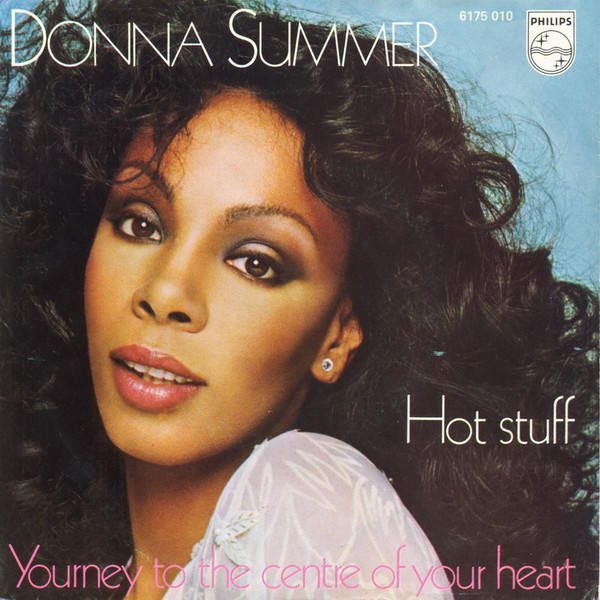
Donna Summer “Hot Stuff” hit #1

Hot Stuff

Donna Summer

Writer(s): Pete Bellotte, Harold Faltermeyer, Keith Forsey (see lyrics here)


Released: April 21, 1979


First Charted: April 20, 1979


Peak: 13 US, 14 CB, 13 GR, 15 HR, 12 RR, 3 RB, 11 UK, 12 CN, 11 AU, 7 DF (Click for codes to charts.)


Sales (in millions): 2.0 US, 0.2 UK, 2.35 world (includes US + UK)


Airplay/Streaming (in millions): -- radio, 82.8 video, 301.66 streaming

Awards:

Click on award for more details.

About the Song:

Summer’s earlier top-ten hits “Love to Love You Baby” and “I Feel Love” “introduced the world to the synthetic-psychedelic Euro-disco sound.” SG and established her as “the reigning queen of disco.” SG By 1979, she was “starting to get sick of disco” SG and “wanted to sing a rock song.” SG Neil Bogart, the head of her Casablanca label, suggested they give the resulting “Hot Stuff” to Cher, FB but Summer insisted on recording it herself “and she did it with a vengeance.” SS It was “one of the hardest-rocking singles of the 1970s” SS and even won a Grammy for best rock female vocal.

Of course, “Hot Stuff” “still sounded a whole hell of a lot like a disco song” SG and ended up “a classic of the disco era.” DJ Although “Summer wasn’t an especially wild woman in real life, she could play one on record.” SG This was “one of the most salaciously sexually” SS songs of the decade. It “is a song about absolutely needing sex right now, about being so horny that you’re practically climbing the walls. Summer sells the hell out of it.” SG She’s “all feverish urgency.” SG

The groove on ‘Hot Stuff’ is just a monster. The beat is a slowed-down panther-stalk version of the disco boom. The synth hook whines and nags, pushing the intensity further while also providing one more sticky hook.” SG At the end, Jeff “Skunk” Baxter of the Doobie Brothers and formerly with Steely Dan, “shows up to play a guitar solo that’s all spiky, discordant edges, growling just as hard as Summer.” SG

It was the lead single from Bad Girls, the “last, biggest, and best” SG of a run of six studio albums in the last half of the ‘70s. Rolling Stone called it “the only great disco album other than Saturday Night Fever.” SG


Resources:


First posted 1/23/2023.

Saturday, June 3, 1972

Staple Singers “I’ll Take You There” hit #1

I’ll Take You There

The Staple Singers

Writer(s): Al Bell (see lyrics here)


Released: February 1972


First Charted: April 1, 1972


Peak: 11 US, 12 CB, 4 GR, 11 HR, 14 RB, 30 UK, 21 CN, 6 DF (Click for codes to charts.)


Sales (in millions): --


Airplay/Streaming (in millions): 1.0 radio, 27.7 video, 138.41 streaming

Awards:

Click on award for more details.

About the Song:

“The Staple Singers’ ‘I’ll Take You There’ never mentions any particular god, or any set of beliefs. It only imagines a place where things are better. But it’s still hard to hear it as anything other than a gospel song – one of the purest and most direct that ever went to #1 in America.” SG Roebuck “Pops” Staples, the family patriarch, said, “We always tried to do material that was uplifting.” FB

The song “came out while the Civil Rights struggle was still raging…And yet it imagines a time, or a place, where things might get better…There’s a beautiful audacity in that image — the same beautiful audacity that has powered gospel music since before the advent of recorded sound. And while we’re still not there, we can hear some version of that imagined utopia in that groove.” SG Mavis Staples, who sings lead on “Take You There,” said, “When we heard Dr. Martin Luther King preach, we said, ‘If he can preach this, we can sing it.’” SF

Pops grew up in the Mississippi Delta playing with blues greats including Charlie Patton and Robert Johnson. He moved to Chicago during the depression and started singing with his family at his brother’s church in 1948. Four years later, they signed to their first record company as the Staple Singers. In 1968, Al Bell signed them to Stax. He was credited with “I’ll Take You There.” He said the song came to him in his father’s back yard after his brother’s funeral, but Mavis said they co-wrote the lyrics in her apartment. She was furious about not getting credited, which partially led to the group departing Stax in 1975. SG

The song “might be the first reggae-influenced single to make it to #1 in America.” SG It takes from a 1969 reggae instrumental called “The Liquidator.” Bell played it for the legendary Muscle Shoals Rhythm Section, who claimed they didn’t know it was someone else’s record. They thought it was a demo Bell recorded. SG Rolling Stone’s David Fricke described “I’ll Take You There as the “epitome of the Muscle Shoals Sound.” WK

It is also “a great showcase for Mavis,” SG who mostly ad-libs the call-and-response vocals. “She’s casual and commanding, whooping and grunting but always staying in the pocket. Sometimes, she takes over, bringing the full force of her voice. Sometimes, she just sits back and enjoys what’s happening.” SG


Resources:

  • DMDB encyclopedia entry for The Staple Singers
  • FB Fred Bronson (2003). The Billboard Book of Number One Hits (5th edition). Billboard Books: New York, NY. Page 312.
  • SF Songfacts
  • SG Stereogum (2/27/2019). “The Number Ones” by Tom Breihan
  • WK Wikipedia


First posted 1/23/2023.