Showing posts with label top R&B songs all time. Show all posts

Saturday, September 15, 2012

Today in Music (1962): Booker T & the MGs topped the R&B chart with “Green Onions”

Green Onions

Booker T. & the MGs

Writer(s): Steve Cropper, Al Jackson, Jr., Booker T. Jones, Lewie Steinberg


Released: July 1962


First Charted: August 11, 1962


Peak: 3 BB, 3 CB, 3 GR, 3 HR, 14 RB, 7 UK, 39 CN, 73 AU, 7 DF (Click for codes to charts.)


Sales (in millions): 1.0 US


Airplay/Streaming (in millions): 1.0 radio, 42.1 video, 239.82 streaming

Awards:

Click on award for more details.

About the Song:

Booker T. & the MGs were the house band for Stax records, “soul’s biggest hit factory after Motown.” TB The group of session musicians consisted of keyboardist Booker T. Jones, guitarist Steve Cropper, drummer Al Jackson, and bassist Lewis Steinberg. With Donald “Duck” Dunn later replacing Steinberg, the collective would back classics by Otis Redding, Wilson Pickett, and Sam & Dave in the 1960s.

The song “Green Onions” came about when the band were waiting to start a session with rockabilly artist Billy Lee “Red Hot” Riley. SS They started jamming and engineer Jim Stewart “got an earful of a low-down blues that the MG’s were cooking up. He thought it was dynamite. He quickly switched on the tape and caught it all.” SJ Then they played him a dance tune they’d been working on. The latter became “Green Onions.” SJ The single was backed by “Behave Yourself,” the first song the group had played for Stuart. SJ When it was released, Booker had just graduated from high school. SS

The title apparently came about because, according to Cropper, someone said, “Boy, this is some funky music; this music stinks. What’s the stinkiest, nastiest thing you can think of?’” SJ Steinberg “declared green onions the funkiest thing he’d ever smelled.” SS

Author and critic Dave Marsh said the song was “what happens when the best backup band in the universe decides it’s time to be noticed.” DM Thomas Ryan said it was “part R&B, part jazz, the groove was as uncluttered as a rhythm section could get without disappearing altogether.” SS


Resources:


First posted 1/18/2024.

Sunday, October 17, 2010

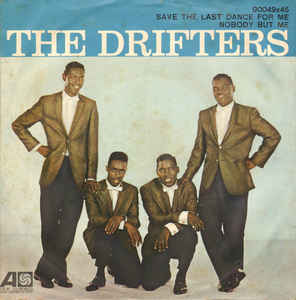
Today in Music (1960): The Drifters “Save the Last Dance for Me” hit #1

Save the Last Dance for Me

The Drifters

Writer(s): Doc Pomus, Mort Shuman (see lyrics here)


First Charted: August 26, 1960


Peak: 13 BB, 16 CB, 2 GR, 15 HR, 11 RB, 2 UK, 11 CN, 14 AU, 11 DF (Click for codes to charts.)


Sales (in millions): 1.0 US, 0.2 UK


Airplay/Streaming (in millions): 7.0 radio, 41.10 video, 83.23 streaming

Awards:

Click on award for more details.

About the Song:

The Drifters have been one of the longest-lasting and most successful R&B groups of all time, forming originally in 1953 and going through multiple incarnations into present day. The group landed eleven top-ten R&B hits in their first couple of years, but were disbanded by manager George Treadwell in 1958. He replaced them with the group the Five Crowns. The new lineup featured Ben E. King (later of “Stand by Me” success) as the lead singer.

The new version of the Drifters reached #2 on the pop charts in 1959 with “There Goes My Baby.” They found even greater success a year later with “Save the Last Dance for Me,” the only #1 pop hit in the group’s long history. The song was written by Doc Pomus and Mort Shuman, who’d had success a year earlier with Dion & the Belmonts’ “A Teenager in Love” (#5 BB) as well as top-ten hits by Fabian. The went on to write several top-five hits for Elvis Presley, including the #1 song “Surrender” in 1961.

Pomus explained that he and Shuman wrote many of their hits after Shuman would return from periodic vacations to Mexico. Shuman would provide fragments of Latin beats and melodies and Shuman would write lyrics that sounded like they were translated into English. DM Pomus wrote the lyrics for “Dance” about remembering his wedding and, because he was in a wheelchair due to polio, watching his wife dance with other people. However, in the song he reminds her who will be going home with her. RC

Pomus said, “We knew we wrote a good one, but we had no reason to think that this was much better than ten other songs.” SJ Originally Jimmy Clanton, a New Orleans singer, wanted to record the song. When Atlantic Records called to say they wanted the song for the Drifters, Pomus said they talked Clanton out of the song by adapting a song they’d written as “Go, Bobby, Go” into “Go, Jimmy, Go” and telling Clanton they’d written it for him. SJ It was a top-five hit for him. Even then, the Drifters’ version of “Save the Last Dance for Me” was relegated to the B-side of a song called “Nobody But Me.” It was Dick Clark, the host of American Bandstand, who suggesting pushing the other song instead.


Resources:


Related Links:


First posted 1/18/2024.

Saturday, June 3, 1972

Staple Singers “I’ll Take You There” hit #1

I’ll Take You There

The Staple Singers

Writer(s): Al Bell (see lyrics here)


Released: February 1972


First Charted: April 1, 1972


Peak: 11 US, 12 CB, 4 GR, 11 HR, 14 RB, 30 UK, 21 CN, 6 DF (Click for codes to charts.)


Sales (in millions): --


Airplay/Streaming (in millions): 1.0 radio, 27.7 video, 138.41 streaming

Awards:

Click on award for more details.

About the Song:

“The Staple Singers’ ‘I’ll Take You There’ never mentions any particular god, or any set of beliefs. It only imagines a place where things are better. But it’s still hard to hear it as anything other than a gospel song – one of the purest and most direct that ever went to #1 in America.” SG Roebuck “Pops” Staples, the family patriarch, said, “We always tried to do material that was uplifting.” FB

The song “came out while the Civil Rights struggle was still raging…And yet it imagines a time, or a place, where things might get better…There’s a beautiful audacity in that image — the same beautiful audacity that has powered gospel music since before the advent of recorded sound. And while we’re still not there, we can hear some version of that imagined utopia in that groove.” SG Mavis Staples, who sings lead on “Take You There,” said, “When we heard Dr. Martin Luther King preach, we said, ‘If he can preach this, we can sing it.’” SF

Pops grew up in the Mississippi Delta playing with blues greats including Charlie Patton and Robert Johnson. He moved to Chicago during the depression and started singing with his family at his brother’s church in 1948. Four years later, they signed to their first record company as the Staple Singers. In 1968, Al Bell signed them to Stax. He was credited with “I’ll Take You There.” He said the song came to him in his father’s back yard after his brother’s funeral, but Mavis said they co-wrote the lyrics in her apartment. She was furious about not getting credited, which partially led to the group departing Stax in 1975. SG

The song “might be the first reggae-influenced single to make it to #1 in America.” SG It takes from a 1969 reggae instrumental called “The Liquidator.” Bell played it for the legendary Muscle Shoals Rhythm Section, who claimed they didn’t know it was someone else’s record. They thought it was a demo Bell recorded. SG Rolling Stone’s David Fricke described “I’ll Take You There as the “epitome of the Muscle Shoals Sound.” WK

It is also “a great showcase for Mavis,” SG who mostly ad-libs the call-and-response vocals. “She’s casual and commanding, whooping and grunting but always staying in the pocket. Sometimes, she takes over, bringing the full force of her voice. Sometimes, she just sits back and enjoys what’s happening.” SG


Resources:

  • DMDB encyclopedia entry for The Staple Singers
  • FB Fred Bronson (2003). The Billboard Book of Number One Hits (5th edition). Billboard Books: New York, NY. Page 312.
  • SF Songfacts
  • SG Stereogum (2/27/2019). “The Number Ones” by Tom Breihan
  • WK Wikipedia


First posted 1/23/2023.