Showing posts with label Keith Forsey. Show all posts

Saturday, May 18, 1985

Simple Minds hit #1 with “Don’t You Forget About Me”

Don’t You Forget About Me

Simple Minds

Writer(s): Keith Forsey, Steve Schiff (see lyrics here)


Released: February 20, 1985


First Charted: February 23, 1985


Peak: 11 BB, 12 CB, 11 GR, 12RR 36 AC, 13 AR, 1 CO, 7 UK, 11 CN, 6 AU, 1 DF (Click for codes to charts.)


Sales (in millions): -- US, 1.45 UK, 1.97 world (includes US + UK)


Airplay/Streaming (in millions): 1.0 radio, 453.29 video, 885.23 streaming

Awards:

Click on award for more details.

About the Song:

The Scottish new wave rock band Simple Minds formed in 1977 and found popularity in the UK where they hit #1 with their 1984 album Sparkle in the Rain. That same year, they landed their fourth top-20 hit in the UK. However, they had yet to dent the United States’ Billboard Hot 100. That changed in 1985 with “Don’t You (Forget About Me).”

The song, featured in the hit movie The Breakfast Club, soared to #1 in the US and gave Simple Minds their first top-10 hit in the UK. It wasn’t written by the band, but by producer Keith Forsey and Steve Schiff, who was a guitarist and songwriter with the Nina Hagen band. Forsey also wrote the #1 hit “Flashdance…What a Feelin’” for the 1983 movie Flashdance and would later write “Shakedown” for Bob Seger, a #1 song from Beverly Hills Cop II. SF Forsey and Schiff’s original demo opens the movie while Simple Minds’ version closes things out. WK

There’s some dispute as to whether the song was written for Simple Minds or for Bryan Ferry. In any event, both said no. Simple Minds thought they should only record material they had written. The song was also rejected by Billy Idol and Cy Curnin of the Fixx. WK The record company suggested Corey Hart, but Forsey didn’t think he was right for the song.

Simple Minds eventually agreed to record the song, although there are varied stories as to why. One version says that Chrissie Hynde of the Pretenders, persuaded Jim Kerr, the lead singer of the band and her then-husband, after Forsey called her. WK Another account says John Hughes, the director of The Breakfast Club, screened the film for the band. SF Either way, the band still initially thought it would be “a throwaway song on the soundtrack to a forgettable movie.” WK Once they recorded it, however, some of the band members now thought the song had “genuine commercial potential.” WK


Resources:


Related Links:


First posted 1/25/2021; last updated 5/2/2024.

Saturday, May 28, 1983

Irene Cara hit #1 with “Flashdance…What a Feelin’”

Flashdance…What a Feelin’

Irene Cara

Writer(s): Irene Cara, Keith Forsey, Giorgio Moroder (see lyrics here)


Released: March 1983


First Charted: April 2, 1983


Peak: 16 US, 16 CB, 14 GR, 15 RR, 4 AC, 2 RB, 2 UK, 13 CN, 17 AU, 8 DF (Click for codes to charts.)


Sales (in millions): 1.0 US, 0.25 UK, 3.25 world (includes US + UK)


Airplay/Streaming (in millions): -- radio, 84.2 video, 315.66 streaming

Awards:

Click on award for more details.

About the Song:

Italian composer Giorgio Moroder, dubbed the “Father of Disco,” was a pioneer in electronic dance music. He was best known for his production work with Donna Summer, but also worked with Blondie, David Bowie, Janet Jackson, and others. He worked on soundtracks as well, including 1978’s Midnight Express, 1980’s American Gigolo, and 1983’s Flashdance. The latter sold more than 20 million copies worldwide, fueled by Michael Sembello’s “Maniac” and Irene Cara’s “Flashdance…What a Feelin’,” both #1 hits. Moroder wrote the music for the latter with Irene Cara in mind because of what she did with the theme song (#3, 1980) for Fame. He would later write “Danger Zone” and “Take My Breath Away” for 1986’s Top Gun. SF

Cara was initially reluctant to work with Donna Summer’s producer because, as she expected, critics suggested she sounded like Summer on “What a Feelin’.” FB She considered the accusations sexist because, as she said, “There are so many records made by male artists today that sound alike. But nobody makes an issue of that.” FB

She wrote the lyrics for “What a Feelin’” with Ken Forsey, who later wrote “Don’t You Forget About Me” for The Breakfast Club and “Shakedown” for Beverly Hills Cop II. SF Cara and Forsey wrote the song while driving to a recording session. She suggested the idea of singing about the feeling associated with dancing. Forsey extended the idea to be about “dancing for my life.” As Cara said, the phrase “‘what a feeling’ was a metaphor about a dancer, how she’s in control of her body when she dances and how she can be in control of her life.” FB This fit with the storyline of the movie “of a Pittsburgh factory worker who beats out incredible odds to live out her dreams to dance.” TB

The Flashdance soundtrack knocked Michael Jackson’s Thriller from the top of the album chart for two weeks during Irene Cara’s six-week run at the top with “Flashdance…What a Feelin’.” Thriller would return to the top for 20 more weeks – 37 total – before getting knocked out by another music-themed movie soundtrack – Footloose. “What a Feelin’” earned an Academy Award for Best Original Song and a Golden Globe Award for Best Original Song. Cara also took him a Grammy for Best Female Pop Vocal.


Resources:


First posted 11/2/2019; last updated 4/15/2023.

Saturday, June 2, 1979

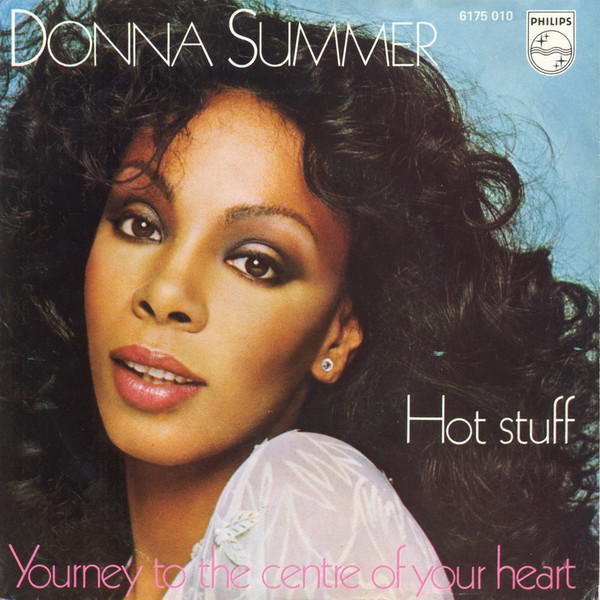
Donna Summer “Hot Stuff” hit #1

Hot Stuff

Donna Summer

Writer(s): Pete Bellotte, Harold Faltermeyer, Keith Forsey (see lyrics here)


Released: April 21, 1979


First Charted: April 20, 1979


Peak: 13 US, 14 CB, 13 GR, 15 HR, 12 RR, 3 RB, 11 UK, 12 CN, 11 AU, 7 DF (Click for codes to charts.)


Sales (in millions): 2.0 US, 0.2 UK, 2.35 world (includes US + UK)


Airplay/Streaming (in millions): -- radio, 82.8 video, 301.66 streaming

Awards:

Click on award for more details.

About the Song:

Summer’s earlier top-ten hits “Love to Love You Baby” and “I Feel Love” “introduced the world to the synthetic-psychedelic Euro-disco sound.” SG and established her as “the reigning queen of disco.” SG By 1979, she was “starting to get sick of disco” SG and “wanted to sing a rock song.” SG Neil Bogart, the head of her Casablanca label, suggested they give the resulting “Hot Stuff” to Cher, FB but Summer insisted on recording it herself “and she did it with a vengeance.” SS It was “one of the hardest-rocking singles of the 1970s” SS and even won a Grammy for best rock female vocal.

Of course, “Hot Stuff” “still sounded a whole hell of a lot like a disco song” SG and ended up “a classic of the disco era.” DJ Although “Summer wasn’t an especially wild woman in real life, she could play one on record.” SG This was “one of the most salaciously sexually” SS songs of the decade. It “is a song about absolutely needing sex right now, about being so horny that you’re practically climbing the walls. Summer sells the hell out of it.” SG She’s “all feverish urgency.” SG

The groove on ‘Hot Stuff’ is just a monster. The beat is a slowed-down panther-stalk version of the disco boom. The synth hook whines and nags, pushing the intensity further while also providing one more sticky hook.” SG At the end, Jeff “Skunk” Baxter of the Doobie Brothers and formerly with Steely Dan, “shows up to play a guitar solo that’s all spiky, discordant edges, growling just as hard as Summer.” SG

It was the lead single from Bad Girls, the “last, biggest, and best” SG of a run of six studio albums in the last half of the ‘70s. Rolling Stone called it “the only great disco album other than Saturday Night Fever.” SG


Resources:


First posted 1/23/2023.