


Abbey Road |
|
Released: September 26, 1969 Peak: 111 US, 118 UK, 111 CN, 118 AU Click for codes to charts. Sales (in millions): 12.0 US, 1.93 UK, 30.0 world (includes US and UK) Genre: classic rock |

Tracks:Click on a song title for more details.
Total Running Time: 47:03 The Players:
|
Rating: 4.740 out of 5.00 (average of 33 ratings)
Quotable:"A worthy last chapter for the greatest band of all" – Josh Tyrangiel and Alan Light, Time magazineAwards:(Click on award to learn more).
|


About the Album:Abbey Road, “recorded in the iconic West London studio that it takes its name from, was met with mixed reception upon release. But as time passed, it became lauded as the band’s best effort.” CQ It was their “most tightly constructed,” AM “most polished” TL and “the best sounding Beatles’ record.” JI It showed the group “still pushing forward in all facets of their art.” AM The album echoed “some of the faux-conceptual forms of Sgt. Pepper, but featuring stronger compositions and more rock-oriented ensemble work.” AM It is a sentimental farewell that revives the magic of their early work while expounding on their maturity as musicians.” PM “There’s an overt lust and desire overtaking the boyish innocence that initially skyrocketed the group to popularity.” CQ In addition, “Lennon, McCartney and Harrison reputedly sang more three-part harmony here than on any other Beatles album.” 500 It all makes for “a sentimental conclusion to the legendary career of, arguably, the greatest band of all time—the Fab Four sent themselves off with a bittersweet and unforgettable goodbye.” PM The EndAbbey Road was technically the last Beatles’ album. “The messy, joyless Let It Be“ TL was the last official studio release, but was a reworked version of the aborted Get Back project from January 1969 in which the Beatles aimed to “get back to their roots.” As such, there’s a “sense of melancholy” CQ as the album “carries a feeling of completion and finality.” CQIn early 1969, the Beatles were “exhausted and angry with one another.” 500 John Lennon and wife Yoko Ono were more interested in promoting themselves as “avant garde peacenik performance artists” JI and the group was feuding over who should control the finances. Even their producer, “the normallly unruffled” George Martin, said “I don’t want to be part of this anymore.” JI As a result, he was surprised when Paul McCartney asked him to help produce a Beatles’ record “like we used to.” JI “Determined to go out with the same glory with which they had first entranced the world at the start of the decade, the group reconvened at EMI’s Abbey Road Studios.” 500 “Though the break-up was looming, you'd never know it.” TL Martin said, “It was a very happy record. I guess it was happy because everybody thought it was going to be the last.” 500 George Harrison said, “It felt as if we were reaching the end of the line.” CQ It was. August 20 marked the last time the four members were in the studio together. 500 “Abbey Road felt like a breath of fresh air from a band that had spent the previous few years in turmoil—and the Beatles knew this would be their last album, and that freedom of seeing the finish line helped create their most polished album. They came together as friends for a victory lap.” PM George Harrison Gets to Shine“Always the humblest Beatle, Harrison’s vocals and guitar work are stately, restrained and beautiful.” RV Abbey Road also helped in “solidifying him as…more than capable of matching the talents of Paul and John.” CQ He contributes “Something” and “Here Comes the Sun” as major additions to the Beatles’ catalog.To Link or Not to LinkMcCartney wanted an entire album of songs which linked together while Lennon pushed for each song to be separate, “preferably with all of his on one side.” JI They compromised with Lennon’s approach for the first side and McCartney’s concept for most of the second.The MedleyThe medley on the second side “might only be a bunch of bits and scraps stuck together, but it still sounds fantastic.” TL “McCartney and producer George Martin managed to take a bunch of tunes which, in and of themselves, were not among the strongest in the Beatles' canon, and weave them into one of the most memorable musical suites in rock history.” PKThe album’s “touching, official close (Golden Slumbers/ Carry That Weight/ The End) is nicely undercut, in typical Beatles fashion, by…McCartney’s cheeky Her Majesty.” AZ It would take Paul “five years to do anything better than the 19-minute medley that closes the album.” EW’93 ReissueA 2019 deluxe edition of the album added a disc of alternate takes. A super deluxe edition added two discs’ worth.The SongsHere’s a breakdown of each of the individual songs. |
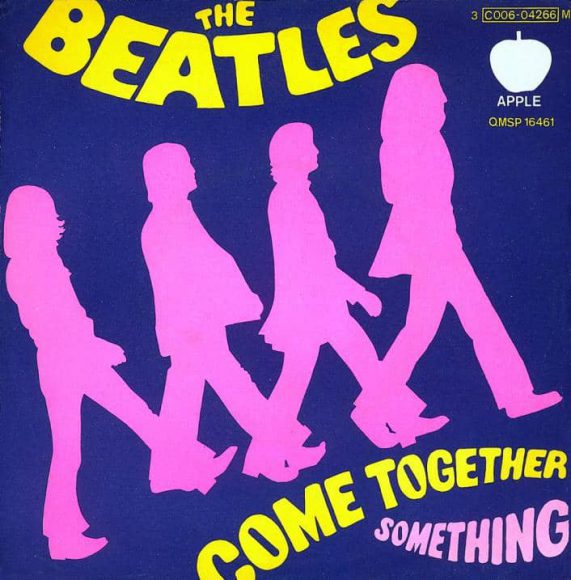 |
Come TogetherThe Beatles |
Writer(s): John Lennon, Paul McCartney (see lyrics here) Lead vocals: John Lennon Released: double A-side single with “Something” (10/18/1969), Abbey Road (9/26/1969), The Beatles 1967-1970 (compilation, 4/2/1973), The Beatles 1 (compilation, 11/14/2000) Peak: 11 US, 13 CB, 12 GR, 13 HR, 1 CL, 25 AR, 4 UK, 15 AU, 1 DF Click for codes to charts. Sales (in millions): 2.0 US, 0.6 UK Airplay/Streaming (in millions): 2.0 radio, 97.0 video, 874.14 streaming Covered by: The Supremes (1970), Ike & Tina Turner (1970, #57 BB, 21 RB), Tina Turner (1976), Aerosmith (1978, #23 BB), Michael Jackson (1988, #3 UK), Delbert McClinton (1995), Bobby McFerrin & Robin Williams (1998), Paul Weller (2004), Arctic Monkeys (2012, #21 UK), Godsmack (2012, #21 AR), Gary Clark Jr. (2017, #15 AR, 39 MR), Craig David (2001) |
Awards:(Click on award to learn more).
|


About the Song:“Come Together” was released as a double-A-sided single along with “Something.” Both songs appeared on the Abbey Road album, the first time that the Beatles released singles featured on one of their UK albums. The songs initially climbed the U.S. Billboard Hot 100 chart separately with “Come Together” reaching #2 and “Something” coming in right behind it at #3. However, starting with the November 29, 1969, chart, the magazine consolidated the two sides of a single into one entry, making “Come Together” / “Something” a #1 hit. FB In the UK, the pair of songs made for the Beatles’ lowest-charting new single since 1962’s “Love Me Do.”The song was inspired by LSD advocate Timothy Leary. He intended to run for Governor of California and asked John Lennon to write a campaign song based on the slogan, “Come Together – Join the Party!” WK The campaign fizzled and Leary passed on the song. SF Lennon used the phrase to write a song during July 1969 sessions for the Beatles’ album Abbey Road. WK “Come Together” is “an overtly sexual song that also contains one of rock's greatest bass lines by Paul McCartney” RV and “a nod to Chuck Berry for the central riff.” RV It was based on Berry’s 1956 single “You Can’t Catch Me,” both lyrically and musically. WK Because of the similarities, Paul McCartney suggested slowing down the tempo. WK The Beatles also added a heavy bass riff, but it wasn’t enough to keep Chuck Berry’s publisher from suing for copyright infringement. WK They settled out of court with the agreement that Lennon would record three songs from the publishing company on his next album. WK |
 |
SomethingThe Beatles |
Writer(s): George Harrison (see lyrics here) Lead vocals: George Harrison Released: double A-side single with “Come Together” (10/18/1969), Abbey Road (9/26/1969), The Beatles 1967-1970 (compilation, 4/2/1973), The Beatles 1 (compilation, 11/14/2000) Peak: 11 US, 2 CB, 12 HR, 17 AC, 1 CL, 4 UK, 14 CN, 15 AU, 1 DF Click for codes to charts. Sales (in millions): 2.0 US, 0.2 UK Airplay/Streaming (in millions): 5.0 radio, 84.0 video, 423.21 streaming Covered by: Joe Cocker (1969), Shirley Bassey (1970, #55 BB, 81 CB, 59 HR, 6 AC, 4 UK), Booker T. & the MG’s (1970, #76 BB, 93 CB, 78 HR, 38 AC), Tony Bennett (1970, #23 AC), Frank Sinatra (1970), Elvis Presley (1973), Johnny Rodriguez (1974, #85 BB, 6 CW), Tanya Tucker (1995), Jeff Lynne with Joe Walsh & Dhani Harrison (2014), Lauryn Hill (2014) |
Awards:(Click on award to learn more).
|


About the Song:Music historians largely view the song as marking “Harrison’s ascendancy as a composer to the level of the Beatles’ principal songwriters, John Lennon and Paul McCartney.” WK It was his “first major hit with the Beatles,” DJ released as a double-A-sided single with “Come Together.” When considered separately, Billboard magazine said “Something” peaked at #3 on the Hot 100 chart, but when the magazine decided to combine both sides of singles as one entry beginning with the November 29 chart, the pair of songs reached #1. FB“The supremely melodic ballad…became the first Harrison-penned Beatles hit.” AM Lennon said it was the best song on Abbey Road WK while Beatles’ drummer Ringo Starr called that song and Harrison’s “While My Guitar Gently Weeps” “two of the finest love songs ever written.” WK Frank Sinatra called it “the greatest love song of the past 50 years.” JI Elton John called “one of the best love songs, ever, ever, ever written…It’s like the song I’ve been chasing for the last thirty-five years.” WK In Saturday Review, Ellen Sander described it as “one of the most beautiful songs George Harrison has ever written.” WK In Revolution in the Head, Ian MacDonald described the song as “the acme of Harrison’s achievement as a writer.” WK It became a standard, even covered by singers like Frank Sinatra.” DJ It ranks second only to “Yesterday” as the Beatles’ most-covered song. WK Shirley Bassey and Booker T. & the MG’s both charted with versions in 1970. Johnny Rodriguez also hit the charts with the song in 1974. The song has been covered by more than 200 artists, WK including Tony Bennett, James Brown, Bob Dylan, Lauryn Hill, Lena Horne, Elton John, Liberace, the Miracles, the O’Jays, Elvis Presley, Bruce Springsteen, and Tanya Tucker. Early on he intended the song for Jackie Lomax, whose debut album Harrison was producing for Apple Records. WK In March 1969, he gave the song to Joe Cocker, WK who released his version in November of that year. Harrison started writing the song in September 1968, but stopped work on it because he thought it might be a melody from another song, considering how easily it had come to him. WK Harrison borrowed the first line from James Taylor’s 1968 composition, ‘Something in the Way She Moves.’” DJ The song is generally considered a love song to Harrison’s first wife, Pattie Boyd, although he later suggested it was about the Hindu deity Krishna. WK |
Maxwell’s Silver HammerThe Beatles |
Writer(s): John Lennon, Paul McCartney Lead vocals: Paul McCartney Released: Abbey Road (9/26/1969) Peak: 15 CL, 19 DF Click for codes to charts. Sales (in millions): -- Airplay/Streaming (in millions): -- radio, -- video, 60.74 streaming |
Oh! DarlingThe Beatles |
Writer(s): John Lennon, Paul McCartney Lead vocals: Paul McCartney Released: Abbey Road (9/26/1969), The Beatles 1967-1970 (compilation, 2023 reissue) Peak: 6 CL, 5 DF Click for codes to charts. Sales (in millions): -- Airplay/Streaming (in millions): -- radio, -- video, 178.43 streaming Covered by: Huey Lewis & the News (1995) About the Song:On the first side, Paul offers up the “throat-shedding ‘Oh! Darling.’“ PK |
Octopus’s GardenThe Beatles |
Writer(s): Ringo Starr Lead vocals: Ringo Starr Released: Abbey Road (9/26/1969), The Beatles 1967-1970 (compilation, 4/2/1973) Peak: 18 CL, 21 DF Click for codes to charts. Sales (in millions): -- Airplay/Streaming (in millions): -- radio, -- video, 115.80 streaming About the Song:We get the “goofball humor” EW’12 of “the silly Ringo singalong Octopus's Garden.” PK |
I Want You (She’s So Heavy)The Beatles |
Writer(s): John Lennon, Paul McCartney Lead vocals: John Lennon Released: Abbey Road (9/26/1969), The Beatles 1967-1970 (compilation, 2023 reissue) Peak: 13 CL, 25 DF Click for codes to charts. Sales (in millions): -- Airplay/Streaming (in millions): -- radio, -- video, 91.98 streaming About the Song:Lennon “veered from the stormy metal” 500 of “the sparse but enchanting I Want You (She’s So Heavy)“ PK to the “driving funk of Come Together.” TL |
 |
Here Comes the SunThe Beatles |
Writer(s): George Harrison (see lyrics here) Lead vocals: George Harrison Released: Abbey Road (9/26/1969), The Beatles 1967-1970 (compilation, 4/2/1973) First Charted: November 2010 Peak: 3 CL, 58 UK, 99 AU, 7 DF Click for codes to charts. Sales (in millions): -- Airplay/Streaming (in millions): 3.0 radio, 147.9 video, 1663.72 streaming Covered by: Richie Havens (#16 BB, 18 AC), Peter Tosh (1971), Steve Harley (1976, #10 UK), John Williams (1998), Sheryl Crow (2007), Brad Palsey with Pharrell Williams (2014) |
Awards:(Click on award to learn more).
|


About the Song:If one were asked to guess which of the Beatles’ songs is their most-streamed on Spotify, the logical starting place would be one of their twenty #1 hits in the United States. Astonishingly, though, the Beatles only song to surpass the billion airs mark on Spotify is “Here Comes the Sun.” The “the buoyant” AM “folk-pop diamond” 500 wasn’t even released as a single in the U.S. or UK, although it did see release as a B-side to “Oh! Darling” in 1970 in Japan. WKThe cut was written by George Harrison, who was lucky to get one or two songs on an album amidst the songs co-written by John Lennon and Paul McCartney. He wrote it in early 1969 at Eric Clapton’s country house on a day he chose to skip a Beatles’ company meeting with Apple. WK As Harrison said, “It was just sunny and it was all just the release of that tension that had been building up on me.” SF He also said, “The relief of not having to go see all those dopey accountants was wonderful, and I walked around the garden with one of Eric’s acoustic guitars and wrote ‘Here Comes the Sun.’” WK Harrison plays acoustic guitar and his newly acquired Moog synthesizer on the cut. It was one of the first pop songs to feature the latter. SF Rolling Stone’s Mikal Gilmore called it a “graceful anthem of hope amid difficult realities.” WK Catholic Herald editor William Oddie said the song conveys “gratitude for the beauty of creation.” WK Tom Petty, who worked with Harrison in the Traveling Wilburys, said “No piece of music can make you feel better than this.” SF Beatles’ producer George Martin went so far as to say it was “in some ways one of the best songs ever written.” WK |
BecauseThe Beatles |
Writer(s): John Lennon, Paul McCartney Lead vocals: John Lennon with Paul McCartney and George Harrison Released: Abbey Road (9/26/1969) Peak: 13 CL, 32 DF Click for codes to charts. Sales (in millions): -- Airplay/Streaming (in millions): -- radio, -- video, 62.80 streaming Covered by: Lynsey DePaul (1976), Vanessa-Mae (1998) About the Song:One of the many snippets culled together on the second half of the record into one massive medley is “the exquisite vocal sunrise of Because“ 500 with its “majestic harmonies.” TL |
You Never Give Me Your MoneyThe Beatles |
Writer(s): John Lennon, Paul McCartney Lead vocals: Paul McCartney Released: Abbey Road (9/26/1969) Peak: 11 CL, 20 DF Click for codes to charts. Sales (in millions): -- Airplay/Streaming (in millions): -- radio, -- video, 59.18 streaming About the Song:The “deliciously bitter” 500 but “melodic You Never Give Me Your Money,” PK is “an allusion to the legal wranglings preoccupying the group.” RV |
Sun KingThe Beatles |
Writer(s): John Lennon, Paul McCartney Lead vocals: Paul McCartney Released: Abbey Road (9/26/1969) Peak: 11 CL, 24 DF Click for codes to charts. Sales (in millions): -- Airplay/Streaming (in millions): -- radio, -- video, 45.60 streaming Covered by: Bee Gees (1976) |
Mean Mr. MustardThe Beatles |
Writer(s): John Lennon, Paul McCartney Lead vocals: Paul McCartney Released: Abbey Road (9/26/1969) Peak: 11 CL, 24 DF Click for codes to charts. Sales (in millions): -- Airplay/Streaming (in millions): -- radio, -- video, 38.61 streaming |
Polythene PamThe Beatles |
Writer(s): John Lennon, Paul McCartney Lead vocals: Paul McCartney Released: Abbey Road (9/26/1969) Peak: 11 CL, 24 DF Click for codes to charts. Sales (in millions): -- Airplay/Streaming (in millions): -- radio, -- video, 37.12 streaming Covered by: Roy Wood (1976) |
She Came in Though the Bathroom WindowThe Beatles |
Writer(s): John Lennon, Paul McCartney Lead vocals: Paul McCartney Released: Abbey Road (9/26/1969) Peak: 14 CL, 20 DF Click for codes to charts. Sales (in millions): -- Airplay/Streaming (in millions): -- radio, -- video, 53.17 streaming Covered by: Joe Cocker (1969, #30 BB), Bee Gees (1976) |
Golden SlumbersThe Beatles |
Writer(s): John Lennon, Paul McCartney Lead vocals: Paul McCartney Released: Abbey Road (9/26/1969) Peak: 6 CL, 9 DF Click for codes to charts. Sales (in millions): -- Airplay/Streaming (in millions): -- radio, -- video, 144.28 streaming Covered by: Trash (1969, #35 UK), Bee Gees (1976), Phil Collins (1998), Ben Folds (2002) |
Carry That WeightThe Beatles |
Writer(s): John Lennon, Paul McCartney Lead vocals: Paul McCartney Released: Abbey Road (9/26/1969) Peak: 6 CL, 9 DF Click for codes to charts. Sales (in millions): -- Airplay/Streaming (in millions): -- radio, -- video, 73.17 streaming Covered by: Trash (1969, #35 UK), Bee Gees (1976), Phil Collins (1998) |
The EndThe Beatles |
Writer(s): John Lennon, Paul McCartney Lead vocals: Paul McCartney Released: Abbey Road (9/26/1969) Peak: 6 CL, 9 DF Click for codes to charts. Sales (in millions): -- Airplay/Streaming (in millions): -- radio, -- video, 51.29 streaming Covered by: Phil Collins (1998) |
Her MajestyThe Beatles |
Writer(s): John Lennon, Paul McCartney Lead vocals: Paul McCartney Released: Abbey Road (9/26/1969) Peak: 6 CL, 9 DF Click for codes to charts. Sales (in millions): -- Airplay/Streaming (in millions): -- radio, -- video, 0.55 streaming About the Song:The album’s “touching, official close (Golden Slumbers/ Carry That Weight/ The End) is nicely undercut, in typical Beatles fashion, by…McCartney’s cheeky Her Majesty.” AZ |
Resources/References
Related DMDB Pages:


First posted 2/15/2008; last updated 8/31/2025. |


No comments:
Post a Comment