Showing posts with label top singer songwriter songs. Show all posts

Saturday, December 22, 1979

Rupert Holmes “Escape (The Piña Colada Song)” hit #1

Escape (The Piña Colada Song)

Rupert Holmes

Writer(s): Rupert Holmes (see lyrics here)


First Charted: October 19, 1979


Peak: 13 US, 13 CB, 14 GR, 14 HR, 13 RR, 8 AC, 13 CL, 23 UK, 12 CN, 3 AU, 1 DF (Click for codes to singles charts.)


Sales (in millions): 1.0 US, 0.6 UK


Airplay/Streaming (in millions): -- radio, 95.57 video, 428.18 streaming

Awards:

Click on award for more details.

About the Song:

Rupert Holmes “had been part of the pop-music dream factory for a decade when he got to #1.” SG He was born in 1947 in Northwich, England. His father was an American Army officer and his mom was English. They moved to New York when he was 6 and he latter attended the Manhattan School of Music. In 1969, he joined “an anonymous bubblegum group” SG called the Cuff Links before having chart success with Street People (“Jennifer Tomkins,” #36, 1970) and the Buoys (“Timothy,” #17, 1971). He also wrote jingles and material for other artists, including songs for the soundtrack for A Star Is Born.

He released four solo albums from 1974 to 1978. “None of them sold, but those records helped Holmes build a name for himself as a writer of funny, irony-infused story-songs.” SG He achieved his first success as a solo artist with “Let’s Get Crazy Tonight,” a minor hit (#72) from his fourth solo album, 1978’s Pursuit of Happiness. Holmes jokingly described his career as “the Poseidon Adventure of pop.” FB

However, he finally achieved chart-topping success with “Escape,” the last #1 song of the 1970s. It is an “infernally catchy soft-rock ditty, an infidelity-themed story-song that ends in an O. Henry twist.” SG Holmes got the idea for the song while reading the newspaper The Village Voice. The narrator is bored with his relationship and responds to a personal ad by someone who likes, among other things, piña coladas. He says they should meet at a bar to plan their escape. It ends up being his own girlfriend and both are pleasantly surprised to find out things they never knew about each other.

Holmes saw the guy as “so vain it never occurs to him that the girl was also bored…When he meets her, it’s kind of a comeuppance. She’s the strong one because she instigated the thing. Hopefully, they see each other in a new light.” FB It makes for good storytelling, but raises questions. They have “elementary preferences that they haven’t communicated,” SG discovered only because they tried to cheat on each other. What chance does this couple have for success? Ultimately, though, it makes for a fantastic pop song precisely because it achieves the unusual quality of challenging the listener to ask such questions.


Resources:

  • DMDB encyclopedia entry for Rupert Holmes
  • FB Fred Bronson (2003). The Billboard Book of Number One Hits (5th edition). Billboard Books: New York, NY. Page 518.
  • SG Stereogum (3/9/2020). “The Number Ones” by Tom Breihan
  • WK Wikipedia


First posted 12/6/2022.

Saturday, October 23, 1976

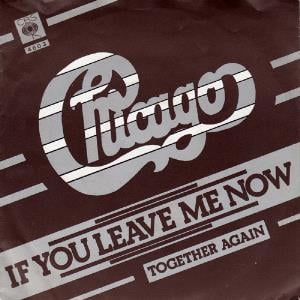
Chicago “If You Leave Me Now” hit #1

If You Leave Me Now

Chicago

Writer(s): Peter Cetera (see lyrics here)


Released: July 30, 1976


First Charted: August 6, 1976


Peak: 12 US, 11 CB, 15 GR, 12 HR, 13 RR, 11 AC, 1 CL, 13 UK, 12 CN, 15 AU, 1 DF (Click for codes to charts.)


Sales (in millions): 2.0 US, 0.8 UK


Airplay/Streaming (in millions): -- radio, 63.4 video, 250.72 streaming

Awards:

Click on award for more details.

About the Song:

Chicago formed in the city of the same name in 1967. Their jazz-inflected rock made them somewhat oblivious to genre trends and proved to be a hit-making formula as well. From 1969 to 1975 they landed eleven songs in the top 10 and were sitting on five consecutive #1 albums when Chicago X was released. While that album missed the top slot, peaking at #3, it continued the group’s perfect record of platinum albums and gave the band something they’d never had before – a #1 song.

“If You Leave Me Now” is “a breezy ballad about attempting to stave off a breakup.” SG It’s written and sung by Peter Cetera, who “sings the hell out of the song, hitting inverted-eyebrow blue-eyed-soul sincerity notes all over the place.” SG He “sells the wounded sadness of the song’s sentiment” SG backed by “a slow horn riff, some acoustic-guitar flourishes, [and] a sad-bastard string section.” SG The Guardian said the song “impossibly lush and beautifully written, but its sadness is pervasive and affecting.” WK Stereogum’s Tom Breihan, however, suggests that it “is soft and gooey enough that it never even sounds like a possible-breakup song. Instead, it comes off as a simple love song, a prom slow-dance kind of thing.” SG

The other band members weren’t overjoyed about how “that one huge ballad begat more huge ballads — most of them from Peter Cetera.” SG Prior to that, the band had more of a collective. Keyboardist Robert Lamm said, “If somebody is obviously egoing out, there’s six of ous to deal with and we’ll get together and give him a knuckle sandwich.” FB

However, Cetera’s role was becoming more prominent. Lamm had written and sung some of the band’s best known songs such as “Saturday in the Park,” “25 or 6 to 4,” and “Does Anybody Really Know What Time It Is?” Trombonist James Pankow wrote “Make Me Smile,” on which guitarist Terry Kath sang lead. Although Pankow and trumpeter Lee Loungnane had penned the band’s last four top-10 hits, it was Cetera who took the lead on vocals.


Resources:

  • FB Fred Bronson (2003). The Billboard Book of Number One Hits (5th edition). Billboard Books: New York, NY. Page 446.
  • SG Stereogum (9/18/2019). “The Number Ones” by Tom Breihan
  • WK Wikipedia


Related Links:


First posted 12/27/2022.

Saturday, February 7, 1976

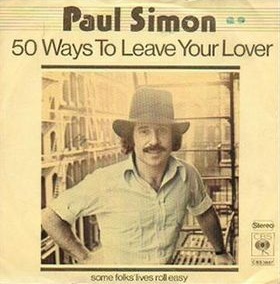
Paul Simon “50 Ways to Leave Your Lover” hit #1

50 Ways to Leave Your Lover

Paul Simon

Writer(s): Paul Simon (see lyrics here)


Released: January 2, 1976


First Charted: December 12, 1975


Peak: 13 US, 13 CB, 12 GR, 11 HR, 14 RR, 12 AC, 1 CL, 23 UK, 1 CN, 35 AU, 1 DF (Click for codes to charts.)


Sales (in millions): 1.0 US, 0.2 UK


Airplay/Streaming (in millions): 2.0 radio, 19.65 video, 193.83 streaming

Awards:

Click on award for more details.

About the Song:

Paul Simon and Art Garfunkel recorded as a duo from 1964 to 1970, finding themselves at the forefront of the folk-rock movement. They “were more playful than they get credit for being, but for a lot of self-impressed ’60s kids…they were poets, and that was a big part of the appeal.” SG When Simon launched his solo career, he “became a kid in a candy store. He tinkered with reggae, with gospel, with Peruvian folk music. He set these bold, vivid, joyous sounds to breezy, nostaliga-drenched lyrics, clearly taking nothing too seriously.” SG

He started writing “50 Ways to Leave Your Lover” “as a sort of kids’ game” SG in response to his failed marriage. His three-year-old son Harper was at his apartment and Simon was teaching him rhyming, coming up with lines like “You just slip out the back, Jack” and “Make a new plan, Stan.” As author Dave Thompson said, “Think of a name and Simon will come up with a ruse ro rhyme with it.” DT It might be the single silliest divorce song ever put on record.” SG

Simon himself called it “a nonsense song” SG but it is “actually a dazzling little piece of storytelling.” SG “Simon presents the whole thing as a dialog, almost a scene from a movie.” SG It “isn’t mired in reflection or self-pity. Instead, it’s a sly exultation, a wink at the whole idea that there can be freedom after marriage.” SG

Musically, the song “is a casually funky track, one that keeps bubbling throughout. The chorus doesn’t explode; it effortlessly slides right in.” SG It also features backup vocals from Patti Austin, Valerie Simpson, and Phoebe Snow – all “prominent musicians in their own right.” SG


Resources:

  • DMDB encyclopedia entry for Paul Simon
  • FB Fred Bronson (2003). The Billboard Book of Number One Hits (5th edition). Billboard Books: New York, NY. Page 428.
  • SG Stereogum (8/232019). “The Number Ones” by Tom Breihan
  • DT Dave Thompson (2011). 1000 Songs That Rock Your World. Krause Publications: Iola, WI. Page 219.


Related Links:


First posted 10/11/2023.

Thursday, November 30, 1972

Todd Rundgren “Hello It’s Me” released this month

Hello It’s Me

Todd Rundgren

Writer(s): Todd Rundgren (see lyrics here)


Released: November 1972


First Charted: September 28, 1973


Peak: 5 US, 2 CB, 6 GR, 4 HR, 8 RR, 17 AC, 2 AR, 1 CO, 17 CN, 68 AU, 1 DF (Click for codes to charts.)


Sales (in millions): --


Airplay/Streaming (in millions): 3.0 radio, 60.5 video, 36.4 streaming

Awards:

Click on award for more details.

About the Song:

Singer/songwriter and multi-instrumentalist Todd Rundgren formed his first band, Nazz, in 1967 when he was 19 years old. The first song he ever wrote, “Hello It’s Me,” was inspired by a failed high school relationship. Todd got dumped rather casually and he wrote a song about how he would have preferred her breaking up with him – in a sensitive phone call. He ended up flipping the perspective so that the guy breaks off the relationship and walks the listener through one side of a phone call in which “he hashes out why they can’t be together and lets her know that she should have her freedom.” SF

Rundgren said the song’s chord progression was taken from the introduction of a rendition of “When Johnny Comes Marching Home by jazz organist Jimmy Smith. SF He said, “Those changes became what are the changes underneath ‘Hello It’s Me.’ [They] are actually almost lifted literally from something that was, from Jimmy Smith’s standpoint, a throwaway.” WK

The “dirge-like version with lead vocals by Stewkey Antoni” SF was released as the B-side to “Open My Eyes” in July 1968. However, Boston radio station WMEX started playing “Hello” instead and other stations followed suit. The song eventually reached #66 on the Billboard Hot 100.

Nazz released two studio albums before Rundgren departed for a solo career. He got his first taste of top-40 success with “We Gotta Get You a Woman,” a #20 hit in 1970. His second solo album gave him two more minor hits before he broke through with his greatest mainstream success on 1972’s Something/Anything? The album produced the #16 hit “I Saw the Light” (which is the one Rundgren thought would be his first hit) DT and a minor chart entry with “Couldn’t I Just Tell You.”

Then came a new, mid-tempo recording of “Hello It’s Me” which Rundgren called “just a dense arrangement of simple parts.” TB It was released as the album’s third single in November 1972. It didn’t catch on however, until it was reissued in August 1973 – by which time Rundgren had already released another album. The song rose to #5 on Billboard Hot 100, giving Rundgren the biggest hit of his career. He chose to reject commercial music after that and pursued “cultish credibility instead.” TB

In 1998, the song was used significantly in the pilot episode of That ‘70s Show. It was also played during the end credits of the show’s series finale in 2006. Mary J. Blige, Erykah Badu, the Isley Brothers, and Matthew Sweet & Susanna Hoffs have covered the song.


Resources:


Related Links:


First posted 3/11/2023; last updated 4/1/2023.

Friday, July 21, 1972

Gilbert O’Sullivan “Alone Again (Naturally)” hit #1

Alone Again (Naturally)

Gilbert O’Sullivan

Writer(s): Gilbert O’Sullivan (see lyrics here)


Released: February 18, 1972


First Charted: March 4, 1972


Peak: 16 BB, 13 CB, 12 GR, 14 HR, 16 AC, 3 UK, 13 CN, 2 AU, 6 DF (Click for codes to charts.)


Sales (in millions): 2.0 US


Airplay/Streaming (in millions): 3.0 radio, 99.35 video, 160.25 streaming

Awards:

Click on award for more details.

About the Song:

Raymond O’Sullivan was born in Ireland. His father died when he was 11. Two years later, his family moved to Swindon, England. O’Sullivan started playing music while an art student in the 1960s. Influenced by the Beatles and Cole Porter, FB he started writing songs. When he was 22, he would write in the evenings after his daytime job as a postal clerk in London. SF He was managed by Gordon Mills, who also managed Tom Jones and Englbert Humperdinck. It was Mills who urged the singer to change his name to Gilbert O’Sullivan as a play on the theater composers Gilbert and Sullivan. SG

When Mills took on O’Sullivan, it allowed the singer to quit his job, move into a bungalow, and write every day. That’s when he wrote and produced his biggest hit, “Alone Again (Naturally),” “the first ever British chart-topper to open with the promise of suicide.” DT He sings “about heartbreak — not from lived experience, but from coming up with the saddest, most melodramatic situations that he can imagine.” SG

He insisted it wasn’t autobiographical, which may explain how he “doesn’t sound even remotely broken when he’s singing about being broken.” SG The singer is jilted at the altar, “calmly announces that he’s about to throw himself off of a tower…questions the existence of God, sings about the deaths of his parents, and considers the ways that grief can absolutely destroy people.” SG Musically “it’s an amiable and low-key amble, all fluttery acoustic guitars and woodwind tootles and soft string-swirls. It’s dentist’s-office music” SG “that could’ve been used to advertise laundry detergent.” SG

The song was nominated for Grammys for Song and Record of the Year as well as Best Male Pop Vocal Performance. It was the second best-selling single of the year after Don McLean’s “American Pie.” In 1991, Biz Markie was sued for sampling the song. DT It was a landmark case in setting a precedent tat artists had to clear samples to avoid being sued. SF The song has been recorded by more than a hundred artists including Neil Diamond, Johnny Mathis, Pet Shop Boys, and Sarah Vaughan. SF


Resources:


First posted 9/23/2023.