Showing posts with label best blues songs. Show all posts

Monday, November 15, 2010

50 years ago: Etta James “At Last” released

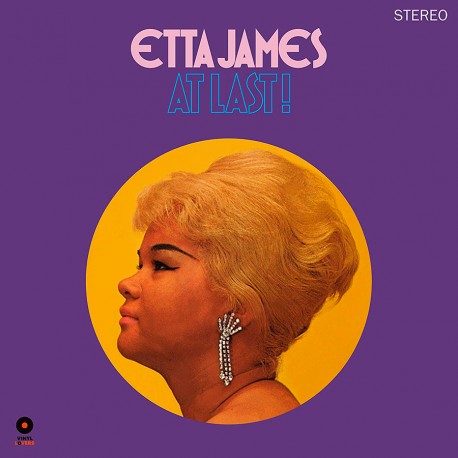
At Last

Etta James

Writer(s): Harry Warren (music), Mack Gordon (lyrics) (see lyrics here)


Released: November 15, 1960


First Charted: January 9, 1961


Peak: 47 US, 30 CB, 30 HR, 2 RB, 69 UK, 72 AU, 1 DF (Click for codes to singles charts.)


Sales (in millions): 1.0 US, 0.6 UK


Airplay/Streaming (in millions): -- radio, 76.9 video, 330.31 streaming

Awards:

Click on award for more details.

About the Song:

The song “At Last” was written by Mack Gordon and Harry Warren, who also wrote “Chattanooga Cho Choo.” It was initially intended for the film Sun Valley Serenade, but studio head Darryl Zanuck thought there were already “too many big ones in this. Let’s save one for the next.” WK The vocal version of the song by John Payne and Lynn Bari was deleted from the film, but an instrumental version by the Glenn Miller Orchestra remained.

The vocal version was then introduced in the 1942 movie Orchestra Wives. This one also featured the Glenn Miller Orchestra, this time with vocals by Ray Eberle and Lynn Bari. Miller took a newly recorded version of the song, which still featured Eberle on vocals, to #2 on the Billboard charts that year. A decade later, Ray Anthony’s Orchestra would take it to #2 again on the Billboard charts with Tommy Mercer on vocals.

The song’s most noted version, however, was recorded by R&B singer Etta James in 1960. It is “the definitive version and her crowning achievement.” NRR Her version was based on an arrangement by Riley Hampton that improvised on the original melody. WK “One is most struck by James’s throaty vocal…but she never oversells the vocal. Instead she works her voice well with the timbre of the music, interjecting just enough romantic longing.” NRR

The song marked a change of labels for Etta James from Modern to Chess/Argo. It was also a change of direction for her. As she said, “I was no longer a teenager. I was twenty-two and sophisticated.” NRR She’d previously had hits with what she called “quickie teenage rockin’, humping and bumping ditties.” NRR Leonard Chess thought she “was a classy ballad singer and saw pop crossover potential in her; it was his decision to back her with violin orchestrations for the song.” SF Harvey Fuqua, formerly of the Moonglows and her boyfriend at the time, started playing standards for her and she “saw in that music the mysterious life that my mother had led when I was a little girl.” NRR

Celine Dion reached #16 on the adult contemporary chart with her version from her 2002 album A New Day Has Come. BeyoncĂ© portrayed Etta James in the 2008 film Cadillac Records and performed the song on the soundtrack. It won a Grammy for Best Traditional R&B Vocal Performance. It also reached #67 on the Billboard Hot 100 and #79 on the R&B chart. She also sang it during Barack and Michelle Obama’s first dance at the Neighborhood Ball on the night of his Presidential inauguration.


Resources:


Related Links:


First posted 7/14/2022; last updated 11/4/2022.

Thursday, November 27, 1986

On This Day (1936): Robert Johnson recorded “Cross Road Blues”

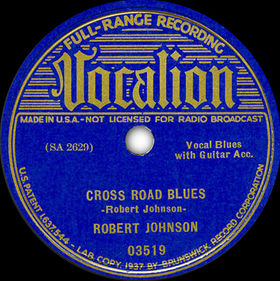
Cross Road Blues (aka “Crossroads”)

Robert Johnson

Writer(s): -- (see lyrics here)


Released: May 1937


First Charted: November 27, 1936


Peak: 2 DF (Click for codes to charts.)


Sales (in millions): --


Airplay/Streaming (in millions): -- radio, 30.8 video, 41.18 streaming

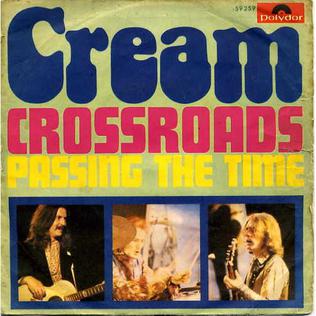
Crossroads

Cream


First Charted: January 25, 1969


Peak: 29 US, 17 CB, 17 HR, 2 CL, 13 CN, 45 AU, 2 DF (Click for codes to charts.)


Sales (in millions): --


Airplay/Streaming (in millions): -- radio, 13.9 video, 55.27 streaming

Awards (Robert Johnson):

Click on award for more details.


Awards (Cream):

About the Song:

Robert Johnson has often been called “The Father of the Blues,” which sort of makes him “The Grandfather of Rock and Roll.” This may be Johnson’s most celebrated work. It “is the sound most people mean today when they say ‘Delta blues.’” EW-156 The song has become legendary because of its connection to Southern folklore about meeting the devil at the crossroads (an intersection of rural roads) and trading one’s soul for musical genius. The myth says Johnson acquired masterful guitar playing skills overnight because he went to the crossroads and sold his soul to the devil.

In reality, Johnson set out touring all through the Delta for a year and when he returned home, his playing wowed audiences, contributing to the idea that he could only have acquired such talent via supernatural means. The story of Johnson selling his soul didn’t emerge until 1966 when Pete Welding wrote an article in Down Beat Music quoting blues man Son House saying “Johnson, in his months away from home, had ‘sold his soul to the devil in exchange for learning to play like that.’” SS Music critic Robert Palmer said, “some of Johnson’s satanic references were simply macho posturing.” SS

The lyrics actually contain no Satanic references, although the protagonist kneels down at the opening of the song to ask for God’s mercy and later worries that he is “sinkin’ down” as darkness approaches. WK Johnson does make references to the devil in two of his other songs. In “Hellhound on My Trail” he talks of trying to stay ahead of the demon hound pursuing him and in “Me and the Devil Blues” he sings, “Early this mornin’ when you knocked upon my door / And I said 'Hello Satan I believe it’s time to go.” WK

The legend has also developed because of another blues singer, Tommy Johnson. He wasn’t related to Robert, but claimed he made a deal with the devil. It was a good way to draw attention. Some people incorrectly attributed the story to Robert. WK

The term “crossroads” actually refers to an intersection of rural roads in the Mississippi Delta. Because cars slow down there, it is an ideal spot for hitchhikers. In Johnson’s song, he laments “being unable to catch a ride at the intersection before the sun sets.” WK Cream’s version adds the line “goin’ down to Rosedale” from Johnson’s “Traveling Riverside Blues.” This has led some to believe that the legendary crossroads are in Rosedale, Mississippi. BH

Johnson may have performed the song as early as 1932. It has become a blues standard “as well as an important piece in the repertoires of blues-inspired rock musicians.” The song shows Johnson’s “mastery of his mentor Son House’s style, particularly in his slide guitar work.” WK

Melodic precedents may include Leroy Carr and Scrapper Blackwell’s “Straight Alky Blues” (1929) and Roosevelt Sykes’ “Black River Blues” (1930). “Johnson infuses their relaxed urban approach with a more forceful rural one.” Johnson creates inconsistent verses ranging from fourteen to fifteen bars in length instead of imploring the well-defined twelve-bar blues technique. WK

The song was the third of eleven singles released during Johnson’s lifetime. They had little impact while he was alive, but after his death in 1938 at the age of 27, his songs became profoundly influential. The 1961 release of King of the Delta Blues Singers inspired notable British blues-rock acts such as Led Zeppelin and Cream, whose live recording of “Crossroads” was a top-40 hit. Rolling Stone named it the #3 greatest guitar song of all time in 2003 and one of the “500 Greatest Songs of All Time” in 2021.

Eric Clapton has developed a strong tie to the song, covering it not just Cream but also with Powerhouse and Derek & the Dominos. Clapton and Jeff Beck perform it on The Secret Policeman’s Other Ball, a compilation of live performances by various artists. It also became the name of Clapton’s 1988 box set, the Crossroads Centre he founded to help people recover from addiction, and the Crossroads Guitar Festival he created to raise money for the Centre.

Clapton said he envisioned “Crossroads” more as a rock song because it had a definitive riff and was played full-chorded with the slide. Clapton embellished it while also simplifying the guitar line and setting it to a straight eight-note or rock rhythm. WK


Resources:


Related Links:


First posted 8/24/2022; last updated 4/25/2025.