Saturday, January 31, 2004

Franz Ferdinand charted with “Take Me Out”

Take Me Out

Franz Ferdinand

Writer(s): Alex Kapranos/Nicholas McCarthy (see lyrics here)


Released: January 12, 2004


First Charted: January 31, 2004


Peak: 66 US, 32 RR, 3 MR, 3 UK, 7 CN, 25 AU, 3 DF (Click for codes to charts.)


Sales (in millions): 1.1 US, 1.2 UK, 2.32 world (includes US + UK)


Airplay/Streaming (in millions): 0.2 radio, 220.44 video, 834.45 streaming

Awards:

Click on award for more details.

About the Song:

The grunge that ruled the ‘90s gave way to the “retro garage-punk [that] emerged as the predominant strain of post-millennial rock music in 2001.” PF American bands like The Strokes and The White Stripes were leading the way, leaving “Britain’s indie aristocracy looking bloated, boring, and irreversibly out-dated.” SY However, this was more serious-minded music, making one thing clear: “rockers forgot how to dance.” PD

“Aspiring buzz bands realized that, down on the disco floor, they could really make their profits” PF and “with one song the Empire struck back.” SY Franz Ferdinand “brought the groove back to indie rock” PD by unapologetically “co-opting the styles of Talking Heads and Gang of Four for their trademark brittle, arty sound.” TB “‘Take Me Out’ crams every known Britpop trick into its fevered four minutes.” SY These Scottish rockers “took a certain strain of cooler-than-thou, spiky post-punk,” MX gave it a dose of “Beatlesque fluency,” SY “and gave us permission to dance to it.” MX It is “effortlessly arty and deliciously fun, at the same time.” NME’09

The song “a crowdpleaser that doesn’t sound out of place blasting during half-time at an NBA game.” PE but is still “a smash hit that was still cool for the indie kids to love.” PE It may be “the most surefire winner any DJ can have in his repertoire.” NME’09 “After a tense build-up…‘Take Me Out’ sounds ready to blast off; instead, Franz pull an aesthetic 180 and slow it down into a militaristic, libidinous funk stomp.” PF “This mod guitar stomp rules any bar where the girls feel like dancing,” RS’09 but is “still heavy enough to lure in those girls’ jock boyfriends.” PF It “remains one of the most satisfying moments in guitar-pop this decade has produced.” DS

Lead singer “Alex Kapranos’ arch delivery and the song’s ambiguous meaning (was it about being taken out like a date, or about being taken out, like…killed?)” PD gave the song an added curiosity factor. In addition, “the innovative accompanying video won MTV’s Breakthrough Video of the Year and the Q Awards’ Video of the Year.” AB’00

He said, “This song is about the tensions between two people, in a sexual sense. That situation where two people are in love with each other but neither will admit it, as if they’d take rejection over acceptance just to end the tension in the situation.” DT


Resources:


Related Links:


Last updated 4/30/2024.

Friday, January 9, 2004

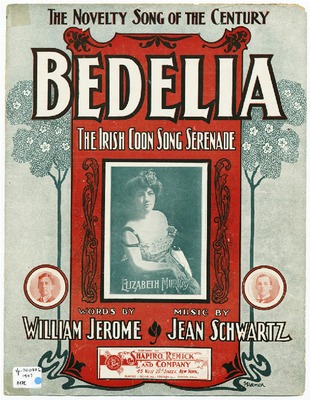
100 years ago: “Bedelia” hit #1 for first time

Bedelia

Billy Murray

Writer(s): Jean Schwartz (music), William Jerome (lyrics) (see lyrics here)


First Charted: December 2003


Peak: 13 US, 13 GA, 17 SM (Click for codes to singles charts.)


Sales (in millions): 3.0 (sheet music)


Airplay/Streaming (in millions): -- radio, -- video, -- streaming

Bedelia

Haydn Quartet


First Charted: January 9, 1904


Peak: 17 US, 13 GA (Click for codes to singles charts.)


Sales (in millions): 3.0 (sheet music)


Airplay/Streaming (in millions): -- radio, -- video, -- streaming

Awards (Haydn Quartet):

Click on award for more details.


Awards (Billy Murray):

About the Song:

“Building songs around girls’ names has always been popular and this one may have been the most popular of this era.” TY2 The sheet music bills the song as “The Novelty Song of the Century” and “An Irish Coon Song Serenade.” TY2 Coon songs were popular at the time, but steeped in racial stereotypes about African Americans. The song has more Irish influence than African American, so one assumes the publisher was trying to capitalize on the coon craze with the latter billing. TY2

The song was introduced by Blanche Ring playing the character of Liliandra in The Jersey Lily, which opened in September 1903. GA It was her first starring role on Broadway. DJ It is unclear who first recorded the song. SecondHandSongs.com lists a December 1903 release date for a version by Billy Murray. That version went to #1. Considering his parents were Irish immigrants, it was fitting that Murray tackled the song, affecting a thick Irish accent to emphasize the song’s comedic nature. He was also one of the most successful singers of the pre-rock era, recording hundreds of early acoustic recordings as a solo act, in duets, and as part of quartets, during the first two decades of the 20th century. SM

Murray’s was among four versions to chart in January 1904. The first was by Arthur Pryor’s Band (#3). It was quickly followed by a recording by the Haydn Quartet, which spent seven weeks at #1. The Murray version and one by George J. Gaskin (#3) came next. Jan Garber reached #22 with the song in 1948.

SecondHandSongs.com also says Arthur Collins recorded the song in 1903 so it may or may not have preceded Murray’s version. There was also a version by Edward M. Favor in 1904. In his book Popular Songs of the Twentieth Century, Edward Foote Gardner also says there were stage versions of the song done by Elizabeth Murray and Emma Carus around this time. GA Other versions were recorded by Dick Kuhn and His Orchestra (1941), Papa Bue’s Viking Jazzband (1965), Ernie Carson and the Social Polecats (1992), and Claus Forchhammer’s Orkester (2005). SH Instrumental versions were done by the Crawford-Ferguson Night Owls (1965), Butch Thompson et al (1985), the Grand Dominion Jazz Band (1988), Gambit Jazzmen (1995), Vintage Jazz (1996), and the Yerba Buena Stompers (2002). SH

The song also appeared in the movie musical Broadway to Hollywood (1933) and Hello, Frisco, Hello (1943). It was revived again in 1953 in the film The Eddie Cantor Story.


Resources:


Related Links:


First posted 12/13/2022; last updated 12/16/2022.

Britney Spears “Toxic” charted

Toxic

Britney Spears

Writer(s): Cathy Dennis, Christian Karlsson, Pontus Winnberg, Henrik Jonback (see lyrics here)


Released: January 12, 2004


First Charted: January 9, 2004


Peak: 9 BB, 14 RR, 37 A40, 11 UK, 12 CN, 12 AU, 21 DF (Click for codes to charts.)


Sales (in millions): 6.0 US, 1.3 UK, 8.66 world (includes US + UK)


Airplay/Streaming (in millions): 0.2 radio, -- video, 1189.11 streaming

Awards:

Click on award for more details.

About the Song:

When Britney Spears (born 1981 in Mississippi) emerged as a teen pop star in the late ‘90s, it was understandable that she would be dismissed as a teen-pop, flash-in-the-pan who would fade quickly. How long could she skate on stirring men’s Catholic school girl fantasies and a thin voice? However, by 2003’s In the Zone album, she was still around. It was her fourth consecutive #1, multi-platinum album.

Part of the attention was due to her becoming tabloid fodder. She garnered plenty of attention with her 55-hour marriage to a childhood friend in Las Vegas and later that same year a surprise marriage to backup dancer Kevin Federline, who she’d dated for three months. However, she’d also shown she could take on a more mature musical style and was still making hits.

After a top-40 hit with Madonna on “Me Against the Music,” Spears released “Toxic.” The song was produced by the Swedish team of Christian Karlsson (aka “Bloodshy”) and Pontus Winnberg (aka “Avant”). The lyrics were penned by Cathy Dennis, a British singer/songwriter who had four top-10 hits in the U.S. in the late ‘80s and early ‘90s.

The techno/dance-pop song was written with Janet Jackson in mind WK and then offered to Kylie Minogue, but she turned it down. WK It featured “club-inspired backbeats and violin lines reminiscent of James Bond films.” TB It topped the charts in 11 countries and won a Grammy for Best Dance Recording. Thunder Bay Press declared it her “greatest musical triumph.” TB


Resources:


Related Links:


First posted 4/6/2024.