Showing posts with label best country songs all time. Show all posts

Friday, December 21, 2018

50 years ago: Glen Campbell topped the country chart with “Wichita Lineman”

Wichita Lineman

Glen Campbell

Writer(s): Jimmy Webb (see lyrics here)


First Charted: November 2, 1968


Peak: 3 US, 2 CB, 3 HR, 16 AC, 12 CW, 7 UK, 14 CN, 15 AU (Click for codes to singles charts.)


Sales (in millions): 1.0 US, 0.2 UK, 1.2 world (includes US + UK)


Airplay/Streaming (in millions): -- radio, 32.54 video, 46.38 streaming

Awards:

Click on award for more details.

About the Song:

Glen Campbell worked as a session guitarist in Los Angeles in the 1960s and even served as a vocalist with the Beach Boys for a short time. His big break as a solo artist came in 1967 when he recorded a song by Jimmy Webb called “By the Time I Get to Phoenix”. The song was a #2 country hit.

Campbell turned to the man he’d called “the best musical poet to come out of America” TC for another gem. It proved to have immense crossover appeal, hitting #1 on the country and adult contemporary charts as well as going top 10 on the top charts in the U.S. and U.K. It was also nominated for a Grammy for Record of the Year.

Webb was inspired by a real-life event to write his tune about a lonely telephone line repairman who ironically labors to ensure that others stay connected. He was driving through a remote area of northern Oklahoma and was struck by the image of a lineman working on a telephone pole out in the middle of this flat, remote area which was “almost surreal in its boundless horizons and infinite distances.” TC

In “just two short verses and one chorus, [it] says as much in them as many authors say in a lifetime.” BBC The music, which included Webb playing Hammond organ, matched the story with its “somehow vast and yet empty soundscape.” TB Webb told Campbell later that “Phoenix,” “Lineman,” and Campbell’s other Webb-penned hit “Galveston” were all about the same character. TB


Resources:

  • BBC BBC Radio 2 (2004). “Sold on Song Top 100”.
  • CR Toby Creswell (2005). 1001 Songs: The Great Songs of All Time. Thunder’s Mouth Press: New York, NY. Page 388-9.
  • MC Neil McCormack (3/13/09). Telegraph.co.uk “100 Greatest Songs of All Time
  • TB Thunder Bay Press (2006). Singles: Six Decades of Hot Hits & Classic Cuts. Outline Press Ltd.: San Diego, CA. Page 101.


Related Links:


First posted 11/2/2011; last updated 11/4/2021.

Friday, November 23, 2018

50 years ago: Tammy Wynette’s “Stand by Your Man” topped the country chart

Stand by Your Man

Tammy Wynette

Writer(s): Billy Sherrill, Tammy Wynette (see lyrics here)


Released: September 20, 1968


First Charted: October 19, 1968


Peak: 19 US, 23 CB, 19 HR, 11 AC, 13 CW, 13 UK, 15 CN, 9 AU, 1 DF (Click for codes to singles charts.)


Sales (in millions): -- US, 0.4 UK


Airplay/Streaming (in millions): -- radio, 45.86 video, 56.59 streaming

Awards:

Click on award for more details.

About the Song:

Producer Billy Sherrill had the idea for the song “Stand by Your Man.” He had the title scribbled on a scrap of paper which he carried in his pocket for a year. During a recording session for Tammy Wynette on August 26, 1968, he suggested the title to her. She “had an instant affinity for the concept.” TR The wrote the song in under a half hour. AC Wynette said that Sherrill told her the melody came from a work by Richard Strauss that was in the public domain. TR

The song stirred controversy amongst the women’s liberation movement as an “example of a compliant wife willing to defer to her husband,” SF but “would play well in the Bible Belt.” AC Wynette defended the song “as not a call for women to place themselves second to men, but rather a suggestion that women attempt to overlook their husbands’ shortcomings and faults if they truly love them.” WK Ironically, she was married five times.

Sherrill admitted that he intended the song for women who wanted no part of feminism. TR “Even though to some skeptics it may hint of chauvinism, as far as I’m concerned they can like it or lump it. ‘Stand by Your Man’ is just another way of saying ‘I love you – without reservations.’” TR

The song was her fifth #1 out of 20 country chart toppers. It took five releases in the UK for it to become a hit, but then it went all the way to #1 in 1975. SF It was “the most successful record of Wynette’s career, and is one of the most familiar songs in the history of country music.” WK In 2003, Country Music Television rated the song the greatest in country in music. WK “With the almost cult status of ‘Stand by Your Man,’ Tammy would never again be just another girl singer, and her stature would demand that country charts make room for…powerful women.” AC


Resources:

  • DMDB encyclopedia entry for Tammy Wynette
  • AC Ace Collins (1996). The Stories Behind Country Music’s All-Time Greatest 100 Songs. New York, NY; The Berkley Publishing Group. Pages 201-3.
  • TR Tom Roland (1991). The Billboard Book of Number One Country Hits. Billboard Books: New York, NY. Page 16.
  • SF Songfacts
  • WK Wikipedia


First posted 10/27/2021; last updated 10/23/2022.

Saturday, July 27, 2013

50 years ago: Johnny Cash’s “Ring of Fire” hit #1 on country charts

Ring of Fire

Johnny Cash

Writer(s): June Carter, Merle Kilgore (see lyrics here)


Released: April 19, 1963


First Charted: June 1, 1963


Peak: 17 US, 14 CB, 14 GR, 13 HR, 17 US, 12 AU, 1 DF (Click for codes to charts.)


Sales (in millions): 1.2 US, 0.5 UK


Airplay/Streaming (in millions): -- radio, 62.9 video, 315.81 streaming

Awards:

Click on award for more details.

About the Song:

While it has become one of Johnny Cash’s signature hits, “Ring of Fire” wasn’t his originally. June Carter, who Cash married in 1968, wrote the song with Merle Kilgore and her sister Anita originally recorded it. She released it as “(Love’s) Ring of Fire” on her album Folk Songs Old and New and as a single. WK

Cash heard Anita’s version and claimed he had a dream in which the song was accompanied by Mexican horns. He told Anita he’d give her six months and if her version wasn’t a hit, he was going to record it how he felt it. He recorded it the same year with mariachi-style horns. WK His version topped the country charts for seven weeks.

There are claims that Carter saw the phrase “love is like a burning ring of fire” underlined in an Elizabethan poetry book that belonged ot her uncle, A.P. Carter. WK At the time, she and Cash were married to other people, but were friends and singing partners. She was “driving around aimlessly one night, worried about Cash’s wildman ways – and aware that she couldn’t resist him.” RS500 When they married in 1968, Merle Kilgore (the co-writer on “Ring of Fire”) was the best man. SF

Cash’s career had waned slightly in the early ‘60s; he hadn’t hit #1 since 1959’s “Don’t Take Your Guns to Town.” Cash’s version of “Ring of Fire” was “a forceful blend of his image and musical attitude” AMG which helped develop his image of “The Man in Black.” The phrase “fell into a ring of fire” sounded “intimidating and dangerous” AMG and like “something an outlaw would do.” AMG


Resources:


Related Links:


First posted 10/31/2021; last updated 7/12/2023.

Monday, June 1, 2009

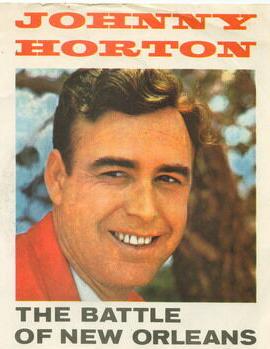
50 years ago: Johnny Horton hit #1 with “The Battle of New Orleans”

The Battle of New Orleans

Johnny Horton

Writer(s): Jimmy Driftwood (see lyrics here)


Released: April 6, 1959


First Charted: April 27, 1959


Peak: 16 US, 19 CB, 16 HR, 110 CW, 16 UK, 17 CN, 16 AU (Click for codes to singles charts.)


Sales (in millions): 1.0 US, -- UK, 1.0 world (includes US + UK)


Airplay/Streaming (in millions): 2.0 radio, 9.34 video, 23.58 streaming

Awards:

Click on award for more details.

About the Song:

“The Battle of New Orleans” dates back to 1815. On August 8 of that year, Andrew Jackson led American forces against British troops in New Orelans, not knowing the War of 1812 had officially ended two weeks earlier. A folk song called “The Eighth of January” celebrated the victory and became a popular fiddle tune. FB

It wasn’t until 1955 that Jimmy Driftwood, a high school teacher and principal from Arkansas, wrote lyrics for it in an effort to get his students more interested in learning history. WK The song described the battle in a comical tone from the perspective of an American solider. Driftwood became well known in the area for his historical songs. WK In the late 1950s, RCA gave him a recording contract and he recorded a dozen songs in 1958, including “The Battle of New Orleans.” WK

The song was subsequently recorded by many different artists, including Johnny Cash, Les Claypool, Lonnie Donegan, Bill Haley, Doug Kershaw, Vaughn Monroe, the Nitty Gritty Dirt Band, Dolly Parton, Leon Russell, and Sha Na Na. It was Johnny Horton, however, who took the song to #1 on the Billboard Hot 100, as well as the country charts. His version omits many of the historical references.

Sadly, Horton was killed in a head-on collision on November 5, 1960. He performed that night at the Skyline in Austin, Texas – the same club where Hanks Williams made his final appearance before his death. In another strange coincidence, Horton’s widow, Billie Jean, was formerly married to Williams. FB Ironically, Horton was driving because he’d had a premonition of his death and consequently refused to fly on airplanes. FB

Billboard ranked “New Orleans” the #1 song of 1959. It won Grammys for Song of the Year and Best Country & Western Recording.


Resources:

  • DMDB encyclopedia entry for Johnny Horton
  • FB Fred Bronson (2003). The Billboard Book of Number One Hits (5th edition). Billboard Books: New York, NY. Page 54.
  • SF Songfacts
  • WK Wikipedia


First posted 3/13/2021; last updated 8/26/2022.