The Show’s Status
The Sound of Music was the final work for the famous musical theater team of Richard Rodgers and Oscar Hammerstein II. (The latter died in 1960). “It’s part of the fabric of musical theater, championed as an artistic triumph in some quarters and regarded, no less affectionately, as kitsch in others.” TM
The pair previously worked on iconic musicals like South Pacific and The King and I. Like those, this was “set in a foreign locale, it starred a female lead in charge of children, it concerned an unlikely romance between an older man and a younger woman, it had a social/political element, and it featured a stirring anthem for a soprano (in this case, ‘Climb Ev’ry Mountain’).” AM-C
The Story
The musical was based on a book by Howard Lindsay and Russell Crouse. It drew heavily from Maria Von Trapp’s autobiography. TB She was a nun in Austria prior to World War II. She became a governess for Captain George Von Trapp, left to raise seven children on his own after the death of his wife. Maria falls in love and marries him. “The musical’s first section offers a glimpse of prewar European upper-crust family life, while the second act provides a human perspective on the tumultuous events of 1930s Europe.” TM
The Songs
The musical introduced “a series of earworms that just won’t take no for an answer.” TM “All of the show’s major motifs can be appreciated not just as plot devices but hymns to the glory of music.” TM
“The Sound of Music”
They include standards such as the title song, which “has a majestic and graceful sweep – it’s exactly the series of notes you’d expect to burst forth from nature as some idealistic young heroine passes by.” TM
“My Favorite Things”
“To appreciate just how strong Sound of Music’s individual songs are, seek out a few of the many interpretations that followed in the show’s wake.” TM Fore example, My Favorite Things became both a Christmas and jazz standard, such as with John “Coltrane and his group reinventing the song, while exhibiting a deep reverence for the musical invention.” TM
“Do-Re-Mi”
Do-Re-Mi has become a favorite sing-a-long for children to “effortelessly learn the notes of the major scale.” TM It was also the center of one of the earliest flash mob viral videos.
The Cast Album
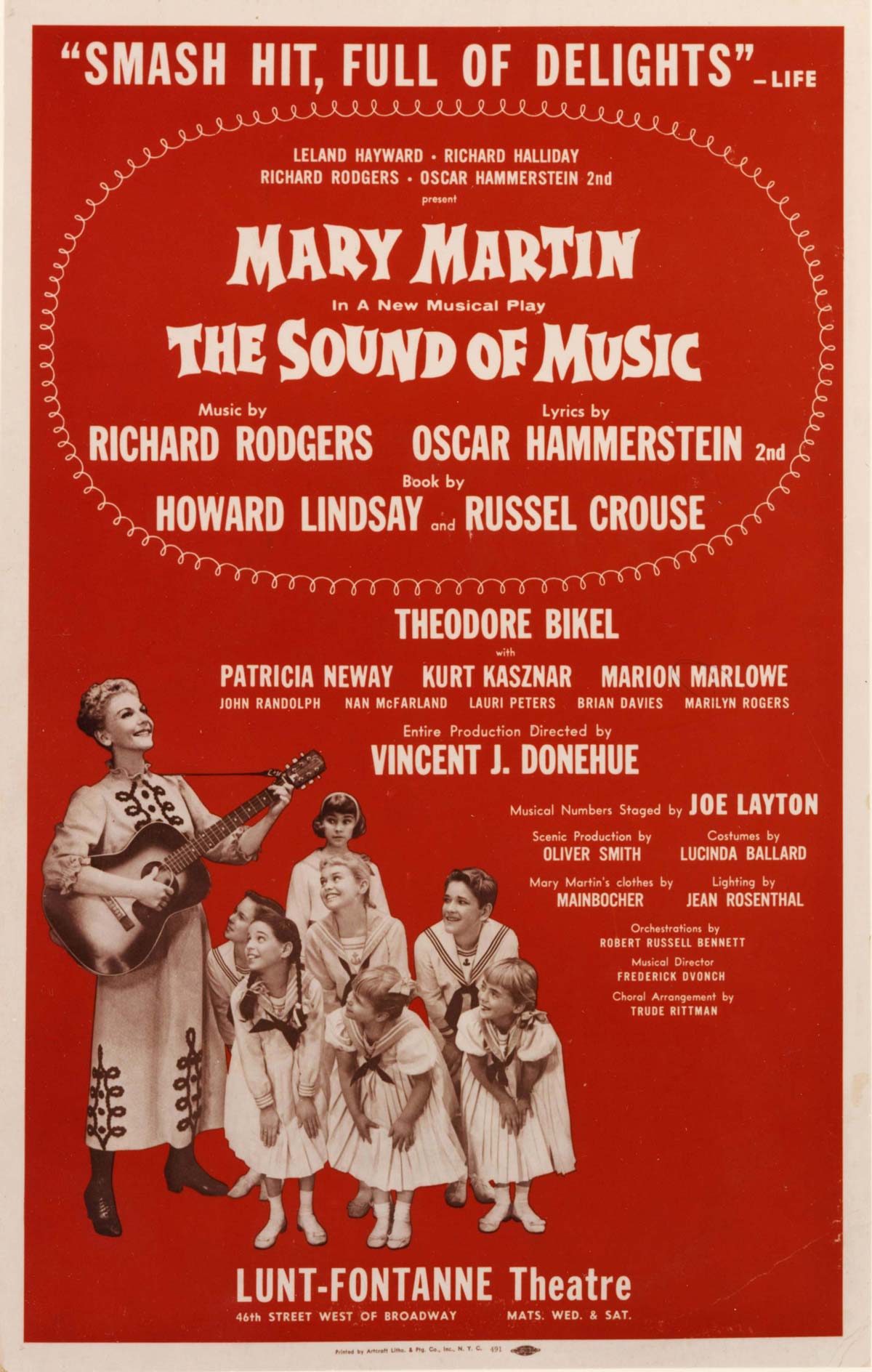
The cast album went to #1 and sold more than 2 million copies in the United States, but “has been so overshadowed by the spectacularly popular film soundtrack album that it’s difficult to judge it on its own merits.” CA The original stage cast featured a 45-year-old Mary Martin playing the 21-year-old Maria. Despite the age discrepancy, She “seems perfectly matched to the material, yet her interpretation of the character differs greatly from that offered by Julie Andrews” CA in the 1965 movie version. “Martin is more wistful, delivering the title song with a deeper, plaintive quality.” CA
Theodore Bikel is a strong presence as Captain Von Trapp. Kurt Kasznar and Marion Marlowe as Max Detweiler and Elsa Schraeder are also standouts; they perform How Can Love Survive? and No Way to Stop It delightfully. The children, including Lauri Peters as Liesl, exude warmth. From a technical and musical standpoint, this Sound of Music album is highly commendable, and as a record of the final Rodgers and Hammerstein score, it’s a must for serious collectors of transcendent musical theater.” CA
As conducted by Frederick Dvonch, the score in general has a more legit tone here than it does on the soundtrack recording, and Patricia Neway brings full operatic beauty and power to the role of the Mother Abbess.” CA
The Movie and Soundtrack
The movie version of The Sound of Music came six years after the original stage musical. It became the highest-grossing movie of all-time up to that point and won the Oscar for Best Picture. The soundtrack was a #1 in the United States and United Kingdom, spending a whopping 70 weeks at the pinnacle in the UK. It also sold more than 22 million copies worldwide, making it one of the top 100 best-sellers of all time.
“One of the principal reasons for the enduring appeal…is the fresh approach given to the material.” CA The star, Julie Andrews, had starred in the musical My Fair Lady and was fresh from an Academy Award for her title role in Mary Poppins, another story about a children’s nanny. She “brings wit, spirit, and buoyancy to the role of Maria. Perfectly sung and brilliantly acted, Andrews’ great performance is also notable for her clear but unaffected diction, and she knows exactly which lines to sing, which ones to exclaim.” CA
“The songs of the Captain and the Mother Abbess are very well sung by Bill Lee and Margery McKay, respectively, dubbing for Christopher Plummer and Peggy Wood. McKay’s rendition of ‘Climb Every Mountain’ is notably stirring. Charmian Carr does her own singing as Liesl; she’s charming in Sixteen Going on Seventeen with Dan Truhitte as Rolf, and in all of her tracks with the children…The arrangements and orchestrations of the film’s music overall are bright, uplifting, and thoroughly delightful from beginning to end.” CA
|