Showing posts with label Julie Andrews. Show all posts

Thursday, March 15, 2012

My Fair Lady opened on Broadway: March 15, 1956


My Fair Lady is “the crowning achievement” AZ for lyricist Alan Jay Lerner and composer Frederick Loewe. Some consider it to be “the most perfect stage musical ever.” CL “It boasts a magnificent score…witty, intelligent, beautiful, and romantic.” NRR This is “a collection of performances that long ago became a ubiquitous and indispensable fixture of American musical theater.” AZ

The musical was an updated version of George Bernard Shaw’s Pygmalion, a story about “the mythic Greek figure who falls in love with his sculpture.” TM In My Fair Lady, the story focuses on “the relationship between an elocutionist” R-C and “pre-World War I London flower girl Eliza Doolittle, who aspires to a better accent and the social advantages that will come with it.” R-S Its 2,700 performances “gracefully spanned the Eisenhower and Camelot eras, then begat a wildly popular film version, whose 1965 Best Picture Oscar capped the show’s decade of prominence.” AZ


The cast album “captures landmark performances by Julie Andrews, Rex Harrison and Stanley Holloway.” NRR Andrews was a “twenty-year-old revelation” ZS as “the fairest of all ladies,” ZS making the “loverly…score soar” ZS with her “glorious voice and emotional range.” ZS Harrison is “effortlessly charming” ZS in his recreation of the stage role as “Professor Henry Higgins (he had also appeared in the film adaptation of…Pygmalion.” R-S

“The show yielded an astounding number of songs that became standards, including the luminous I Could Have Danced All Night and I’ve Grown Accustomed to Her Face.” TM Among the other gems in this “embarrassment of riches,” AZ including On the Street Where You Live, The Rain in Spain, Wouldn’t It Be Loverly, and Why Can’t the English?.


For the movie version, Harrison and Holloway were back again, but Andrews wasn’t deemed enough of a star although “embarrassingly, by the time the movie opened, Mary Poppins had made her more than enough of a star to do so.” R-S Audrey Hepburn stepped into the role with the singing voice dubbed by Marni Nixon, who “was an accomplished Hollywood voice ghost, having previously sung for Deborah Kerr in The King and I, Natalie Wood in West Side Story, and Rosalind Russell in Gypsy.” R-S

Ultimately the soundtrack paled to the cast recording, which was considered critically and commercially more successful. The cast recording sold 8 million copies in the U.S. and topped the Billboard charts for 15 weeks. It also spent 19 weeks atop the UK charts.


Awards:

Resources and Related Links:

Friday, December 3, 2010

50 years ago: Camelot opened on Broadway

Camelot

Frederick Loewe (music), Alan Jay Lerner (lyrics)

The Musical

Opened on Broadway: December 3, 1960


Number of Performances: 873


Opened at London’s West End: August 1964


Number of Performances: 518


Movie Release: October 25, 1967

Cast Album


Recorded: December 11, 1960


Charted: January 23, 1961


Peak: 16 US, 37 UK


Sales (in millions): 0.5 US


Genre: show tunes


Soundtrack


Charted: November 11, 1967


Peak: 11 US, 37 UK


Sales (in millions): 1.0 US


Genre: show tunes


Songs on Cast Album:

  1. Overture
  2. March
  3. I Wonder What the King Is Doing Tonight (RICHARD BURTON)
  4. The Simple Joys of Maidenhood (JULIE ANDREWS)
  5. Camelot (RICHARD BURTON)
  6. Follow Me (BERRY/ MARY SUE)
  7. C’est Moi (ROBERT GOULET)
  8. The Lusty Month of May (JULIE ANDREWS)
  9. Then You May Take Me to the Fair (JULIE ANDREWS/ JAMES YARNELL/ JOHN CULLUM)
  10. How to Handle a Woman (RICHARD BURTON)
  11. Before I Gaze at You Again (JULIE ANDREWS)
  12. If Ever I Would Leave You (ROBERT GOULET)
  13. The Seven Deadly Virtues (RODDY McDOWALL)
  14. What Do the Simple Folk Do? (RICHARD BURTON)
  15. Fire on Goodness (MALE ENSEMBLE)
  16. I Loved You Once in Silence (JULIE ANDREWS)
  17. Guenevere
  18. Finale Ultimo (Camelot Reprise) (RICHARD BURTON)


Songs on Soundtrack:
  1. Prelude and Overture - Orchestra
  2. I Wonder What the King is Doing Tonight - Arthur
  3. The Simple Joys of Maidenhood - Guenevere
  4. Camelot and the Wedding Ceremony - Arthur, Guenevere, and Chorus
  5. C'est Moi - Lancelot
  6. The Lusty Month of May - Guenevere and Women
  7. Follow Me and Children's Chorus - Chorus
  8. How to Handle a Woman - Arthur
  9. Take Me to the Fair - Guenevere, Lionel, Dinadan, Sagramore
  10. If Ever I Would Leave You - Lancelot
  11. What Do the Simple Folk Do? - Guenevere and Arthur
  12. I Loved You Once In Silence - Guenevere
  13. Guenevere - Chorus
  14. Finale Ultimo - Arthur and Tom

Rating:

4.633 out of 5.00 (average of 14 ratings for cast album and soundtrack combined)


Quotable: “One of the great Lerner & Loewe musicals” – Wikipedia


Awards (Cast Album and Soundtrack): (Click on award to learn more).

About the Show:

Lerner & Loewe turned to the legend of King Arthur, specifically T.H. White’s novel The Once and Future King, for their 1960 musical Camelot. Initially, Loewe agreed to write the music, but said he had no interest in the project and that it would be his last score if things went badly. WK-C The production of the show was delayed when Lerner had to seek medical attention after his wife left him. WK-C The show initially ran too long with Lerner noting that “only Tristan and Isolde equaled it as a bladder endurance contest.” WK-C

However, the result was a success. “The advance sale for the show was the largest in Broadway history.” WK-C It opened on December 3, 1960, at the Majestic Theatre and ran for 873 performances. WK-C It starred Richard Burton and Julie Andrews and introduced Robert Goulet in his first Broadway role. WK-C It also won four Tony Awards.

Initial reaction from New York critics was mixed, but a 1993 New York Times review noted that the musical “has grown in stature over the years, primarily because of its superb score.... [which] combined a lyrical simplicity with a lush romanticism.” WK-C A 2003 review said “Camelot has it all – a beautiful English princess swept off her feet by a shy, but passionate bachelor king; an ardent French knight, torn between devotion to his liege and an uncontrollable hunger, reciprocated, to be sure, for the king’s tempestuous wife.” WK-C

The story follows Arthur and Guinevere from their first meeting when they have yet to meet, but stumble across each other accidentally. Arthur – still unknown to Guinevere – persuades her of the joys of Camelot in the title song and she agrees to marry him.

Lancelot, a young Frenchman, enters the picture five years later when he comes to become one of Arthur’s knights after hearing about the Round Table, “a democratic system built around the idea of “a new kind of knight – one that does not pillage and fight, but tries to uphold honor and justice.” WC-C He is devoted to Arthur, but he and Guinevere battle feelings for each other.

Their forbidden love is uncovered by Mordred, Arthur’s illegitimate son, who is determined to overthrow Camelot. He accuses them of treason and Arthur, born by his own law, is obliged to burn Guinevere at the stake. To his relief, the escaped Lancelot returns to save her.

Before Mordred attacks Camelot, Arthur meets Lancelot and Guinevere and forgives them. In camp the night before battle, Arthur is inspired by boy named Tom of Warwick who wishes to join the Round Table. Arthur instructs him “to run behind the lines and survive the battle, so he can tell future generations about the legend of Camelot.” WK-S

The 1964 film version directed by Joshua Logan snagged eight Oscars, but ultimately fell short of the Broadway version. “There wasn’t time for half a dozen songs, which have been deleted, leaving the highlights.” WR-S Richard “Harris is a much more demonstrative King Arthur than Burton, overplaying his role as if he's trying to be a royal Henry Higgins, as played by Rex Harrison (in My Fair Lady).” WR-S Vanessa “Redgrave has the impossible task of replacing Andrews…in fact, she can’t sing.” WR-S Franco Nero, who stepped in as Lancelot, had the singing done by Gene Merlino, who’s “ not a patch on Goulet. The result is a mediocre soundtrack album that really doesn’t deserve to be mentioned in the same sentence as the original Broadway cast recording.” WR-S

Resources and Related Links:


Other Related DMDB Pages:


First posted 6/10/2011; last updated 12/24/2021.

Monday, November 16, 2009

Today in Music (1959): The Sound of Music opened on Broadway

The Sound of Music

Richard Rodgers (music), Oscar Hammerstein II (lyrics)

The Musical


Opened on Broadway: November 16, 1959


Number of Performances: 1443


Opened at London’s West End: May 18, 1961


Number of Performances: 2386


Movie Release: March 29, 1965


Cast Album


Charted: December 21, 1959


Peak: 116 US


Sales (in millions): 2.5 US


Genre: show tunes


Soundtrack


Charted: March 20, 1965


Peak: 12 US, 170 UK


Sales (in millions): 15.0 US, 2.44 UK, 22.0 world (includes US and UK)


Genre: show tunes


Songs on Cast Album:

  1. Preludium
  2. The Sound of Music
  3. Maria
  4. My Favorite Things
  5. Do-Re-Mi
  6. Sixteen Going on Seventeen
  7. The Lonely Goatherd
  8. How Can Love Survive?
  9. The Sound of Music (Reprise)
  10. Laendler
  11. So Long, Farewell
  12. Climb Ev’ry Mountain
  13. No Way to Stop It
  14. An Ordinary Couple
  15. Processional
  16. Sixteen Going on Seventeen (Reprise)
  17. Edelweiss
  18. Climb Ev’ry Mountain (Reprise)


Songs on Soundtrack:

  1. Prelude/The Sound of Music
  2. Overture/Preludium (Dixet Dominus)
  3. Morning Hymn/Alleluia
  4. Maria
  5. I Have Confidence
  6. Sixteen Going on Seventeen
  7. My Favorite Things
  8. Do-Re-Mi
  9. The Sound of Music
  10. The Lonely Goatherd
  11. So Long, Farewell
  12. Climb Ev’ry Mountain
  13. Something Good
  14. Processional/Maria
  15. Edelweiss
  16. Climb Ev’ry Mountain (Reprise)


Singles/Hit Songs:

These were covers of songs from this musical which became hits:
  • “The Sound of Music” – Patti Page (#90 BB, 1959)
  • “My Favorite Things” – Herb Alpert (#45 BB, 1968)
  • “Do-Re-Mi” – Mitch Miller (#70, 1959), Anita Bryant (#94 BB, 1959)
  • “Climb Ev’ry Mountain” – Tony Bennett (#74 BB, 1959), Hesitations (#90 BB, 1968)

Rating:

4.439 out of 5.00 (average of 14 ratings for cast album and soundtrack combined)


Awards (Cast Album): (Click on award to learn more).


Awards (Soundtrack): (Click on award to learn more).

The Show’s Status

The Sound of Music was the final work for the famous musical theater team of Richard Rodgers and Oscar Hammerstein II. (The latter died in 1960). “It’s part of the fabric of musical theater, championed as an artistic triumph in some quarters and regarded, no less affectionately, as kitsch in others.” TM

The pair previously worked on iconic musicals like South Pacific and The King and I. Like those, this was “set in a foreign locale, it starred a female lead in charge of children, it concerned an unlikely romance between an older man and a younger woman, it had a social/political element, and it featured a stirring anthem for a soprano (in this case, ‘Climb Ev’ry Mountain’).” AM-C

The Story

The musical was based on a book by Howard Lindsay and Russell Crouse. It drew heavily from Maria Von Trapp’s autobiography. TB She was a nun in Austria prior to World War II. She became a governess for Captain George Von Trapp, left to raise seven children on his own after the death of his wife. Maria falls in love and marries him. “The musical’s first section offers a glimpse of prewar European upper-crust family life, while the second act provides a human perspective on the tumultuous events of 1930s Europe.” TM

The Songs

The musical introduced “a series of earworms that just won’t take no for an answer.” TM “All of the show’s major motifs can be appreciated not just as plot devices but hymns to the glory of music.” TM

“The Sound of Music”
They include standards such as the title song, which “has a majestic and graceful sweep – it’s exactly the series of notes you’d expect to burst forth from nature as some idealistic young heroine passes by.” TM

“My Favorite Things”
“To appreciate just how strong Sound of Music’s individual songs are, seek out a few of the many interpretations that followed in the show’s wake.” TM Fore example, My Favorite Things became both a Christmas and jazz standard, such as with John “Coltrane and his group reinventing the song, while exhibiting a deep reverence for the musical invention.” TM

“Do-Re-Mi”
Do-Re-Mi has become a favorite sing-a-long for children to “effortelessly learn the notes of the major scale.” TM It was also the center of one of the earliest flash mob viral videos.


The Cast Album

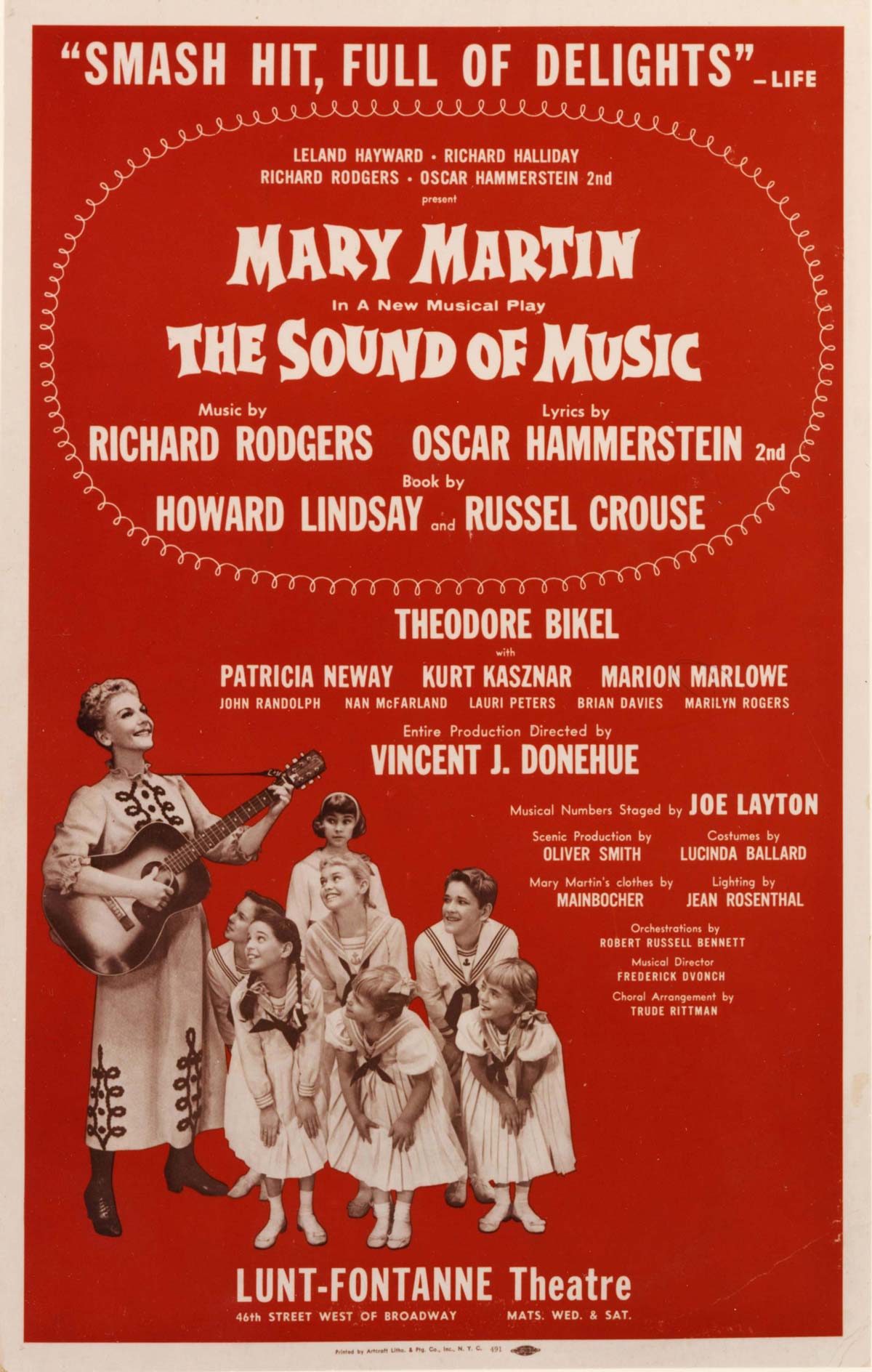
The cast album went to #1 and sold more than 2 million copies in the United States, but “has been so overshadowed by the spectacularly popular film soundtrack album that it’s difficult to judge it on its own merits.” CA The original stage cast featured a 45-year-old Mary Martin playing the 21-year-old Maria. Despite the age discrepancy, She “seems perfectly matched to the material, yet her interpretation of the character differs greatly from that offered by Julie Andrews” CA in the 1965 movie version. “Martin is more wistful, delivering the title song with a deeper, plaintive quality.” CA

Theodore Bikel is a strong presence as Captain Von Trapp. Kurt Kasznar and Marion Marlowe as Max Detweiler and Elsa Schraeder are also standouts; they perform How Can Love Survive? and No Way to Stop It delightfully. The children, including Lauri Peters as Liesl, exude warmth. From a technical and musical standpoint, this Sound of Music album is highly commendable, and as a record of the final Rodgers and Hammerstein score, it’s a must for serious collectors of transcendent musical theater.” CA

As conducted by Frederick Dvonch, the score in general has a more legit tone here than it does on the soundtrack recording, and Patricia Neway brings full operatic beauty and power to the role of the Mother Abbess.” CA


The Movie and Soundtrack

The movie version of The Sound of Music came six years after the original stage musical. It became the highest-grossing movie of all-time up to that point and won the Oscar for Best Picture. The soundtrack was a #1 in the United States and United Kingdom, spending a whopping 70 weeks at the pinnacle in the UK. It also sold more than 22 million copies worldwide, making it one of the top 100 best-sellers of all time.

“One of the principal reasons for the enduring appeal…is the fresh approach given to the material.” CA The star, Julie Andrews, had starred in the musical My Fair Lady and was fresh from an Academy Award for her title role in Mary Poppins, another story about a children’s nanny. She “brings wit, spirit, and buoyancy to the role of Maria. Perfectly sung and brilliantly acted, Andrews’ great performance is also notable for her clear but unaffected diction, and she knows exactly which lines to sing, which ones to exclaim.” CA

“The songs of the Captain and the Mother Abbess are very well sung by Bill Lee and Margery McKay, respectively, dubbing for Christopher Plummer and Peggy Wood. McKay’s rendition of ‘Climb Every Mountain’ is notably stirring. Charmian Carr does her own singing as Liesl; she’s charming in Sixteen Going on Seventeen with Dan Truhitte as Rolf, and in all of her tracks with the children…The arrangements and orchestrations of the film’s music overall are bright, uplifting, and thoroughly delightful from beginning to end.” CA

Resources and Related Links:


Other Related DMDB Pages:


First posted 11/13/2011; last updated 8/15/2024.