Showing posts with label Florence Ballard. Show all posts

Friday, March 27, 2015

50 years ago: The Supremes hit #1 with “Stop! In the Name of Love”

Stop! In the Name of Love

The Supremes

Writer(s): Brian Holland/Lamont Dozier/Eddie Holland (see lyrics here)


Released: February 8, 1965


First Charted: February 20, 1965


Peak: 12 US, 11 CB, 11 GR, 11 HR, 2 RB, 7 UK, 3 CN, 42 AU, 1 DF (Click for codes to charts.)


Sales (in millions): 1.0 US, 0.12 UK, 1.12 world (includes US + UK)


Airplay/Streaming (in millions): 2.0 radio, 10.9 video, 104.52 streaming

Awards:

Click on award for more details.

About the Song:

This song grew out of an argument between Lamont Dozier – one of the songwriters – and his girlfriend. She was about to head out the door when he yelled “stop, in the name of love!,” a slight variation of the phrase “stop, in the name of the law.” TB It broke the tension and they both starting laughing over the silliness of the line. TC

Of course, Dozier was one-third of the famed Holland-Dozier-Holland writing team at Motown. They crafted many of Motown’s biggest hits, but were more associated with the Supremes than any other act. “’Stop!’ moves with the grace of HDH’s greatest productions.” DM Initially, the Supremes – Diana Ross, Mary Wilson, and Florence Ballad – thought the song was “insufficiently feminine, too forthright.” TC Once in the studio, however, they had fun with it. TC

As for the signature choreography, they were making a live appearance before having the moves for the song worked out. Moments before they went on stage, they worked with Motown head honcho Berry Gordy and a couple of the members of the Temptations to come up with the moves – in the mens’ room! SJ

The song became the trio’s fourth #1 out of five consecutive chart-toppers. In fact, they amassed a dozen #1 songs from 1964 through the end of the decade, giving them more trips to the top than any other American act in the 1960s. It also made them the most successful Motown act of the decade. TB


Resources:


Related Links:


First posted 4/15/2020; last updated 4/2/2023.

Friday, October 31, 2014

50 years ago: The Supremes hit #1 with “Baby Love”

Baby Love

The Supremes

Writer(s): Brian Holland, Lamont Dozier, Eddie Holland (see lyrics here)


Released: September 17, 1964


First Charted: October 3, 1964


Peak: 14 US, 12 CB, 2 GR, 14 HR, 14 RB, 12 UK, 10 CN, 26 AU, 1 DF (Click for codes to charts.)


Sales (in millions): 1.0 US, 0.25 UK, 1.25 world (includes US + UK)


Airplay/Streaming (in millions): 2.0 radio, 21.0 video, 167.61 streaming

Awards:

Click on award for more details.

About the Song:

The Supremes first topped the Billboard Hot 100 in August 1964 with “Where Did Our Love Go.” When “Baby Love” also made it to #1, the trio became the first Motown act to top the Billboard Hot 100 a second time. They would top the chart a dozen times total, more than any other Motown act or American pop music group. WK This was the first #1 in the UK for a Motown group and the Supremes’ only chart-topper there. It “catapulted [them] to the top of Motown’s artist roster.” FB

The song was written by the Motown writing team of Brian Holland, Lamont Dozier, and Eddie Holland. The trio wrote many of the Supremes chart-toppers, including “Where Did Our Love Go,” “Come See About Me,” “Stop! In the Name of Love,” “You Can’t Hurry Love,” “Back in My Arms Again,” and “You Keep Me Hangin’ On.” They also wrote #1 songs for the Four Tops (“Reach Out (I’ll Be There),” “I Can’t Help Myself (Sugar Pie Honey Bunch)”) and the Marvelettes (“Please Mr. Postman”).

Dozier explained that this song was about “my first love who I never really got over.” He said many of the songs he wrote for Motown were inspired by her. SF Brian Holland explained “We pictured a simple story about a girl whose boyfriend has left her and who loves him very dearly and would like the boy to come back.” SF

Motown head honcho Berry Gordy insisted that the Holland-Dozier-Holland team produce a sound-a-like follow-up for “Where Did Our Love Go.” That mean more of Diana Ross’s “cooing lead vocal and oohing, Florence Ballard and Mary Wilson’s ‘baby-baby’ backup, the Funk Brothers’ instrumental track, and teenager Mike Valvano’s footstomping.” WK The stomping percussion became a trade mark on early Supremes’ songs, SF “putting their peers to shame in almost every area.” TB

The song received a Grammy nomination for Best Rhythm & Blues Recording.


Resources:


Related Links:


First posted 3/12/2021; last updated 4/3/2023.

Sunday, August 22, 2004

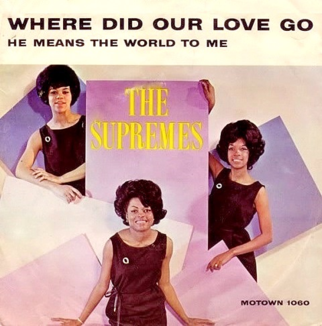
40 years ago: The Supremes “Where Did Our Love Go” hit #1

Where Did Our Love Go

The Supremes

Writer(s): Brian Holland, Lamont Dozier, Eddie Holland (see lyrics here)


Released: June 17, 1964


First Charted: July 3, 1964


Peak: 12 US, 12 CB, 12 GR, 12 HR, 12 RB, 3 UK, 11 CN, 14 AU, 4 DF (Click for codes to charts.)


Sales (in millions): 2.0 US, 0.2 UK


Airplay/Streaming (in millions): 3.0 radio, 18.4 video, 95.47 streaming

Awards:

Click on award for more details.

About the Song:

Motown “built both and empire and an era-defining sound” TB and “The Supremes were the towering stars who made Motown what it was.” TB The four girls from the Detroit housing projects were originally known as the Primettes. They started out at Motown as “high school kids hanging around the studio, adding backing vocals or hand claps whenever anybody needed them.” TB

By 1962, they were down to a trio of Diana Ross, Florence Ballard, and Mary Wilson and had started recording singles. From 1961 to 1964 they released eight singles, most of which barely scraped the charts or failed to chart. Other artists at Motown even called them “the No-Hit Supremes.” FB They didn’t find their sound until Motown founder Berry Gordy paired them with the songwriting and production team of Eddie Holland, Lamont Dozier, and Brian Holland.

They struck gold in 1964 with “Where Did Our Love Go,” “a simple lilt of a song about the unraveling of an unstable love affair.” TB It was, however, “ a brilliant piece of songcraft and personal building that…announced the Supremes as a cultural force.” TB Interestingly, it was first presented to the Marvelettes, who turned it down. FB

It established a template for songs written by H-D-H for the Supremes. It was the first of five consecutive chart-toppers for the group and eleven #1’s overall – second only to the Beatles at the time. The song also represented what to expect from a Motown song in general – “big beats, propulsive bass, sweetly sung lyrics about romantic dilemmas, choruses that would get stuck in your head all day.” TB

Yes, it’s a song “about a desperate romantic situation, but it’s light and fun, built for dancing.” TB Vocally, Ross “sounds like she’s doing everything she can to maintain her compusre.” TB Wilson and Ballard “gently circle Diana Ross’ voice, murmuring ‘baby, baby’ languidly in the background.“ TB Musically, the song “is fast and simple, anchored to that foot-stomping beat.” TB


Resources:


Related Links:


First posted 2/4/2023.