Showing posts with label Carnegie Hall. Show all posts

Saturday, January 16, 1988

Today in Music (1938): Benny Goodman performed at Carnegie Hall

Complete Legendary Carnegie Hall Concert

Benny Goodman


Recorded: January 16, 1938


Charted: December 20, 1952


Peak: 18 US, -- UK, -- CN, -- AU


Sales (in millions): 0.5 US, -- UK, 0.5 world (includes US and UK)


Genre: jazz


Tracks, Disc 1:

Song Title (Writers) [time] (date of single release, chart peaks). Chart information is for original studio releases. Click for codes to singles charts.

  1. Benny Goodman Introduction (recorded 1950) [0:22]
  2. Don’t Be That Way (Edgar Sampson, Benny Goodman, Mitchell Parish) [4:12] (3/12/38, 1 US)
  3. Sometimes I’m Happy (Vincent Youmans, Irving Caesar, Clifford Grey) [4:13] (9/14/35, 12 US) *
  4. One O’Clock Jump (Eddie Durham, Buster Smith) [6:47] (3/12/38, 8 US)
  5. Applause; transition to Twenty Years of Jazz [0:41]
  6. Sensation Rag (Edwin “Eddie” Edwards) [1:12]
  7. I’m Coming Virginia (Will Marion Cook, Donald Heywood) [2:15]
  8. When My Baby Smiles at Me (Bill Munro, Andres Sterling, Ted Lewis, Harry Von Tilzer) [0:52]
  9. Shine (Cecil Mack, Ford Dabney, Lew Brown) [0:55]
  10. Blue Reverie (Duke Ellington, Harry Carney) [3:32]
  11. Applause, transition back to Goodman Orchestra [0:22]
  12. Life Goes to Party (Harry James, Benny Goodman) [4:05]
  13. Setting Up for Jam Session [0:40]
  14. Honeysuckle Rose (Thomas “Fats” Waller, Andy Razaf) [16:42]
  15. Applause; setting up and tuning up for BG Small Groups [1:00]
  16. Body and Soul (Johnny Green, Edward Heyman, Robert Sour, Frank Eyton) [3:10] (9/7/35, 5 US)
  17. Applause as Lionel Hampton enters [0:27]
  18. Avalon (Vincent Rose, B.G. DeSylva, Al Jolson) [4:04]
  19. The Man I Love (George Gershwin, Ira Gershwin) [3:35] (9/11/37, 20 US)
  20. I Got Rhythm (George Gershwin, Ira Gershwin) [4:51]

Tracks, Disc 2:

  1. Blue Skies (Irving Berlin) [3:14] (8/17/46, 9 US)
  2. Loch Lomand (traditional) [3:04] (12/18/37, 12 US)
  3. Applause: Benny Goodman’s ‘No Encore’ announcement [1:14]
  4. The Blue Room (Richard Rodgers, Lorenz Hart) [2:36]
  5. Swingtime in the Rockies (Jimmy Mundy, Benny Goodman) [2:38] (8/15/36, 2 US)
  6. Applause: Martha Tilton returns to stage [0:21]
  7. Bei Mir Bist du Schön (Scholom Secunda, Jacob Jacobs, adapted by Sammy Cahn & Saul Chaplin) [3:54] (1/29/38, 4 US)
  8. Applause: setting up for BG small groups [0:32]
  9. China Boy (Dick Winfree, Phil Boutelje) [4:45] (6/27/36, 9 US)
  10. Stompin’ at the Savoy (Edgar Sampson, Benny Goodman, Chick Webb) [5:55] (7/11/36, 11 US)
  11. Applause: BG Quartet continues but changes program [0:24]
  12. Dizzy Spells (Benny Goodman, Lionel Hampton, Teddy Wilson) [5:37]
  13. Applause; transition back to Goodman orchestra for finale [0:41]
  14. Sing Sing Sing with a Swing (Louis Prima) [12:02] (4/9/38, 7 US)
  15. Applause until encores [1:03]
  16. If Dreams Come True (Edgar Sampson, Benny Goodman, Irving Mills) [2:34] *
  17. Big John’s Special (Horace Henderson) [3:41]

* unique to Complete Legendary Carnegie Hall Concert


Total Running Time: 101:04

Rating:

4.650 out of 5.00 (average of 4 ratings)


Quotable: “One of the greatest concerts ever captured on record.” This “belongs in every serious music library.” – Scott Yanow, All Music Guide


Awards: (Click on award to learn more).

About the Album:

Band leader and clarinetist Benny Goodman, “touted as the ‘King of Swing’ at his peak,” NRR was “the first real jazz musician to capture a mass bourgeois white audience in America.” AZ He was also the first to stage a full jazz concert at Carnegie Hall. SY His publicist, Wynn Nathanson, initially suggested it as a publicity stunt, but after “his film Hollywood Hotel opened to rave reviews and giant lines, he threw himself into the work.” WK It sold out its capacity 2,760 seats at the then-high top price of $2.75 a seat. WK

This “belongs in every serious music library, capturing Benny Goodman and the swing era in general at its height.” SY His “fantastic performance at Carnegie Hall” AZ started with three contemporary numbers, then played a history of jazz, and then a jam session on Honeysuckle Rose, “which found sidemen of the orchestras of Duke Ellington and Count Basie interacting with Goodman's star.” SY Later some “trio and quartet numbers were well-received and a vocal on Loch Lomond by Martha Tilton provoked five curtain calls.” WK

“This concert has been regarded as one of the most siginificant in jazz history” WK and “one of the greatest concerts ever captured on record.” SY This was “a turning point in the way jazz is judged by outsiders.” SY It had “finally been accepted by mainstream audiences.” WK “It is hard to believe that tapes of this momentous event were kept in a closet, forgotten until rediscovered by accident in 1950” SY by Benny’s sister-in-law in a closet in his apartment. WK

The performance “captures Goodman and his orchestra at the peak of their performance.” AZ He is “fronting top performers and appearing before an energetic audience.” NRR His “stellar bandsmen were joined by Lionel Hampton and members of the Count Basie and Duke Ellington ensembles for this famous festival of jazz during the height of the swing music era.” NRR

“There are many, many high points, including exciting versions of Don’t Be That Way and One O’Clock Jump, a tribute to the 20 years of jazz that were then on record; …exciting performances by the Trio and Quartet; and, of course, Sing, Sing, Sing with Gene Krupa’s creative (if not too subtle) drumming and Jess Stacy’s remarkable ad lib piano solo.” SY

Three of these songs are featured in the DMDB book The Top 100 Songs of the Pre-Rock Era, 1890-1953, albeit not the versions by Goodman. Ben Selvin had a chart-topper with Blue Skies in 1927, Red Nichols took I Got Rhythm to #5 in 1930, Coleman Hawkins had a #13 hit with Body and Soul in 1940.


Notes: When issued on CD in 1999, the original Carnegie Hall Jazz Concert was expanded (track listing reflects that) and retitled The Legendary Carnegie Hall Concert.

Resources and Related Links:


Other Related DMDB Pages:


First posted 11/14/2008; last updated 1/29/2022.

Monday, July 6, 1987

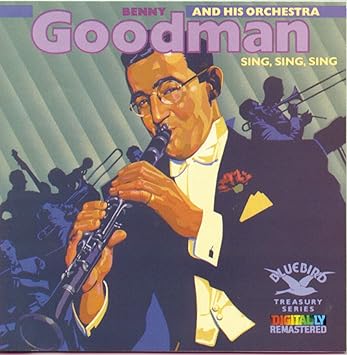
On This Day (1837): Benny Goodman recorded “Sing Sing Sing”

Sing, Sing, Sing (With a Swing)

Benny Goodman

Writer(s): Louis Prima, Leon Berry (see lyrics here)


Recorded: July 6, 1937


First Charted: April 9, 1938


Peak: 7 US, 12 GA (Click for codes to charts.)


Sales (in millions): --


Airplay/Streaming (in millions): -- radio, 70.63 video, 45.61 streaming

Awards:

Click on award for more details.

About the Song:

By the start of the Swing era in 1936, Benny Goodman was its king. He started playing clarinet professionally at the age of 16 and formed his own permanent band by the time he was 25. “Sing, Sing, Sing” was the band’s most renowned performance with solos by Benny as well as drummer Gene Krupa (on his last hit before leaving the band) and trumpeter Harry James. This instrumental includes interpolation of “Christopher Columbus,” PM a Chu Berry song which was written for Fletcher Henderson. SS

“Sing, Sing, Sing,” which Goodman called a “killer diller,” NPR’99 was the closer at the bandleader’s legendary Carnegie Hall concert on January 16, 1938. It was the first time jazz comprised a full concert instead of being part of a larger show SS and marked the birthplace of the legitimacy of the genre. NPR’99

“Sing, Sing, Sing” was written by Louis Prima in 1936, but was dramatically reworked as an instrumental by Goodman to become what Steve Sullivan called “the all-time house rocker of the swing era” in his book Encyclopedia of Great Popular Song Recordings. SS He credited the song with exemplifying “the sky-high excitement of Big Band jazz at its greatest.” SS

Helen Ward, who was initially slated to sing on the track, noted that Gene Krupa was supposed to stop drumming at the end of the third chorus, but when he kept going, Goodman chimed in with his clarinet. The reslt was an eight-minute cut which took up both sides of a 12-inch 78 rpm record, a break from the traditional three-minute recordings which could fit on a 10-inch 78. WK The recording was immediately well-received: Down Beat magazine’s Tom Collins said the performance “will make record history.” SS


Resources:


Related Links:


Last updated 9/5/2023.