Showing posts with label top gospel songs. Show all posts

Friday, February 13, 2015

Today in Music (1965): The Impressions “People Get Ready” charted

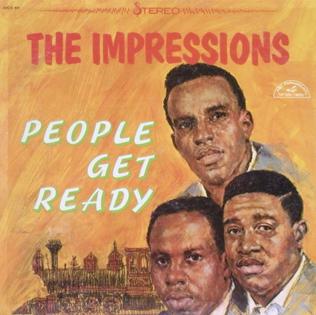
People Get Ready

The Impressions

Writer(s): Curtis Mayfield (see lyrics here)


First Charted: February 13, 1965


Peak: 14 BB, 15 CB, 20 GR, 17 HR, 3 RB, 1 DF (Click for codes to charts.)


Sales (in millions): --


Airplay/Streaming (in millions): -- radio, 9.9 video, 53.18 streaming

Awards:

Click on award for more details.

About the Song:

Curtis Mayfield and Jerry Butler met in a Chicago church choir as teens. They formed the Impressions in 1958 when they joined up with a vocal trio from Tennessee. The lineup had changed by 1962 with Butler moving on and Mayfield writing the songs. In 1963, they teamed with producer Johnny Pate whose “polished arrangements propelled the Impressions to popular success.” NRR

The group’s most celebrated song, “People Get Ready,” may just sound like a “simple song of Christian faith” NRR and Mayfield acknowledged that the influence for this “soul song with a big dose of gospel” TC “came directly from the pulpit.” TC However, “the racial subtext was obvious to African Americans.” NRR

Mayfield composed the song in 1964, on the eve of Martin Luther King Jr.’s march on Chicago. SS It became “the unofficial anthem of the Civil Rights Movement.” NRR It is “about the sin of slavery never atoned for, the systemic racism that followed, and the promise of deliverance.” NRR The song uses trains as a metaphor for freedom, which harkens back to the 1830s and the Underground Railroad, which wasn’t an actual train but a network that helped slaves escape to freedom.

Mayfield sings “in a silken falsetto over pizzicato strings and Sam Gooden responds, ‘There’s a train a-coming.’ Mayfield’s guitar marks time with staccato upstrokes over low French horns while bell-like glockenspiel tones rise to the heavens. ‘You don’t need no baggage,’ sings Mayfield; Gooden and Cash respond, ‘You just get on board.’ This is a train song; this is a gospel song delivering good news.” NRR

While the song wasn’t a big hit initially, “it has become one of the longest-lasting soul singles of all time.” TC That has been helped by Aretha Franklin’s cover version on Lady Soul and a rock version by Vanilla Fudge. There was also “Bob Marley & the Wailers’ joyful mash-up, ‘One Love/People Get Ready.’” NRR The song also marked an important reunion for Rod Stewart and Jeff Beck in 1985.


Resources:


First posted 1/31/2024.

Wednesday, February 28, 1979

This Month in Music (1779): “Amazing Grace” published

Amazing Grace

John Newton (words)

Writer(s): John Newton (words), traditional (music) (see lyrics here)


First published: February 1779


Released: --


First Charted: December 5, 1970 (Judy Collins)


Peak: 15 US, 13 CB, 8 GR, 12 HR, 5 AC (Collins), 15 UK, 13 CN, 15 AU (Royal Scots Dragoon Guards) (Click for codes to charts.)


Sales (in millions): -- US, 0.96 UK, 7.0 world (includes US + UK)


Airplay/Streaming (in millions): -- radio, 413.30 video, -- streaming

Awards (Newton):

Click on award for more details.


Awards (Dixie Hummingbirds):


Awards (Mahalia Jackson):


Awards (Collins):


Awards (Royal Scots):

About the Song:

“Amazing Grace” is “arguably the best-known Christian hymn;” LC music historian Steve Sullivan called it “the best-loved religious hymn of all time.” SS “If America had a national folk hymn, this would probably be it.” HY It has been published in nearly 1400 hymnals, HY appeared on more than 11,000 albums, and been performed an estimated ten million times. CC

The 1946 a cappella version by the gospel group the Dixie Hummingbirds was inducted into the Grammy Hall of Fame. The 1970 version by Judy Collins is the Library of Congress’ National Recording Registry. In 1972, the Royal Scots Dragoon Guards took their bagpipe-driven rendition to #1 in Australia, Canada, and the UK. The song gave the Guards the distinction of being the oldest established act to ever hit the charts as they had formed 294 years earlier in 1678 TB – a century before “Amazing Grace” was written.

The first known recording was by the Original Scared Harp Choir in August 1922. It has since been recorded or performed by multiple artists including Alabama, Tori Amos, Joan Baez, Andrea Bocelli, the Byrds, Glen Campbell, Johnny Cash, Destiny’s Child, Neil Diamond, Fats Domino, Bryan Ferry, Aretha Franklin, Crystal Gayle, Al Green, Merle Haggard, Alan Jackson, Mahalia Jackson, George Jones, Leadbelly, Brenda Lee, Loretta Lynn, Reba McEntire, Sarah McLachlan, Blind Willie McTell, the Mormon Tabernacle Choir, Anne Murray, Willie Nelson, Aaron Neville, Patti Page, Phish, Elvis Presley, Cliff Richard, LeAnn Rimes, Kenny Rogers, Diana Ross, Sufjan Stevens, Rod Stewart, Sister Rosetta Tharpe, Randy Travis, Ike & Tina Turner, Carrie Underwood, and the Weavers. SH

The words are from a poem John Newton wrote describe “the joy and peace of a soul uplifted from despair to salvation through the gift of grace.” LC In 1835, a singing instructor named William Walker set Newton’s words to “New Britain,” SS a folk melody believed to be of Scottish or Irish origin. WK It was published that September in the book Southern Harmony and Musical Companion. SS

Although he didn’t write the poem until 1772, Newton was inspired by events as far back as 1748. While travelling from Africa to Liverpool, he was caught up in a ferocious storm at sea. Although an atheist at the time, he called out to God for mercy and when the ship finally landed safely in Donegal, Ireland, it was the beginning of his spiritual conversion. CC

John was inspired by his own triumphs to “escape danger, disease, abuse, and death.” LC He was born in Wapping, England in 1725. His father, a merchant sea captain, was often gone for two to three years at a time on sea voyages. Newton’s mother died of tuberculosis when John was seven and he was temporarily in the care of friends of hers before his father returned, remarried, and put John in boarding school. By the age of 11, he went to work at sea alongside his father.

John was “raised far afield of the prevailing Anglican traditions” LC and didn’t live a life of faith. In 1743, he was forced into the British Navy where he was flogged and relieved of his post after a failed escape attempt. He went on to captain a slave ship. Still, he was repeatedly faced with the idea that he had been miraculously spared. Once he was thrown from a horse and barely missed being impaled by a row of stakes. Another time, he arrived late for a tour of a warship, only to see it overturn and drown everyone on board. LC

As he wrote in his famous hymn, however, “the hour I first believed” came in the form of a violent storm at sea in which he was saved yet again when his replacement on deck was thrown overboard. By 1750, he had married and was a changed man. He became an abolitionist and returned to the sea but now led sailors in prayer whereas he previously would have taunted them for their beliefs. After suffering a stroke, he gave up his life at sea in 1854 and took a job in the Customs Office at Liverpool.

Newton was ordained in the ministry in June 1764 LC and, through a collaboration with William Cowper, wrote more than 280 hymns. HY “Amazing Grace” first appeared in February 1779 as Hymn 41 in Book I of a collection called The Olney Hymns. WK It was originally called “Faith’s Review and Expectation.” WK Newton died in 1807 at 82 years old.


Resources:


First posted 9/1/2023.

Wednesday, March 1, 1972

This Month in Music (1872): “Swing Low, Sweet Chariot” published

Swing Low, Sweet Chariot

Wallace Willis, Henry Thacker Burleigh (arranged)

Writer(s): Wallace Willis, Henry Thacker Burleigh (arranged) (see lyrics here)


Published: March 1872


First Charted: May 14, 1910 (Fisk Jubilee Singers)


Peak (different versions): 7 PM, 25 CL, 15 UK (Click for codes to charts.)


Sales (in millions): --


Airplay/Streaming (in millions): -- radio, 16.06 video, -- streaming

Awards (Willis):

Click on award for more details.


Awards (Fisk):


Awards (Robeson):

About the Song:

“Swing Low, Sweet Chariot” “achieved immortality as a spiritual” SS with ties to the Underground Railroad. When slaves sang the lines “Swing low, sweet chariot / Comin’ for the carry me home” it was a signal that the Underground Railroad was coming to help the slaves to freedom. SH It was reportedly a favorite of Harriet Tubman, the heroic leader of the Underground Railroad. SH

The song is credited to Wallace Willis, a slave likely born prior to the Civil War in Mississippi. However, he was owned not by a white man, but a Choctaw Indian. In the early part of the 19th century, members of their tribe took up farming, converted to Christianity, and purchased slaves to assimilate and avoid being removed from their land by white Americans. SH Unfortunately, they were still forced from their lands in the 1830s.

Willis was hired out to the Spencer Academy, a Choctaw boys’ school. He and his wife lived in a wood cabin on the edge of campus and would sit outside in the evening singing spirituals such as “Swing Low, Sweet Chariot.” Alexander Reid, the superintendent of the academy, enjoyed their singing and often had them sing for students and visitors.

In 1871, Reid saw the Jubilee Singers perform. They were a choir from Fisk Free Colored School, later Fisk University. The all-black college was founded in 1866 to focus on the education of freed slaves. In 1871, the Jubilee Singers toured to raise money for the school. They raised $40,000 in a year and a half, following roughly the route of the Underground Railroad, singing songs from the abolitionist movement. International tours in England and Europe followed. SS Reid introduced “Swing Low, Sweet Chariot” to the group after telling the school’s treasurer and musical director, George L. White, that he’d heard better. AS

In March 1872, they published a book called Jubilee Songs: A Sung by the Jubilee Singers which included “Swing Low, Sweet Chariot.” While Willis has been credited with the song, like many spirituals, it bears similarities to the melody and style of songs from the Guinea coast and Equatorial Bantu where most slaves were taken. SS In the case of “Swing Low” it had the same response and refrain as “The Story of Tangalimlibo,” a Bantu song. Lyrically the text has a Biblical basis in II Kings, verses 2 and 11. LC

A new version of the Fisk Jubilee Singers toured in 1899 and was eventually recorded by the Victor Talking Machine Company. Their first session was on December 8, 1909, and their first song was “Swing Low, Sweet Chariot.” It is “a slow, beautiful a cappella performance in the semi-classical European style” sup>SS which was marketed as a Negro folk song. SS It became a top-ten hit in 1910 and was inducted into the Grammy Hall of Fame and the National Recording Registry.

The song’s popularity also owes a debt to classical composer Antonín Dvořák, who came to the United States in 1892 to run the National Conservatory of Music. He said, “the future music of this country must be founded upon what are called the Negro melodies.” SS He integrated “Swing Low, Sweet Chariot” into his famed Symphony No. 9 in E Minor (From the New World. In 1917, Dvořák’s student Harry T. Burleigh arranged “Swing Low” for solo voice and then published it in 1920 for mixed chorus. LC

A 1926 recording by Paul Robeson is also in the Grammy Hall of Fame. In 1995, Ladysmith Black Mambazo took the song to #15 on the UK charts. Others who’ve done renditions include Louis Armstrong, Joan Baez, Johnny Cash, Eric Clapton, Benny Goodman, the Grateful Dead, Etta James, B.B. King, Dolly Parton, and Nina Simone.


Resources:


First posted 9/2/2023.