Showing posts with label Teddy Wilson. Show all posts

Tuesday, July 15, 1986

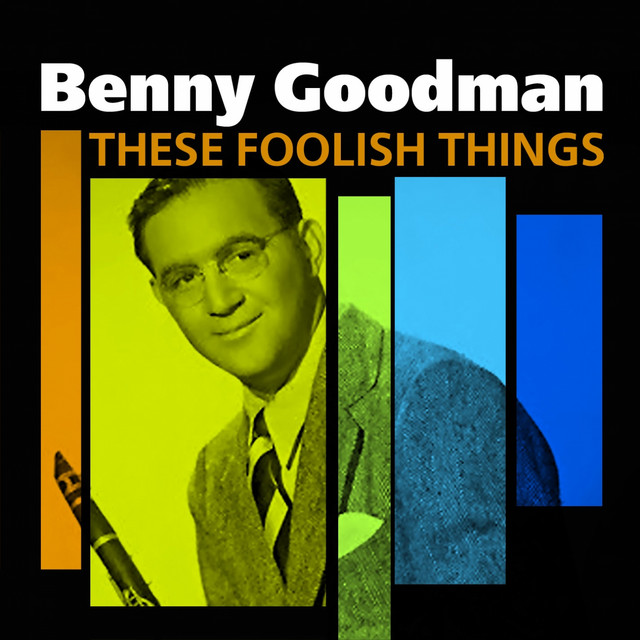
50 years ago: Benny Goodman hit #1 with “These Foolish Things”

These Foolish Things Remind Me of You

Benny Goodman’s Orchestra with Helen Ward

Writer(s): Harry Link and Jack Strachey (music), Eric Maschwitz, aka Holt Marvell (words) (see lyrics here)


First Charted: June 27, 1936


Peak: 12 US, 12 HP, 14 GA, 14 SM (Click for codes to charts.)


Sales (in millions): --


Airplay/Streaming (in millions): -- radio, 0.22 video, -- streaming

Awards:

Click on award for more details.

About the Song:

Eric Maschwitz, the Head of Variety at the BBC, wrote the lyrics for “These Foolish Things” in the UK under the pseudonym Holt Marvell. He wrote it at the request of Joan Carr for a late-evening revue to be broadcast by the BBC. WK British cabaret singer Jean Ross, with whom Maschwitz had a fling, was the song’s muse, according to Maschwitz, although his wife Hermione Gingold speculated that it was about her or actress Anna May Wong. WK

Maschwitz wrote this as a list song, or catalog song, “delineating the various things that remind the singer of a lost love.” WK He “used the same type of complex rhyme scheme that Cole Porter used in ‘You’re the Top’ to enumberate the fleeting memories of young love.” TY2 American Harry Link is sometimes credited as a co-writer for contributing a bridge to the song. WK

It first appeared in the London revue Spread It Around, sung by Dorothy Dickson. SM Turner Layton, who was from the United States but based in Britain, was the first to record “These Foolish Things.” SM In the U.S., Teddy Wilson’s Orchestra recorded the “bittersweet nostalgic song” TY2 with Billie Holiday on vocals. However, it was Benny Goodman’s Orchestra, with Helen Ward on vocals, who was the first to chart with the song SM and take it to #1.

That same year, versions of the song charted by Nat Brandywynne and his Stork Club Orchestra with vocals from Buddy Clark (#6), pianist Carroll Gibbons with his orchestra (#8), and Joe Sanders’ Orchestra (#17). PM Others to record the song include Nat “King” Cole, Sam Cooke, Bing Crosby, Sammy Davis Jr., Billy Ward & His Dominoes, Bob Dylan, Ella Fitzgerald, Bryan Ferry, Etta James, Frankie Laine, Aaron Neville, Sarah Vaughan, and Rod Stewart (#13 AC, 2002). WK

The song was used in the movie musical Ghost Catchers in 1944 TY2 and in the Humphrey Boart movie Tokyo Joe in 1949. WK In 1946, Frank Sinatra would take the song to #1 in the UK. SM


Resources:


Related Links:


First posted 3/17/2023.

Friday, February 28, 1975

50 years ago: Marion Harris hit #1 with “Tea for Two”

Tea for Two

Marion Harris

Writer(s):Vincent Youmans, Irving Caesar (see lyrics here)


First Charted: January 24, 1925


Peak: 13 US, 3 GA, 2 DF (Click for codes to singles charts.)


Sales (in millions): 1.0 US (sheet music sales)


Airplay/Streaming (in millions): -- radio, 0.05 video, -- streaming

Awards (Marion Harris)


Awards (Art Tatum):

About the Song:

This “charming boy/girl duet” LW was introduced by Louise Groody and John Barker in the Broadway musical comedy No, No, Nanette. JA The score was generally regarded as the best of composer Vincent Youman’s short career. He died from tuberculosis at 48. LW Meanwhile, lyricist Irving Caesar “demonstrates all the hallmarks of Tin Pan Alley craftsmanship, artfully simple and pleasingly full of rhymes and alliterations.” LW He was “the archetypical Tin Pan Alley cigar chomping, wisecracking showman” LW with more than a 1000 songs to his name upon his death at age 101 in 1996.

The lyrics, which were dashed off in 5 minutes, were intended to be temporary, but were never changed. TY Marion Harris had the first charted version, taking it to #1 in 1925. That same year, the Benson Orchestra of Chicago landed at #5 with their instrumental version while Ben Bernie also had a top ten hit with the song. PM Other charted versions came from the Ipana Troubadours (#15, 1930) and Teddy Wilson (#18, 1937). PM Warren Covington had a million-selling cha-cha version with the Tommy Dorsey Orchestra (“Tea for Two Cha Cha,” #7, 1958). TY

The song “is one of the most recorded standards of Tin Pan Alley,” JA having been covered by musicians as diverse as Russian classical composer Dmitri Shostakovich, who adapted the tune as “Tahiti Trot” in 1928, LW and jazz pianist Art Tatum (#18, 1939) whose instrumental version is “a masterclass in piano virtuosity.” LW Jazz musicians have particularly responded to the song because “the complex harmonic construction of the melody gives great scope for improvisation.” LW

Tatum had played the song for years, even predating his initial 1933 recording of it at his debut solo recording session. Fellow musician Fats Waller once stopped in the middle of playing at New York Club when Art Tatum entered and announced, “I play piano, but God is in the house tonight!” SS


Resources:


Last updated 11/23/2022.