Showing posts with label Marvin Hamlisch. Show all posts

Wednesday, March 8, 2017

Carole Bayer Sager: Top 40 Songs

First posted 12/15/2019.

Songwriter Carole Bayer was born 70 years ago on this day in 3/8/1947 in Brooklyn, NY. She was married to record-producer Andrew Sager from 1970 to 1978 and has also been romantically linked to songwriters Marvin Hamlisch and Burt Bacharach (married 1985 to 1991). She won an Academy Award (“Arthur’s Theme” by Christopher Cross) and Grammy Award (“That’s What Friends Are For,” Dionne & Friends). For a complete list of this act’s DMDB honors, check out the DMDB Music Maker Encyclopedia entry.


Top 40 Songs

Dave’s Music Database lists are determined by song’s appearances on best-of lists as well as chart success, sales, radio airplay, streaming, and awards. In the event of songs which have been recorded more than once, only the top-ranked song is included in the list. Songs which hit #1 on the following charts have been noted: Billboard Hot 100 pop charts (US), Cashbox (CB), Hit Records (HR), Radio & Records (RR), Billboard R&B chart (RB), Billboard country chart (CW), United Kingdom pop chart (UK), Canadian pop chart (CN), and Australian pop chart (AU).

DMDB Top 1%:

1. That's What Friends Are For (Dionne Warwick with Elton John, Gladys Knight, & Stevie Wonder, 1985) #1 US, AC, RB, CN, AU

DMDB Top 5%:

2. Arthur’s Theme (Best That You Can Do) (Christopher Cross, 1981) #1 US, CB, HR, RR, AC
3. A Groovy Kind of Love (Phil Collins, 1988) #1 US, CB, RR, AC, UK, CN
4. On My Own (Patti LaBelle with Michael McDonald, 1986) #1 US, CB, RR, RB, CN
5. Nobody Does It Better (Carly Simon, 1977) #1 RR, AC
6. When I Need You (Leo Sayer, 1977) #1 US, CB, HR, RR, AC, UK, CN
7. A Groovy Kind of Love (The Mindbenders, 1966) #1 CB, HR

DMDB Top 10%:

8. Heartlight (Neil Diamond, 1982) #1 AC
9. Don’t Cry Out Loud (Melissa Manchester, 1978)

DMDB Top 20%:

10. It’s My Turn (Diana Ross, 1980)
11. Love Power (Dionne Warwick with Jeffrey Osborne, 1987) #1 AC

Beyond the DMDB Top 20%:

12. Midnight Blue (Melissa Manchester, 1975) #1 AC
13. You’re Moving Out Today (Carole Bayer Sager, 1977) #1 AU
14. You’re the Only One (Dolly Parton, 1979) #1 CW
15. Making Love (Roberta Flack, 1982)
16. Heartbeaker (Dolly Parton, 1978) #1 CW
17. Try It on My Own (Whitney Houston, 2002)
18. You’re Moving Out Today (Bette Midler, 1977)
19. Fly Away (Peter Allen, 1981)
20. Ever Changing Times (Aretha Franklin with Michael McDonald, 1991)

21. Looking Through Your Eyes (LeAnn Rimes, 1998)
22. I’d Rather Leave While I’m in Love (Rita Coolidge, 1979)
23. On the Way to the Sky (Neil Diamond, 1981)
24. Front Page Story (Neil Diamond, 1982)
25. Turn Around (Neil Diamond, 1984)
26. Through the Eyes of Love (Melissa Manchester, 1979)
27. The Prayer (Andrea Bocelli with Celine Dion, 1998)
28. Break It to Me Gently (Aretha Franklin, 1977)
29. Some Changes Are for Good (Dionne Warwick, 1981)
30. Over You (Natalie Cole with Ray Parker, Jr.; 1988)

31. Love Always (El DeBarge, 1986)
32. A Chance for Heaven (Christopher Cross, 1984)
33. Stronger Than Before (Carole Bayer Sager, 1981)
34. Finder of Lost Loves (Dionne Warwick with Glenn Jones, 1985)
35. Take Good Care of You and Me (Dionne Warwick with Jeffrey Osborne, 1989)
36. That’s What Friends Are For (Rod Stewart, 1982)
37. I Never Loved You Anyway (The Corrs, 1997)
38. Night Shift (Quarterflash, 1991)
39. Someone Else’s Eyes (Aretha Franklin, 1991)
40. It’s the Falling in Love (Michael Jackson with Patti Austin, 1979)


Awards:


Monday, August 6, 2012

A Chorus Line send-off to Marvin Hamlisch: August 6, 2012

image from pasadenanow.com

The award-winning composer Marvin Hamlisch died on Monday, August 6, 2012. He was born in New York City, NY on June 2, 1944. He won Oscars (scores for The Sting and The Way We Were and the song from the latter), Emmys (4), Grammys (4), Golden Globes (2), and the Pulitzer Prize. He was probably best known for his Tony award-winning musical, A Chorus Line.

A Chorus Line is a tribute to “the dancers who are often treated as so much mobile scenery in Broadway musicals.” AMG “The musical was derived from several taped workshop sessions with Broadway dancers, known as ‘gypsies.’” WK “It is set on the bare stage of a Broadway theatre during an audition for chorus line members of a musical. The show gives a glimpse into the personalities of the performers and the choreographer as they describe the events that have shaped their lives and their decisions to become dancers.” WK The musical “is sometimes considered to have broken new ground with its frank portraits of talented but frustrated performers.” AMG

The score is by Marvin Hamlisch and Edward Kleban while “the show was directed and co-choreographed (with Bob Avian) by Michael Bennett.” WK It “is a favorite of ‘theater people’ everywhere, but was designed to showcase the abilities of dancers rather than singers. Consequently, only the ballad What I Did for Love has had a life outside of the show’s context.” AMG

”What I Did for Love” by Ethel Merman

A Chorus Line opened off-Broadway at The Public Theater on May 21, 1975. Advance word had created such a demand for tickets that the entire run sold out immediately. Producer Joseph Papp decided to move the production uptown, and on July 25 it opened at the Shubert Theatre, where it ran for 6,137 performances. It held the distinction of being the longest running show in Broadway history until its record was surpassed by Cats on June 19, 1997 and then The Phantom of the Opera in 2006.” WK “It still remains as the longest running musical whose first performance originated in the United States. The show has enjoyed many successful productions worldwide and was revived on Broadway in 2006.” WK

“The original Broadway production was an unprecedented box office and critical hit, receiving 12 Tony Award nominations and winning nine of them, in addition to the 1976 Pulitzer Prize for Drama,” WK “one of the few musicals ever to receive this honor.” WK “A production mounted at the Theatre Royal Drury Lane in London’s West End won the Laurence Olivier Award as Best Musical of the Year 1976, the first year in which the awards were presented. An unsuccessful film adaptation was released in 1985.” WK


Awards for A Chorus Line:


Resources and Related Links:

Sunday, December 29, 2002

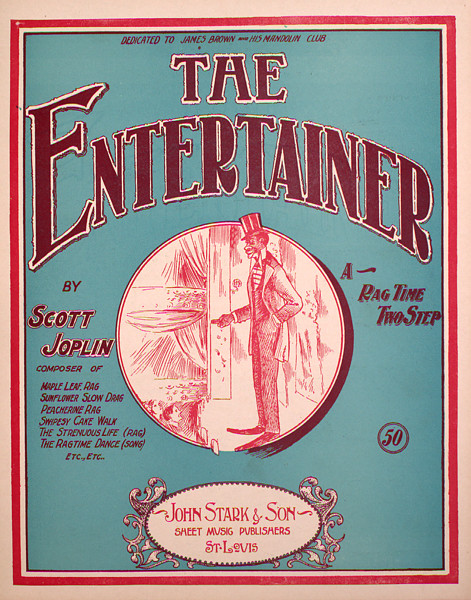
On This Day (1902): Scott Joplin published “The Entertainer”

The Entertainer

Scott Joplin

Writer(s): Scott Joplin (lyrics: NA, instrumental)


Published: December 29, 1902


First Charted: --


Peak: -- (Click for codes to charts.)


Sales (in millions): --


Airplay/Streaming (in millions): -- radio, 18.73 video, 17.07 streaming

Awards (Scott Joplin):

Click on award for more details.


Awards (Marvin Hamlisch):

About the Song:

Scott Joplin was “the first classical trained black composer to become a household name in America.” SF His music was at the forefront of the ragtime movement of the late 19th century and early 20th century. He published his ragtime classic “The Entertainer” in 1902 and “within a year it was perhaps second in popular acclaim only to ‘Maple Leaf Rag’ among Joplin’s compositions.” SS A 1903 story in the St. Louis Globe-Democrat said it was “probably the best and most euphonious of his latter-day compositions…It is a jingling work of a very original character.” SS

The song was initially sold as sheet music and, in the 1910s, as a piano roll that worked on player pianos. WK It wasn’t recorded on wax until 1928, when Napoleon Hayes and Matthew Prater did a version with guitar and mandolin. SS In 1970, Joshua Rifkin recorded the song on Scott Joplin: Piano Rags and it became a million-selling record. In 1979, Alan Rich wrote in New York Magazine that the recording “created, almost alone, the Scott Joplin revival.” WK

Indeed, the song enjoyed its greatest success just a few years after Rifkin’s recording when it was featured in the 1973 movie The Sting. Marvin Hamlisch’s recording was a surprise hit, reaching #3 on the Billboard Hot 100. His soundtrack recording for the movie won a Oscar for Best Original Song Score and Adaptation. The New York Times wrote “thanks to the film and its score, Joplin’s work became appreciated in both the popular and classical musical worlds.” WK Record World proclaimed it the “classical phenomenon of the decade.” WK

Perhaps the most amusing revelation of the song’s iconic status, however, is that it has become one of the songs often played by ice cream trucks to attract customers while driving through neighborhoods. WK


Resources:


First posted 4/3/2021; last updated 9/5/2023.

Saturday, February 2, 1974

Barbra Streisand hit #1 with “The Way We Were”

The Way We Were

Barbra Streisand

Writer(s): Alan Bergman, Marilyn Bergman, Marvin Hamlisch (see lyrics here)


First Charted: October 20, 1973


Peak: 13 US, 11 CB, 13 GR, 11 HR, 13 RR, 12 AC, 31 UK, 11 CN, 6 AU, 6 DF (Click for codes to singles charts.)


Sales (in millions): 2.0 US, -- UK, 2.0 world (includes US + UK)


Airplay/Streaming (in millions): -- radio, 22.6 video, 45.46 streaming

Awards:

Click on award for more details.

About the Song:

“The Way We Were” “capped a rare entertainment grand slam” AMG in that the song, album, and movie all hit #1. AMG Streisand was no stranger to the Billboard pop charts, having racked up 20 hits since “People,” taken from the musical Funny Girl, charted in 1964. However, “The Way We Were” was her first chart-topper – she would accomplish the feat four more times – and her second of eight to the adult contemporary charts.

Barbra conveys “the lyric with great passion and style, without resorting to overly sentimental histrionics.” AMG The result was the biggest song of 1974 WHC and one of her “finest performances.” AMG The song is “ingrained into the memory of anyone who was listening to radio in the mid-’70s.” AMG

The movie “starred Streisand and Robert Redford as a pair of opposites who fall in love. They are followed “from college to marriage to divorce and beyond.” FB The use of the word “memories” throughout the song perfectly captures the essence of the film’s focus on “emotions of long-term (and long-lost) love.” AMG

The original movie version of the song was recorded with an orchestral backing which was scrapped in favor of a more pop arrangement for the single and Barbra’s subsequent album of the same name. BB

When awards season hit, the track took home prizes for Best Song at the Golden Globes and Academy Awards. The song was also ranked #8 on the American Film Institute’s list of top 100 film songs of all time. WK


Resources:

  • AMG All Music Guide by Matthew Greenwald
  • BB Billboard (9/08). “All-Time Hot 100
  • FB Fred Bronson (2003). The Billboard Book of Number One Hits (5th edition). Billboard Books: New York, NY. Page 356.
  • WHC Joel Whitburn (1999). A Century of Pop Music. Menomonee Falls, WI; Record Research, Inc. Page 101.
  • WK Wikipedia.org


Related Links:


First posted 2/2/2012; last updated 11/26/2022.