Showing posts with label John Scott Trotter. Show all posts

Friday, August 5, 1994

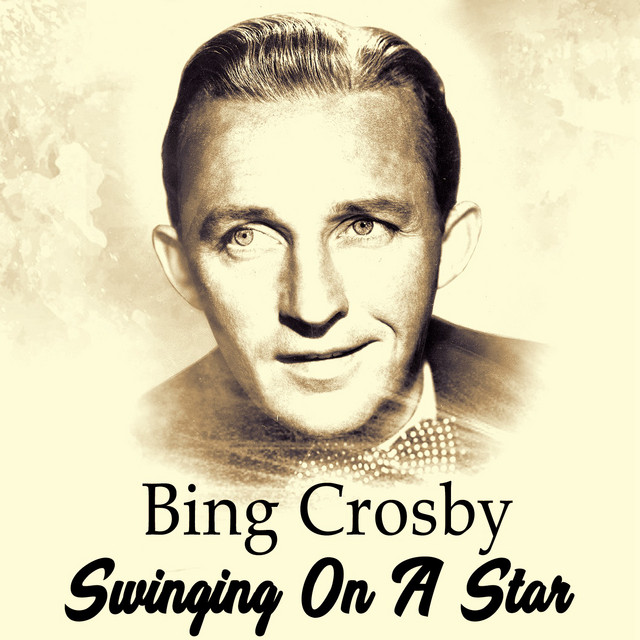
50 years ago: Bing Crosby hits #1 with “Swinging on a Star”

Swinging on a Star

Bing Crosby with the Williams Brothers Quartet & the John Scott Trotter Orchestra

Writer(s): Jimmy Van Heusen (music), Johnny Burke (words) (see lyrics here)


First Charted: May 13, 1944


Peak: 19 US, 1 GA, 2 HP, 14 AU, 14 DF (Click for codes to charts.)


Sales (in millions): 1.0 US


Airplay/Streaming (in millions): -- radio, 1.4 video, -- streaming

Awards:

Click on award for more details.

About the Song:

Composer Jimmy Van Heusen was at Bing Crosby’s house for dinner specifically to discuss plan’s for a song for the impending movie Going My Way, starring Crosby. Bing’s son complained about not wanting to go to school the next day, to which Dad replied, “If you don’t go to school, you might grow up to be a mule. Do you wanna do that?” WK Van Heusen relayed the remark to lyricist Johnny Burke, WK who turned it into the line “By the way if you hate to go to school/ You may grow up to be a mule.”

The movie, which featured Crosby as a young Catholic priest, was one of his best-loved performances. Crosby sings the song a group of children at St. Dominic’s Church TY1 who are behaving much as his own son had the night Van Heusen had come to dinner. WK The tune amusingly became a favorite for young listeners, DJ but had plenty of adult fans as well – it won the Academy Award for Best Song.

Crosby recorded “Swinging on a Star” with the John Scott Trotter Orchestra and the Williams Brothers Quartet, which included 7-year-old Andy Williams, a future singing star himself. PM It became the biggest hit of 1944. CPM Others who’ve recorded the song include Tony Bennett, Rosemary Clooney, Burl Ives, Shari Lewis, Maureen McGovern, Oscar Peterson, and Frank Sinatra. WK

The song resurfaced multiple times in television in film, including a Little Lulu cartoon (1947), a performance from Jimmy Dean and Rowlf the Dog (a muppet) on the Jimmy Dean Show (1967), Sesame Street (Susan with muppets, 1969), and Julie Andrews’ television special My Favorite Things (1975). It became the theme song for the TV series Out of This World (1987) and Bruce Willis and Danny Aiello performed it in the film Hudson Hawk (1991). WK


Resources:


Related Links:


First posted 8/5/2016; last updated 3/31/2023.

Friday, July 1, 1994

50 years ago: Bing Crosby “I’ll Be Seeing You” hit #1

I’ll Be Seeing You

Tommy Dorsey’s Orchestra with Frank Sinatra

Writer(s): Irving Kahal, Sammy Fain (see lyrics here)


First Charted: April 27, 1940


Peak: 4 US, 2 DF (Click for codes to singles charts.)


Sales (in millions): --


Airplay/Streaming (in millions): -- radio, -- video, -- streaming

I’ll Be Seeing You

Bing Crosby with the John Scott Trotter Orchestra


First Charted: April 22, 1944


Peak: 14 US, 12 GA, 110 HP, 14 AU, 2 DF (Click for codes to singles charts.)


Sales (in millions): -- US, -- UK, -- world (includes US + UK)


Airplay/Streaming (in millions): -- radio, -- video, -- streaming

Awards (Bing Crosby):

Click on award for more details.

About the Song:

Tamara Drasin introduced this “torch ballad” TY about a Parisian love affair in the Broadway musical Right This Way in 1938. The show was a failure, closing after a mere 15 performances. WK Like the musical, the song was initially overlooked. Frank Sinatra recorded it with Tommy Dorsey’s orchestra in 1940, but it didn’t take off at the time. SS

In 1944, the song became an inspiration for a film. The movie, named after the song, starred Joseph Cotton and Ginger Rogers as a couple who meet on a train. Both have secrets. She had been convicted of involuntary manslaughter and he was on leave from a military hospital trying to adjust to daily life after suffering from shell shock. WK

By recasting the song as a war anthem, the song was given new meaning through the perspective of “a soldier who saw the image of his beloved in everything around him.” SS In this new context, Bing Crosby, who ruled the music charts and won an Oscar that year for his performance in Going My Way, recorded the song and took it to #1. As Will Friedwald said, “No other singer could so effectively portray so ineffable a sense of absence and loss.” SS It became the go-to song for couples separated by war. MM

At that point, the Dorsey/Sinatra version resurfaced and went to #4. Over the years, Judy Collins, Barry Manilow, Johnny Mathis, Willie Nelson, and Neil Sedaka have also sung it. MM Liberace used it as his closing theme for many years. MM The song was referenced in an episode of The Honeymooners and was used in episodes of TV shows Get Smart, Designing Women, Star Trek: Deep Space Nine, and Beavis and Butt-head. It was also used in the movies Yanks (1979), Crimes and Misdemeanors (1989), Misery (1990), Shining Through (1992), The Aviator (2004), and The Notebook (2004). Doc Severinsen and the NBC Orchestra performed it on the final episode of The Tonight Show Starring Johnny Carson. WK


Resources:

  • DMDB encyclopedia entry for Frank Sinatra
  • DMDB encyclopedia entry for Bing Crosby
  • MM Max Morath (2002). The NPR Curious Listener’s Guide to Popular Standards. New York, NY; Penguin Putnam Inc. Page 166.
  • SS Steve Sullivan (2013). Encyclopedia of Great Popular Song Recordings (Volumes I & II). Scarecrow Press: Lanham, Maryland. Page 604.
  • TY Don Tyler (1985). Hit Parade 1920-1955. New York, NY: Quill. Page 125.
  • WK Wikipedia


Related Links:


First posted 7/1/2016; last updated 7/25/2022.

Saturday, December 4, 1993

Today in Music (1943): Bing Crosby “I’ll Be Home for Christmas” charted

I’ll Be Home for Christmas

Bing Crosby with John Scott Trotter’s Orchestra

Writer(s): Walter Kent (music), Kim Gannon and Buck Ram (words) (see lyrics here)


Released: October 26, 1943


First Charted: December 4, 1943


Peak: 3 PM, 7 GA, 3 HP, 5 DF (Click for codes to charts.)


Sales (in millions): 1.0 US


Airplay/Streaming (in millions): -- radio, 1.6 video, -- streaming

Awards:

Click on award for more details.

About the Song:

“I’ll Be Home for Christmas” originated in 1922 as a poem by Buck Ram. The songwriter would later be known for some of the Platters’ biggest hits, including “Only You” and “The Great Pretender.” He wrote it for his mother while he was a student at the University of Illinois. WK

In 1943, lyricist Kim Gannon and composer Walter Kent turned it into a song. They were acquaintances of Ram’s mother and happened to discuss the poem at a chance meeting at a bar in 1941. WK Gannon and Kent turned it into a song sung from the point of view of a soldier stationed oversees during World War II. He writes a letter to his family, saying he’ll be home for the holidays.

Bing Crosby recorded the song as “I’ll Be Home for Christmas (If Only in My Dreams)” on October 1, 1943, with the John Scott Trotter Orchestra. His version of the “traditional Tin Pan Alley Christmas favorite” TY1 has been the most successful, reaching #3 on the pop charts and selling a million copies. It became the most requested song at Christmas U.S.O. shows. WK The G.I. magazine Yank said Crosby “accomplished more for military morale than anyone else of that era.” WK Surprisingly, the BBC banned the song, fearing it would lower morale amongst British troops. WK

Others to chart with the song include Reba McEntire (1999, #68 CW), Kenny Chesney (2003, #60 CW), Joe Nichols (2005, #56 CW), Sara Evans (2006, #46 CW), Josh Groban (2006, #96 BB, 1 AC), Elvis Presley with Carrie Underwood (2008, #54 CW), Brian McKnight (2008, #14 AC), Rascal Flatts (2008, #34 CW), Michael Bublé (2010, #7 AU), Kelly Clarkson (2011, #93 BB, 7 AC), Megan Trainor (2014, #5 AC), Seth MacFarlane (2014, #28 AC), Kanisha K (2016, #26 AC), Idina Menzel (2019, #24 AC), and Camila Cabello (2021, #71 BB, 24 UK).


Resources:


Related Links:


First posted 12/20/2023.