Showing posts with label Graham Nash. Show all posts

Sunday, March 22, 2026

Crosby Stills Nash Young: Top 100 Songs

Crosby, Stills, Nash & Young

Top 100 Songs

This page celebrates the 100 best works, collectively, from David Crosby, Stephen Stills, Graham, Nash, and Neil Young. Crosby, Stills, & Nash came together as a folk-rock trio in 1969. They were considered a supergroup given their pedegrees in previous groups. Crosby had been in the Byrds (1964-67, 1973, 1990), Stills in Buffalo Springfield (1966-68), and Nash in the Hollies (1962-68, 1981-83). On some of their albums, they were joined by Stills’ Buffalo Springfield bandmate Neil Young. Stills also formed the group Manassas (1971-73).

For a complete list of this act’s DMDB honors, check out the DMDB Music Maker Encyclopedia entry.

Click here to see other acts’ best-of lists.


Spotify Podcast:

Check out the podcast Remembering David Crosby, 1941-2023, based on this list. Debut: January 24, 2023, at 7pm CST. New episodes based on Dave’s Music Database lists are posted every Tuesday at 7pm CST.

Awards (CSN):


Awards (Buffalo Springfield):


Awards (Young):


Top 100 Songs


Dave’s Music Database lists are determined by song’s appearances on best-of lists, appearances on compilations and live albums by the featured act, and songs’ chart success, sales, radio airplay, streaming, and awards. This list includes songs from Crosby, Stills & Nash; Crosby, Still, Nash & Young; Buffalo Springfield (which included Stills and Young as members), and the solo work of David Crosby, Stephen Stills, Graham Nash, and Neil Young.

DMDB Top 1%:

1. For What It’s Worth (Buffalo Springfield, 1966)
2. Heart of Gold (Neil Young, 1972)
3. Suite: Judy Blue Eyes (CSN, 1969)

DMDB Top 2%:

4. Ohio (CSNY, 1970)
5. Rockin’ in the Free World (Young, 1989)
6. Teach Your Children (CSNY, 1970)
7. Cinnamon Girl (Young, 1969)
8. Love the One You’re With (Stills, 1970)
9. Our House (CSNY, 1970)

DMDB Top 5%:

10. Woodstock (CSNY, 1970)

11. Old Man (Young, 1972)
12. Harvest Moon (Young, 1992)
13. Marrakesh Express (CSN, 1969)
14. Southern Cross (CSN, 1982)
15. Southern Man (Young, 1970)
16. My My Hey Hey (Out of the Blue) (Young, 1979)
17. Helplessly Hoping (CSNY, 1969)
18. Mr. Soul (Buffalo Springfield, 1967)
19. Wooden Ships (CSN, 1969)

DMDB Top 10%:

20. The Needle and the Damage Done (Young, 1972)
21. Down by the River (Young, 1969)
22. Expecting to Fly (Buffalo Springfield, 1967)
23. Helpless (CSNY, 1970)
24. Just a Song Before I Go (CSN, 1977)
25. After the Gold Rush (Young, 1970)
26. Like a Hurricane (Young, 1977)
27. Wasted on the Way (CSN, 1982)
28. Only Love Can Break Your Heart (Young, 1970)
29. Cowgirl in the Sand (Young, 1969)
30. Hero (Crosby with Phil Collins, 1993)

31. Cortez the Killer (Young, 1975)

DMDB Top 20%:

32. Carry On (CSNY, 1970)
33. Hey Hey My My (Into the Black) (Young, 1979)
34. Long Time Gone (CSN, 1969)
35. Rock and Roll Woman (Buffalo Springfield, 1967)
36. War Games (CSN, 1983)
37. Bluebird (Buffalo Springfield, 1967)
38. Almost Cut My Hair (CSNY, 1970)
39. Philadelphia (Young, 1994)
40. American Dream (CSNY, 1988)

41. Sugar Mountain (Young, 1968)
42. Are You Ready for the Country? (Young, 1972)
43. Immigration Man (Crosby/Nash, 1972)
44. Got It Made (CSNY, 1988)
45. Broken Arrow (Buffalo Springfield, 1967)
46. Chicago (Nash, 1971)
47. Déjà Vu (CSNY, 1970)
48. Change Partners (Stills, 1971)
49. Carry Me (Crosby/Nash, 1975)
50. Guinnevere (CSN, 1969)

51. Long May You Run (Stills/Young, 1976)
52. Shadow Captain (CSN, 1977)
53. Blackbird (CSNY, 1969)
54. Fair Game (CSN, 1977)
55. You Don’t Have to Cry (CSN, 1969)
56. Dark Star (CSN, 1977)
57. Military Madness (Nash, 1971)
58. Find the Cost of Freedom (CSNY, 1970)
59. Tonight’s the Night (Young, 1973)
60. Southbound Train (Crosby & Nash, 1972)

61. No Tears Left (CSNY, 1999)
62. A Man Needs a Maid (Young, 1972)
63. War of Man (Young, 1992)
64. 4 + 20 (CSNY, 1970)
65. This Note’s for You (Young, 1988)
66. In My Life (CSNY, 1994)
67. Live It Up (CSN, 1990)
68. Powderfinger (Young, 1979)

DMDB Beyond the Top 20%:

69. Turn Back the Pages (Stills, 1975)
70. Music is Love (Crosby, 1971)

71. Drive My Car (Crosby, 1989)
72. Sit Yourself Down (Stills, 1970)
73. Four Strong Winds (Young, 1978)
74. Long Walk Home (Young, 1987)
75. Marianne (Stills, 1971)
76. Everybody Knows This Is Nowhere (Young, 1969)
77. Sit Yourself Down (Stills, 1970)
78. This Old House (CSNY, 1988)
79. When You Dance I Can Really Love (Young, 1970)
80. I Am a Child (Buffalo Springfield, 1968)

81. Southern Pacific (Young, 1981)
82. It Doesn’t Matter (Manassas, 1972)
83. Cathedral (CSN, 1977)
84. Innocent Eyes (Nash, 1986)
85. We Can Change the World (Nash, 1971)
86. War Song (Young/Nash, 1972)
87. Change Your Mind (Young, 1994)
88. Walk On (Young, 1974)
89. Isn’t It About Time (Manassas, 1973)
90. Ten Men Workin’ (Young, 1988)

91. Downtown (Young, 1995)
92. That Girl (CSNY, 1988)
93. Love is a Rose (Young, 1974)
94. Too Much Love to Hide (CSN, 1982)
95. Unknown Legend (Young, 1992)
96. Johnny’s Garden (Manassas, 1972)
97. No More (Young, 1989)
98. On the Way Home (Buffalo Springfield, 1968)
99. Dear Mr. Fantasy (Stills/Nash, 1980)
100. A Child’s Claim to Fame (Buffalo Springfield, 1967)


Resources and Related Links:


Profile Pages:


First posted 1/20/2023; last updated 3/22/2026.

Friday, October 4, 2019

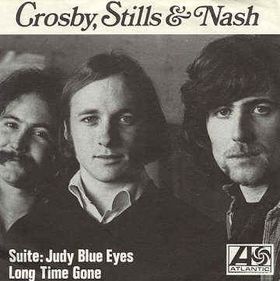
Today in Music (1969): Crosby, Stills & Nash “Suite: Judy Blue Eyes”

Suite: Judy Blue Eyes

Crosby, Stills & Nash

Writer(s): Stephen Stills (see lyrics here)


Released: September 1969


First Charted: October 4, 1969


Peak: 21 US, 15 CB, 18 HR, 1 CL, 11 CN, 50 AU, 2 DF (Click for codes to charts.)


Sales (in millions): --


Airplay/Streaming (in millions): -- radio, 25.50 video, 114.51 streaming

Awards:

Click on award for more details.

About the Song:

David Crosby, Stephen Stills, and Graham Nash already had an impressive pedigree before they united as one force. Crosby had been with the Byrds, Stills with Buffalo Springfield, and Nash in the Hollies. For their new folk-rock trio, they brought “together their prodigious songwriting skills and amazingly complimentary voices” UCR that truly deserved the supergroup label.

The collective reportedly first sang together at – depending on which band member you talk to – either the home of Joni Mitchell or Mama Cass Elliott. They started harmonizing, most likely on “Suite: Judy Blue Eyes,” TM a tune Stills penned about the demise of his relationship with singer Judy Collins. And yes, she does have blue eyes. Collins said that he came to her hotel one night when she was on the West Coast and sang the song for her. She said, “Oh, Stephen, it’s such a beautiful song. But it’s not winning me back.” WK

The title was a play on words referencing the song’s four-part medley. “The roughly three-minute-long first movement could be a self-sufficient pop song in its own right. But it keeps building for close to seven minutes – first to a section of Stills’ vocal solos and finally to the ‘doo doo doo’ coda and tight three-part harmonies that have come to define CSN (and sometimes Y).” TM

“The epic track…came together very quickly, with Stills recording the basic guitar track not long after arriving at the studio.” UCR Engineer Bill Halverson said, “It still gives me goose bumps when I listen to that recording, aware that he blew through seven-and-a-half minutes with all the time changes, all the pauses, all the everything in just one take…No edits, no nothing.’” UCR He “thought he had ruined Stills’ magic by over-brightening the guitar sound, leaving no low end. ‘I had totally overdone the sound, but Stephen was totally into what he was playing,’ Halverson said, ‘and just when it looked like he was going to stop, he started another section and played some more. By now, my whole life was flashing in front of me, and certain that my career was over, I began to sweat.’” UCR “Luckily, Stephen liked what he heard. Millions of fans agreed.” UCR


Resources:


Related Links:


First posted 8/1/2022; last updated 4/25/2024.

Wednesday, May 29, 2019

Today in Music (1969): Crosby, Stills & Nash released their self-titled debut

Crosby, Stills & Nash

Crosby, Stills & Nash


Released: May 29, 1969


Peak: 6 US, 25 UK, 2 CN, 10 AU Click for codes to charts.


Sales (in millions): 4.30 US, 0.10 UK, 4.57 world (includes US and UK), 15.62 EAS


Genre: classic rock/folk rock


Tracks:

Click on a song title for more details.
  1. Suite: Judy Blue Eyes [7:25]
  2. Marrakesh Express [2:39]
  3. Guinnevere [4:40]
  4. You Don’t Have to Cry [2:45]
  5. Pre-Road Downs [3:01]
  6. Wooden Ships [5:29]
  7. Lady of the Island [2:39]
  8. Helplessly Hoping [2:41]
  9. Long Time Gone [4:17]
  10. 49 Bye-Byes [5:16]

Total Running Time: 40:47


Other Songs from This Era:


The Players:

Rating:

4.500 out of 5.00 (average of 24 ratings)


Awards:

(Click on award to learn more).

The Ultimate Supergroup

“Through the 1960s, power in the music industry gradually moved from managers, promoters, producers, and songwriters to the performers themselves. Many followed the Beatles’ example and wrote their own material and by 1968 a small number of musicians were venerated as rock equivalents of the virtuosos of classical music.” TB “If one rock superstar made a band great, the logic ran, surely four superstars would make a group four times greater. Thus was born …the supergroup.” TB

The coming together of David Crosby, Stephen Stills, and Graham Nash (and later Neil Young) wasn’t just any supergroup. They were “hailed by the music press of the day as the ultimate supergroup.” RD “All three were known for their immaculate grasp of close vocal harmonies, their guitar skills, and their ways with a winning folk/pop melody.” RD They were responsible for “introducing the notion of rock musicians as free agents and creating a brief vogue in ‘supergroups.’ They were one of the few American bands that even came close to rivalling the Beatles in the late 1960s.” AB

A Sparkling Resume

March 11, 1970. Crosby, Stills & Nash won the Grammy for Best New Artist – on the same day of the release of their second album, Déjà Vu with Neil Young. They were, however, hardly newbies. They may have had the most impressive resume a Best New Artist could have. Crosby had been a member of the Byrds, Stills was a veteran from Buffalo Springfield, and Nash had been with the Hollies.

“The hippie harmonists initially found their home in the counter-culture: FM-rock radio and the festival circuit,” AB notably performing at the famed Woodstock festival in August 1969. “There is no doubt that Crosby, Stills & Nash’s quiet, heavily acoustic songs provided a welcome for audiences overdosed on hard rock and the incessant political turmoil of the period.” AB

The Debut Album

The trio first sang together at a party in 1969. “Genuinely surprised by how well their voices blended, they got together and recorded” TB their self-titled debut. “Their voices blended together just perfect.” KN They have said they “were meant to sing together.” KN

Nash said, “In our first year together, we spent probably eleven months together, 24 hours a day…with just a couple of guitars [we] would sit people down and say, ‘Listen to this,’ and…rip off these ten songs, do them brilliantly, and floor people…Musically we ate, drank, and slept together every night.” TB

It was “one of the most anticipated rock music debuts of the late 1960s.” AB They matched up to expectations “with aplomb, dishing up a collection of expertly arranged, performed, and produced songs that hinted at a whole world of influences.” RD It was “a sparkling set immortalizing the group’s amazingly close, high harmonies.” AM “The harmonies are absolutely timeless, and the best material remains rock-solid.” AM “A definitive document of its era.” AM

Notes

A 2006 expanded edition added bonus tracks “Do for Others,” “Song with No Words (Tree with No Leaves),” “Everybody’s Talkin’,” and an early version of “Teach Your Children.”

The Songs

Here’s a breakdown of each of the individual songs.

Guinnevere

Crosby, Stills & Nash

Writer(s): David Crosby


Recorded: June 26, 1968


Released: Crosby, Stills & Nash (1969), So Far (compilation, 1974), CSN (box set, 1991), Carry On (compilation, 1991), Greatest Hits (compilation, 2005)


Peak: 15 DF Click for codes to charts.


Sales (in millions): --


Airplay/Streaming (in millions): -- radio, -- video, 12.81 streaming


About the Song:

The album offers “subtler, more introspective joys…in the trancelike, almost soporific Guinevere – the deep vocal lines are spine-chilling.” RD Crosby wrote the song for his girlfriend, Christine, TB who tragically died in a car crash on September 30, 1969.

“David Crosby said, “When all my friends were listening to Elvis and 1950s rock ‘n’ roll, I was listening to Chet Baker, Gerry Mulligan and West Coast jazz. Later I got involved with the folk music scene. After getting kicked out of the Byrds I didn’t have a plan, but I went back to my roots, and ‘Guinnevere’ is a combination of these two influences. This was a demo I cut on borrowed studio time, hoping to land another record contract. Cyrus Faryar from the Modern Folk Quartet played bouzouki; Jack Casady’s bass still gives me chills; it’s like another voice. People ask, ‘Who was Guinnevere?’ Songs are seldom about one person. It’s a love song, an answer to some other love songs, and part of a conversation.” LN

You Don’t Have to Cry

Crosby, Stills & Nash

Writer(s): Stephen Stills

Recorded: December 1968


Released: Crosby, Stills & Nash (1969), CSN (box set, 1991), Carry On (compilation, 1991)


Peak: 23 CL, 26 DF Click for codes to charts.


Sales (in millions): --


Airplay/Streaming (in millions): -- radio, -- video, 15.18 streaming


About the Song:

Stephen Stills said, “It was a letter that never got sent. I took bits and pieces of it, put then into a song and it got posted through the record business instead of the mail.” LN

Lady of the Island

Crosby, Stills & Nash

Writer(s): Graham Nash


Peak: February 11, 1969


Released: Crosby, Stills & Nash (1969), CSN (box set, 1991)


Peak: -- Click for codes to charts.


Sales (in millions): --


Airplay/Streaming (in millions): -- radio, -- video, 4.30 streaming


About the Song:

Nash wrote Lady of the Island about Joni Mitchell. TB Nash, however, said, “It’s a song about two ladies. The Islands in question are Ibiza and Long Island. Warm gentle feelings. Recorded in one take, Crosby and I improvising that niice little fugue in the middle.” LN

Blackbird

Crosby, Stills & Nash

Writer(s): John Lennon, Paul McCartney


Recorded: February 11, 1969


Released: CSN (box set, 1991)


Peak: 14 DF Click for codes to charts.


Sales (in millions): --


Airplay/Streaming (in millions): -- radio, -- video, -- streaming

About the Song:

Graham Nash: “A song by our favorite group. We were staying on Moscow Road in London in 1968, hoping to get onto the Apple Record label. The Beatles were recording The White Album and when we heard McCartney do ‘Blackbird’ we flipped and learned it right away. It was perfect for our three-party harmony.” LN

Wooden Ships

Crosby, Stills & Nash

Writer(s): David Crosby, Stephen Stills, Paul Kanter


Recorded: February 20, 1969


Released: Crosby, Stills & Nash (1969), So Far (compilation, 1974), CSN (box set, 1991), Carry On (compilation, 1991), Greatest Hits (compilation, 2005)


Peak: 5 CL, 9 DF Click for codes to charts.


Sales (in millions): --


Airplay/Streaming (in millions): -- radio, -- video, 33.57 streaming

Awards:

(Click on award to learn more).

About the Song:

Wooden Ships was jointly composed by Crosby and Stills “with a couple of lines of the song written by Paul Kantner” KN of Jefferson Airplane. It is “about two survivors of a nuclear war from opposite sides, meeting by chance on a boat and who plan to start a new civilization together. A real sixties song, to say the least.” KN

While AllMusic.com’s Jason Ankeny said, “the antiwar sentiments of Wooden Ships, though well-intentioned, are rather hokey,” AM the song has also been praised for “evoking the Woodstock Nation-era perfectly.” TB

David Crosby said, “Written in the main cabin of my boat the Mayan. I had the music already. Paul Kanter wrote two verses, Stephen wrote one, and I added the bits at both ends…I borrowed the first part off a little Baptist church sign in Florida that said ‘If you smile at me I will understand, because that is something everybody everywhere does in the same language.’ It’s a weird science fiction story, but one that could happen tomorrow. ‘Silver people on the shoreline’ are guys in radiation suits. We imagined ourselves as the few survivors, escaping on a boat to create a new civilization. Later on, Jackson Browne said, ‘What about all the people who got left behind?,’ and wrote ‘For Everyman’ in response.” LN

Suite: Judy Blue Eyes

Crosby, Stills & Nash

Writer(s): Stephen Stills


Recorded: early 1969


Released: September 1969 (single), Crosby, Stills & Nash (1969), 4 Way Street (live, 1971), So Far (compilation, 1974), CSN (box set, 1991), Carry On (compilation, 1991), Greatest Hits (compilation, 2005)

B-side:Long Time Gone


Peak: 21 BB, 15 CB, 10 GR, 18 HR, 1 CL, 11 CN, 50 AU, 2 DF Click for codes to charts.


Sales (in millions): --


Airplay/Streaming (in millions): -- radio, 25.50 video, 133.66 streaming

Awards:

(Click on award to learn more).

About the Song:

“Stills’ gorgeous opener, Suite: Judy Blue Eyes,” AM is his “paean to Judy Collins.” AB It “is an epic love song remarkable in its musical and emotional intricacy.” AM It “is an almost symphonic work for vocals and guitar, with the occasional Eastern melody and that rollercoaster rush at the end.” RD “The harmonies on this tune couldn't be better.” KN

Stephen Stills said, “It started out as a long narrative poem about my relationship with Judy Collins. It poured out of me over many months and filled several notebooks. I had a hell of a time getting the music to fit. I was left with all these pieces of song and I said, ‘Let’s sing them together and call it a suite,’ because they were all about the same thing and they led up to the same point. And the little kicker at the end about Cuba was just to liven it up because it had gone on forever and I didn’t want it to just fall apart. I said, ‘Now that we’ve sung all these lyrics about one thing, let’s change the subject entirely.’ And we did. Even did it in a different language just to make sure that nobody could understand it.” LN

Marrakesh Express

Crosby, Stills & Nash

Writer(s): Graham Nash


Recorded: early 1969


Released: 7/11/1969 (single), Crosby, Stills & Nash (1969), Replay (compilation, 1980), CSN (box set, 1991), Carry On (compilation, 1991), Greatest Hits (compilation, 2005)

B-side:Helplessly Hoping


Peak: 28 BB, 19 CB, 29 GR, 17 HR, 28 AC, 7 CL, 17 UK, 17 CN, 10 DF Click for codes to charts.


Sales (in millions): --


Airplay/Streaming (in millions): -- radio, -- video, 9.80 streaming

Awards:

(Click on award to learn more).

About the Song:

The “Eastern-influenced musings” AM on “Nash’s incessantly tuneful travelogue” AB “now seem more than a little silly.” AM “The spiraling, upbeat” RD Marrakesh Express is “a happy-go-lucky sounding song…about an actual locomotive trip he took in 1966 between Casablanca and Marrakesh. Nash offered this song to his old group, The Hollies, but they rejected it, saying it wasn’t commercial sounding enough. No wonder he quit that band shortly after.” KN

Graham Nash said, “An actual journey I took in 1966 from Casablanca to Marrakesh, with my first wife Rose. I came back and played it for the Hollies, who rejected it, along with the first ‘Sleep Song.’ After a couple of months of that a man is Liable to go insane, especially being the only one who was smoking grass at the time.” LN

Pre-Road Downs

Crosby, Stills & Nash

Writer(s): Graham Nash


Released: Crosby, Stills & Nash (1969), 4 Way Street (live, 1971), Replay (compilation, 1980)


Peak: -- Click for codes to charts.


Sales (in millions): --


Airplay/Streaming (in millions): -- radio, -- video, 4.49 streaming


About the Song:

“Nash’s Pre-Road Downs is buoyant folk-pop underpinned by light psychedelic textures.” AM

Helplessly Hoping

Crosby, Stills & Nash

Writer(s): Stephen Stills


Released: 7/11/1969 (B-side of “Marrakesh Express”), Crosby, Stills & Nash (1969), So Far (compilation, 1974), CSN (box set, 1991), Carry On (compilation, 1991), Greatest Hits (compilation, 2005)


Peak: 10 CL, 10 DF Click for codes to charts.


Sales (in millions): --


Airplay/Streaming (in millions): -- radio, -- video, 195.78 streaming

Awards:

(Click on award to learn more).


About the Song:

Stephen Stills said, “This song was inspired a long time ago by my tenth-grade English teacher in Tampa, Florida. She was a real knock-out, so much so that she got all the football players to stand up and read poetry, trying to impress her with how sensitive we were and how much we loved this awful stuff. Some of it must’ve rubbed off on me.” LN

Long Time Gone

Crosby, Stills & Nash

Writer(s): David Crosby


Recorded: early 1969


Released: September 1969 (B-side of “Suite: Judy Blue Eyes”), Crosby, Stills & Nash (1969), 4 Way Street (live, 1971), CSN (box set, 1991), Greatest Hits (compilation, 2005)


Peak: 8 CL, 7 DF Click for codes to charts.


Sales (in millions): --


Airplay/Streaming (in millions): -- radio, -- video, 17.87 streaming


About the Song:

“Crosby’s Long Time Gone remains a potent indictment of the assassination of Robert Kennedy.” AM The song features “excellent lead vocals sung by Crosby, but Stills’ playing of several different instruments makes this one extra special.”

David Crosby said, “It was written the night Bobby Kennedy was killed. I believed in him because he said he wanted to make some positive changes in America, and he hadn’t been bought and sold like Johnson and Nixon – cats who made their deals year ago with the special interests in this country in order to gain power. I thought Bobby, like his brother, was a leader who had not made those deals. I was already angry about Jack Kennedy getting killed and it boiled over into this song when they got his brother, too.” LN

49 Bye-Byes

Crosby, Stills & Nash

Writer(s): Stephen Stills


Released: Crosby, Stills & Nash (1969), 4 Way Street (live, 1971), Greatest Hits (compilation, 2005)


Peak: 13 CL Click for codes to charts.


Sales (in millions): --


Airplay/Streaming (in millions): -- radio, -- video, 3.84 streaming

Resources/References:


Related DMDB Pages:


First posted 4/13/2008; last updated 3/21/2026.