Showing posts with label Bye Bye Love. Show all posts

Monday, June 2, 2008

50 years ago: The Everly Brothers achieve a “Dream”: #1 on 4 charts simultaneously

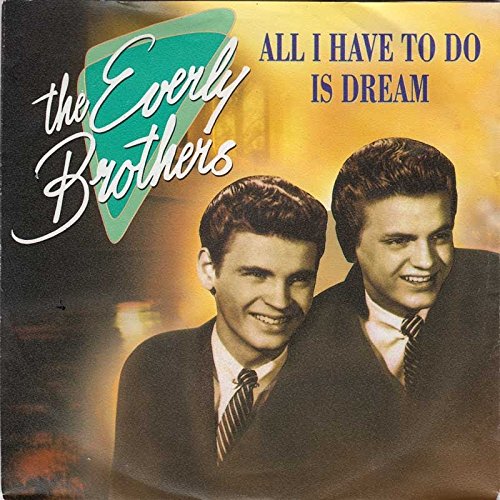
All I Have to Do Is Dream

The Everly Brothers

Writer(s): Felice Bryant, Boudeleaux Bryant (see lyrics here)


First Charted: April 14, 1958


Peak: 15 US, 13 HP, 14 CB, 2 GR, 14 HR, 13 CW, 15 RB, 17 UK, 15 CN, 3 AU, 2 DF (Click for codes to charts.)


Sales (in millions): 1.0 US, -- UK, 1.0 world (includes US + UK)


Airplay/Streaming (in millions): 6.0 radio, 0.43 video, 85.12 streaming

Awards:

Click on award for more details.

About the Song:

The Everly Brothers’ “close-harmony country-rock became an enormous influence on the wave of artists who found fame in the 1960s.” TB Bob Dylan said, “We owe those guys everything. They started it all.” TB Don and Phil Everly, born in 1937 and 1939 respectively, grew up in a musical family. They first performed on their parents’ radio show when they eight and six years old. Don was working as a writer in Nashville in 1954, having crafted songs for Kitty Wells and Justin Tubb. KL When the Everly Brothers tried to launch their own careers, they struck out on their first recording session, but then “Nashville heavyweight” TB Chet Atkins hooked them up with the husband-and-wife writing team of Felice & Boudleaux Bryant, KL who’d written hits for Little Jimmy Dickens, Joe Smith, and Eddy Arnold. FB

Felice met Boudleaux when she was working as an elevator operator in a Milwaukee hotel where he was playing in a jazz band. When she met him, she claims she knew him immediately because she’d dreamed the face of her future husband when she was eight-years old. As such, “All I Have to Do Is Dream” may be closer to their story than any of their other songs. DM It “feels so natural and right in its beautiful hesitations and thoughtful syncopations that it might as well be fated.” DM

The Bryants went on to write the Everlys’ first three big singles – “Bye Bye Love,” “Wake Up Little Susie,” and “All I Have to Do Is Dream.” All three topped the country charts and the latter two topped the pop charts. However, “Dream,” “with Atkins’ innovative tremolo chording backing the brothers’ high-lonesome harmonies,” RS500 also topped the R&B and UK charts, making it the biggest hit of the Everlys’ career. On June 2, 1958, the song became the only record to hit #1 on all four of Billboard’s singles charts simultaneously. WK

Phil Everly recalls first hearing the song “on an acetate and it was just Boudleaux and his guitar. I said, ‘You could put that out and it would be a hit.’” KL “‘It’s just a great, great song. It’s beautiful.’” SF Phil’s sentiments have been echoed in subsequent decades. Richard Chamberlain had a #14 hit with it in 1963. In the ‘70s, Bobbie Gentry & Glen Campbell had a top 40 version of the song and in 1981 Andy Gibb dueted with Victoria Principal for yet another charted version. In the end, though, it is the Everlys who own the “definitive version.” HL Theirs is “so pretty, so evanescent, so – dreamlike” PW that they “don’t sound like two guys. But they don’t sound like one guy, either. They sound…like an angel.” PW


Resources:


Last updated 4/5/2023.

Sunday, May 13, 2007

50 years ago: The Everly Brothers “Bye Bye Love” charted

Bye Bye Love

The Everly Brothers

Writer(s): Boudleaux Bryant, Felice Bryant (see lyrics here)


Released: March 1957


First Charted: May 13, 1957


Peak: 2 US, 3 HP, 11 CB, 11 HR, 17 CW, 5 RB, 6 UK, 2 CN, 14 AU, 2 DF (Click for codes to singles charts.)


Sales (in millions): 1.0 US


Airplay/Streaming (in millions): 3.0 radio, 13.0 video, 40.5 streaming

Awards:

Click on award for more details.

About the Song:

By 1957, rock and roll had become “ a vehicle for the banal contrivances of camera-friendly faces singing songs about teenage romance.” RY The term “rock and roll” had become a catchphrase for corporate-sponsored teen music with a beat.” RY There were exceptions, however. The Everly Brothers were one of the acts that “brought something new and innovative to their music.” RY They were the first to introduce lead-vocal harmony to the genre. RY

The Everlys came from a musical family. Their parents sang country music on the radio and brought the kids up “with the traditional country style of picking and singing.” AC Once Phil and Don Everly graduated from high school, they moved to Nashville and almost immediately were landing gigs in clubs, thanks to their father’s connections.Dad also asked his musician friend Chet Atkins to introduce his boys to Wesley Rose, a publisher, who convinced Archie Blyeyer to sign them to Cadence Records. SS

Meanwhile, the writing team of Boudleaux and Felice Bryant, who married five days after they met, had more than 80 songs and were seeking a publisher. A musician friend suggested they contact Fred Rose, a new publisher in Nashville. They found some success with a few country and pop hits over more than a decade of writing, SS but really hit gold when Cadence Records bought the song “Bye Bye Love” for the Everly Brothers after more than thirty other artists turned the song down. SS

Despite the absence of traditional country instruments such as fiddle or steel guitar, it was “a very country-sounding cut.” AC The Everlys took it to the top of the country charts and #2 on the pop chart. It was the first taste of success for the Everly Brothers, who would go on to have more than thirty more hits. “The unearthly combination of Don and Phil Everly’s voices was so perfect, so pure, that it seemed to emanate from a single source.” RY They also had songs, which – thanks to the Bryants in many cases – were infused “with thoughtful lyrics that spoke to the hearts and minds of teenagers.” RY


Resources:

  • AC Ace Collins (1996). The Stories Behind Country Music’s All-Time Greatest 100 Songs. New York, NY; The Berkley Publishing Group. Pages 111-13.
  • RY Thomas Ryan (1996). American Hit Radio: A History of Popular Singles From 1955 to the Present. Prima Publishing: Rocklin, CA. Pages 19-20.
  • SS Steve Sullivan (2013). Encyclopedia of Great Popular Song Recordings (Volumes I & II). Scarecrow Press: Lanham, Maryland. Pages 690-1.


Related Links:


First posted 8/26/2022.