Showing posts with label Billboard top songs. Show all posts

Friday, December 8, 2006

50 years ago: “Singing the Blues” hit #1 on pop charts for first of 10 weeks

Singing the Blues

Marty Robbins

Writer(s): Melvin Endsley (see lyrics here)


First Charted: September 22, 1956


Peak: 17 US, 17 HP, 113Click for codes to singles charts.)


Sales (in millions): --


Airplay/Streaming (in millions): 2.0 radio, 1.01 video, -- streaming

Singing the Blues

Guy Mitchell


First Charted: October 20, 1956


Peak: 110 US, 17 HP, 19 CB, 18 HR, 13 UK, 16 AU (Click for codes to singles charts.)


Sales (in millions): 1.0 US


Airplay/Streaming (in millions): 2.0 radio, 2.66 video, 1.91 streaming

Awards (Robbins):

Click on award for more details.


Awards (Mitchell):

About the Song:

For a man who became “one of country music’s most unique stars,” AC Marty Robbins surprisingly didn’t show much interest in music until after entering the Navy. He started learning guitar while on a ship in the Pacific and when he got home to Phoenix, Airzona, he persuaded an old friend who owned a night club to let him sit in with the house band. After getting a chance to sing, he became a regular headliner at the club. He started charting country hits in 1952, but four years later he had only six chart entries. He had a “tremendous voice and boundless energy” AC but “didn’t know who he wanted to be” AC which kept him from narrowing in a specific direction or style.

Around this time, songwriter Melvin Endsley had dreams of coming to Nashville and writing hits for Hank Williams. After Williams’ death, Endlsey said, “In all honesty, I still was writing songs for him after he died.” AC When he and a friend drove to Nashville in the summer of 1955, he naively dreamed of hitting it big, not realizing “that a country boy just didn’t drive into town, sell a big song and become a star. That only happened in the movies.” AC

However, Endsley and his friend went to a show and ran into Marty Robbins. Ensley said he’d written some songs and Robbins asked him to play some. He then asked him to come to the studio the next day to record. Robbins asked him to hold one song – “Singing the Blues” – for six months because he thought he might like to record it. A year later, Robbins released it as a single and it dethroned Elvis Presley’s “Hound Dog”/”Don’t Be Cruel” single from the top of the country charts.

Two months after that, a Detroit-born singer named Guy Mitchell covered the song and took it to #1 on the pop charts. He racked up nine top-ten hits from 1950 to 1960, including “Heartaches by the Number,” another #1 version of a song which was originally a country hit. Around the same time as Robbins and Mitchell’s takes on the song, Tommy Steele also released it and – like Robbins’ version – hit #1 in the UK.


Resources:

  • DMDB encyclopedia entry for Guy Mitchell
  • DMDB encyclopedia entry for Marty Robbins
  • AC Ace Collins (1996). The Stories Behind Country Music’s All-Time Greatest 100 Songs. New York, NY; The Berkley Publishing Group. Pages 97-99.
  • WK Wikipedia


First posted 8/27/2022.

Saturday, November 26, 2005

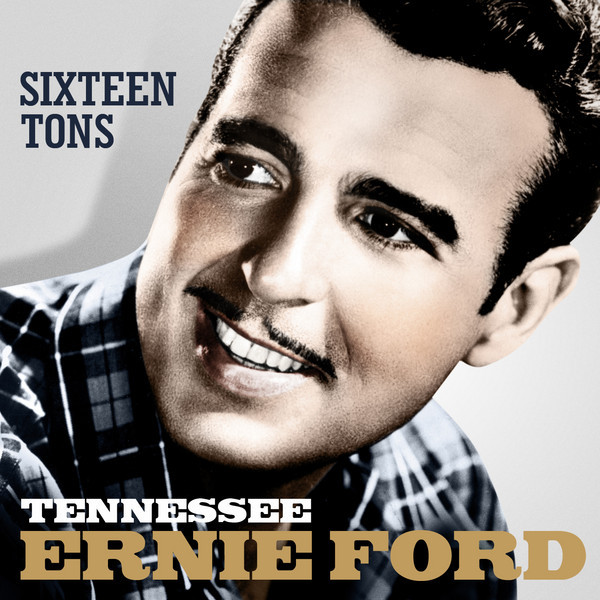
50 years ago: Tennessee Ernie Ford “Sixteen Tons” hit #1 on the pop charts

Sixteen Tons

Tennessee Ernie Ford

Writer(s): Merle Travis (see lyrics here)


Released: October 17, 1955


First Charted: October 24, 1955


Peak: 18 US, 15HP, 17 CB, 17 HR, 110 CW, 14 UK, 16 AU, 6 DF (Click for codes to singles charts.)


Sales (in millions): 2.0 US


Airplay/Streaming (in millions): 3.0 radio, 12.8 video, 45.0 streaming

Awards:

Click on award for more details.

About the Song:

Merle Travis was born in Rosewood, Kentucky, as the son of a mine worker in coal country. He was able to get out of that life by forming a band and playing music, even while serving in the marines. By 1946, he was recording for Capitol Records. His biggest hit was “Divorce Me C.O.D.,” which spent 14 weeks atop the country charts.

A&R man Cliffie Stone thought Travis had pop potential and encouraged him to write original folk ballads instead of modern versions of old folk songs. Travis wrote several “working-type songs” AC but told Stone “these songs are nothing more than a lot of junk.” AC

In 1949, Stone signed “Tennessee” Ernie Ford to a record deal. He achieved major crossover success with “Sixteen Tons,” a song about a Kentucky coal miner which came Merle’s “junk” pool. The chorus was based on a letter from his brother John, a coal miner, who wrote, “You load 16 tons and what do you get? Another day older and deeper in debt.” SS Merle also remembered his father, Rob, saying, “I can’t afford to die. I owe my soul to the company store.” SS The lines made it into the song, which Travis said “wasn’t really written to be serious,” noting “no man could load a ton of coal in a day” and mocking his own line, “Who could pick up a shovel the day they were born?” AC

However, while millions of listeners had never been anywhere close to a coal mine, they could feel “ a miner’s pain and frustrations.” AC The song “also began to reveal the power of country music to effect social change.” AC The song also brought attention to how coal companies had taken advantage of their workers and brought light to issues such as black lung disease and unsafe working conditions.


Resources:

  • DMDB encyclopedia entry for Tennessee Ernie Ford
  • AC Ace Collins (1996). The Stories Behind Country Music’s All-Time Greatest 100 Songs. New York, NY; The Berkley Publishing Group. Pages 91-3.
  • SS Steve Sullivan (2013). Encyclopedia of Great Popular Song Recordings (Volumes I & II). Scarecrow Press: Lanham, Maryland. Pages 78-80.
  • WK Wikipedia


First posted 8/26/2022.

Saturday, May 15, 1982

Paul McCartney and Stevie Wonder hit #1 with “Ebony and Ivory”

Ebony and Ivory

Paul McCartney & Stevie Wonder

Writer(s): Paul McCartney (see lyrics here)


Released: March 29, 1982


Peak: 17 US, 16 CB, 16 GR, 40 HR, 14 RR, 15 AC, 8 RB, 34 AR, 13 UK, 15 CN, 2 AU, 2 DF (Click for codes to singles charts.)


Sales (in millions): 1.0 US, -- UK, 3.56 world (includes US + UK)


Airplay/Streaming (in millions): -- radio, 14.48 video, -- streaming

Awards:

Click on award for more details.

About the Song:

Paul McCartney explained that he got the idea for “Ebony and Ivory” from English comedian Spike Milligan. He saw him on a TV show playing a piano where the keys were segregated, demonstrating how one couldn’t work without the other. SF Paul wrote the song after a fight with his wife Linda, saying, “Why can’t we get it together – our piano can.” SF It took on the greater message of racial harmony with Paul’s acknowledgment that “you can play using just the black notes, or you can play using just the white notes, but combining them gives you great notes. That, I suppose, is a great analogy.” FB

While recording the song, Paul thought it would be a good idea to record it as a duet with Stevie Wonder. When Stevie heard the song, he said “I liked it very much…I liked what it was talking about…I felt like it was positive for everyone.” FB They got together on the island of Montserrat in the West Indies to record the song together, but were not together to film the video. Through the magic of editing, however, they appeared to be performing side by side on the keys of a giant piano. FB

“Ebony and Ivory” marked the first time McCartney had released a duet with another major artist. WK It proved to be a good move. The song debuted at an impressive #29 on the Billboard Hot 100 and reached the top five weeks later. The song wasn’t just the biggest chart-topper of McCartney’s solo career, but for any of the ex-Beatles. It was also the biggest #1 for Stevie Wonder.

While the song proved to be a hit of the moment, it didn’t hold up for fans in the long run. It “was often mocked as superficial and maudlin.” SF Critics considered “its message as overly simplistic and sentimental.” WK Blender magazine ranked it as the 10th worst song of all time in 2004. SF In 2007, BBC 6 Music listeners named it the worst duet ever. SF


Resources:

  • DMDB encyclopedia entry for Paul McCartney
  • DMDB encyclopedia entry for Stevie Wonder
  • FB Fred Bronson (2003). The Billboard Book of Number One Hits (5th edition). Billboard Books: New York, NY. Page 555.
  • SF Songfacts
  • WK Wikipedia


First posted 11/8/2020; last updated 12/26/2022.

Saturday, April 13, 1974

Elton John hit #1 with “Bennie and the Jets”

Bennie and the Jets

Elton John

Writer(s): Elton John (music), Bernie Taupin (lyrics) (see lyrics here)


Released: February 4, 1974


First Charted: February 16, 1974


Peak: 11 US, 11 CB, 11 HR, 13 RR, 15 RB, 1 CL, 37 UK, 12 CN, 5 AU (Click for codes to singles charts.)


Sales (in millions): 2.8 US, 0.25 UK, 3.05 world (includes US + UK)


Airplay/Streaming (in millions): 3.0 radio, 55.08 video, 238.03 streaming

Awards:

Click on award for more details.

About the Song:

Elton John established himself as the most successful act of the 1970s on the strength of hits like “Bennie and the Jets” and five other #1’s that decade. This, however, was his first of only a handful of forays onto the R&B chart, where it reached #15. He was thrilled with the accomplishment, saying “Even if it doesn’t get any higher than 34 I’m gonna stick it up and frame it.” FB He knew, though, that it wasn’t his primary audience. He told Rolling Stone, “What am I going to do on my next American tour? Play the Apollo for a week, open with ‘Bennie’ then say, ‘Thanks, you can all go home now.’” FB It did, however, land him an appearance on Soul Train. WK

In the United States, the song was the third single from Elton John’s Goodbye Yellow Brick Road, following “Saturday Night’s Alright for Fighting” and the title cut. In most other territories, “Candle in the Wind” was released as the third single with “Bennie” (spelled “Benny”) as the B-side. WK Elton didn’t want to release “Bennie” as a single because he was sure it would fail. However, a radio station in Ontario started playing it and then it became the #1 song in the Detroit market. WK The record company decided it would make for the better A-side in America and slated “Candle” as the flip side. FB

The song was sort of an homage to the factionary band of the Beatles’ Sgt. Pepper’s Lonely Hearts Club Band and the glam rock of David Bowie’s Ziggy Stardust persona. Elton described Bennie as “a sci-fi rock goddess” SF and lyricist Bernie Taupin said Bennie and the Jets “were supposed to be a prototypical female rock ‘n’ roll band out of science fiction.” SF He explained that he “had this wacky science fiction idea about a futuristic rock and roll band of androids fronted by some androgynous kind of Helmut Newton style beauty.” SF He said that Robert Palmer’s video for “Addicted to Love” portrayed how he saw the band: “a dapper frontman backed by robotic models.” SF

Taupin also said the song, told from the standpoint of a fan, was a satire on the music industry and its greed and glitz. WK Also of note – the song integrates live sound effects from a show Elton played at Royal Festival Hall in 1972 and a falsetto where Elton tries to sound like Frankie Valli of the Four Seasons. SF


Resources:

  • DMDB encyclopedia entry for Elton John
  • FB Fred Bronson (2003). The Billboard Book of Number One Hits (5th edition). Billboard Books: New York, NY. Page 362.
  • SF Songfacts
  • WK Wikipedia


Related Links:


First posted 4/12/2021; last updated 7/23/2022.