Tuesday, March 17, 1998

Bruce Springsteen covers "We Shall Overcome"

6/8/1963: Pete Seeger “We Shall Overcome” recorded

We Shall Overcome

Pete Seeger

Writer(s): Charles Albert Tindley (see lyrics here)


Recorded: June 8, 1963


First Charted: --


Peak: -- (Click for codes to singles charts.)


Sales (in millions): --


Airplay/Streaming (in millions): -- radio, 4.1 video, 1.2 streaming

Awards:

Click on award for more details.

We Shall Overcome

Joan Baez


First Charted: November 9, 1963


Peak: 90 US, 28 UK (Click for codes to singles charts.)


Sales (in millions): --


Airplay/Streaming (in millions): -- radio, 6.1 video, -- streaming

Awards:

Click on award for more details.

cover of We Shall Overcome album

We Shall Overcome

Bruce Springsteen


Released: March 17, 1998 (cut on Where Have All the Flowers Gone tribute album


First Charted: --


Peak: 1 DF (Click for codes to singles charts.)


Sales (in millions): --


Airplay/Streaming (in millions): -- radio, 1.12 video, -- streaming

Awards:

Click on award for more details.

About the Song:

“We Shall Overcome” dates back to 1901 when Charles Albert Tindley published a hymn called “I’ll Overcome Some Day.” WK He was a noted minister of the Methodist Episcopal Church, authoring roughly 50 gospel hymns. The songs were rooted in African American folk traditions, frequently featuring short refrains which allowed the congregration to join in. His audiences were comprised of many former slaves who were often impoverished and illiterate. WK

The music is said to date back to “No More Auction Block for Me,” an 1833 song sung by former slaves in Canada after Britain abolished slavery. WK Bob Dylan said he used the same melodic motif from “Auction Block” in composing his own classic protest song, “Blowin’ in the Wind.” WK

The modern version of the song is thought to have emerged in 1945 when Lucille Simmons led tobacco workers in singing the song during a cigar workers strike in Charleston, South Carolina. WK It was published in 1947 under the title “We Will Overcome” in an edition of the People’s Songs Bulletin, a publication of People’s Songs, an organization directed by Pete Seeger. WK That version was contributed by Zilphia Horton, the music director of Highlander Folk School, an adult education school in Monteagle, Tennessee that trained union organizers. She learned the song from Simmons and taught it to many others, including Pete Seeger. WK

Martin Luther King, Jr. saw Seeger perform the song in 1957 and remarked how the song stuck with him. WK He recited words from the song in his final sermon before his assassination in 1968. It was sung at his funeral. WK When Guy Carawan became the music direction of Highlander in 1959, his version became associated with the civil rights movement. Seeger and others, such as Joan Baez, sang the song at rallies, festivals, and concerts. WK

Ivan Cooper, a member of the Parliament of Northern Ireland, is shown singing the song in the film Bloody Sunday shortly before British soldiers shot 26 unarmed civilians during a 1972 civil rights protest march. WK Hundreds of thousands of Czechs sang the song in 1989 in Prague during the Velvet Revolution. Roger Waters covered the song in 2010 as a protest against the Israeli blockade of Gaza. WK

Bruce Springsteen covered the song for the 1998 tribute album Where Have All the Flowers Gone: The Songs of Pete Seeger and again in 2006 for an album of songs inspired by Seeger, We Shall Overcome: The Seeger Sessions. He performed the song in 2012 during a memorial concert for Norwegians killed in terrorist attacks the year before. WK


Resources:


Related Links:


First posted 9/23/2022.

Monday, March 16, 1998

Simple Minds’ Neapolis released

First posted 10/10/2020.

Neapolis

Simple Minds


Released: March 16, 1998


Peak: -- US, 19 UK, -- CN, -- AU


Sales (in millions): -- US, -- UK, -- world (includes US and UK)


Genre: alternative rock


Tracks:

Song Title (date of single release, chart peaks) Click for codes to singles charts.

  1. Song for the Tribes
  2. Glitterball (3/14/98, 18 UK)
  3. War Babies (5/30/98, 43 UK)
  4. Tears of a Guy
  5. Superman v. Supersoul
  6. Lightning
  7. If I Had Wings
  8. Killing Andy Warhol
  9. Androgyny


Total Running Time: 45:00


The Players:

  • Jim Kerr (vocals)
  • Charlie Burchill (guitars, keyboards)
  • Derek Forbes (bass)
  • Mel Gaynor (drums)

Rating:

3.195 out of 5.00 (average of 6 ratings)


Awards:

About the Album:

After Virgin Records released them from their contract, Simple Minds decided to reinvent themselves yet again. Since 1991, original members Jim Kerr and Charlie Burchill had essentially recorded as a duio with session musicians. Prior to this album, they reunited with original members Derek Forbes and Brian McGee. McGee’s involvement didn’t go past the rehearsal stage, but Forbes was reinstated as an official member. They also brought back Mel Gaynor, who’d first started working with the band in 1982.

The move meant a return to the more new wave sound of their early ‘80s work instead of the more arena-rock sound they’d crafted since then. One would have thought such a reunion would have revived the band’s fortunes and garnered more attention. However, the album failed to chart in the U.S. when the band’s new label, Chrysalis, opted not to release the album there. WK In the UK it peaked at #19, a long way from the band’s previous six albums which had all peaked in the top 3.

Two singles were released from the album. Glitterball reached the top 20 in the UK while War Babies fell just short of the top 40. The band toured to support the album, but health problems and contractual fiascos dogged the tour. WK After the tour, the band parted with Chrysalis Records and dropped Gaynor and Forbes from the band yet again.


Notes: The Japanese edition also included remixes of “Don’t You Forget About Me” and “Waterfront” as bonus tracks.

Resources and Related Links:

Tuesday, March 3, 1998

Prince Crystal Ball box set

Crystal Ball

Prince


Released: March 3, 1998


Peak: 62 US, 91 RB, --UK, -- CN, -- AU Click for codes to charts.


Sales (in millions): 0.13 US, -- UK, 0.3 world (includes US and UK)


Genre: R&B/funk/pop


Tracks, Disc 1:

  1. Crystal Ball
  2. Dream Factory
  3. Acknowledge Me
  4. Ripopgozazippa
  5. Love Sign (Shock G’s Silky Remix)
  6. Hide the Bone
  7. 2morrow
  8. So Dark
  9. Movie Star
  10. Tell Me How U Wanna Be Done

Tracks, Disc 2:

  1. Interactive
  2. Da Bang
  3. Calhoun Square
  4. What’s My Name
  5. Crucial
  6. An Honest Man
  7. Sexual Suicide
  8. Cloreen Bacon Skin
  9. Good Love
  10. Strays of the World

Tracks, Disc 3:

  1. Days of Wild (live)
  2. Last Heart
  3. Poom Poom
  4. She Gave Her Angels
  5. 18 & Over
  6. The Ride (live)
  7. Get Loose
  8. P Control (remix)
  9. Make Your Mama Happy
  10. Goodbye
Click on individual song titles for more details, including songwriters, recording and release dates, chart peaks, versions recorded by other artists, and basic information aobout the song.

Total Running Time: 2:29:27


Other Songs from This Era:

Rating:

3.081 out of 5.00 (average of 13 ratings)

About the Album

IMHO, this is when Prince lost the plot. When it comes to artist vs. record company battles, it’s pretty hard to side against the artist, but in 1998 Prince seemed to be trying as hard as possible to show exactly why record companies have value.

Prince signed to Warner Bros. in 1977 when he was 18 years old. There were some growing pains, but by the mid-‘80s, it was clear they’d landed a superstar. Prince reached the top ten on the Billboard Hot 100 in 1983 with “Little Red Corvette” and “Delirious” from his top-ten, four-times platinum album 1999. The follow-up, 1984’s Purple Rain, spent 24 weeks at #1 and sold 26 million copies worldwide.

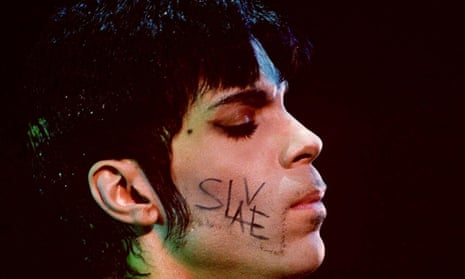
This gave Prince leverage to set up his own label, Paisley Park. From 1985 to 1992, he released eight albums in partnership with Warner. Then the battle began. Despite being signed to a $100 million contract, Prince publicly claimed it was the equivalent of forced servitude because he didn’t own the master recordings or have creative control. He infamously took to appearing in public with “Slave” scrawled on his face.

photograph by Brian Rasic/Rex Features as posted at TheGuardian.com

Prince also changed his name to an unpronounceable symbol () under the argument that the record company owned the name “Prince.” Considering the symbol he’d adopted as his new moniker was unpronounceable, the press – at a loss as to how to refer to him – took to calling him “the Artist Formerly Known as Prince.”

image from NPG Records as posted at Variety.com

Despite the very public split, Prince still owed Warner Bros. several albums. This resulted in several archival releases, including 1993’s The Hits/The B-sides, 1994’s Come, 1994’s The Black Album (which had originally been slated for release in 1987), 1995’s The Gold Experience, and 1996’s Chaos and Disorder.

The Gold Experience was actually jointly released by Warner and Prince’s newly formed label, NPG (New Power Generation), which he formed to replace Paisley Park. The first full-fledged release with NPG came in 1996 with Emancipation. Right out of the gate, Prince was testing his audience. Double albums are typically viewed as sprawling, over-the-top affairs that could be whittled down to one solid album instead. However, he’d had both commercial success and critical acclaim with 1987’s Sign ‘O’ the Times so maybe another multi-disc set could fly.

Of course, this was more than a two-album set. It was a three disc collection. However, it seemed his faithful were still on board as the album reached #11 on the Billboard Hot 100 and was certified as double platinum.

It’s then, however, pushed his audience’s loyalty a step too far. One could forgive the excess of Prince celebrating his newfound freedom with a bloated multi-disc collection. But would they go for two such projects back-to-back? The answer was “NO.”

1998’s Crystal Ball was a FIVE-disc set upon its initial release. The Truth was an album of new material by Prince and Kamasutra was recorded by Prince with the NPG Orchestra. Both have since been made available as individual albums. The other three discs were a dip into the archives from 1983 to 1996. The artist who so publicly lashed out at his former record company for taking advantage of him was now arguably taking advantage of his audience.

To be fair, it’s hard to argue against any artist having the right to own his or her own material and maintaining creative control over the work they create. Certainly record companies have a long history of taking advantage of their signees, whether they be superstars or new artists with no clout. However, Prince’s obliviousness or outright apathy toward his audience and their budgetary constraints made it hard not to see him as an out-of-touch artist obsessed with only creating the art and not considering how it might be consumed by its patrons.

The Songs

Here are insights into some of the individual tracks. They are presented in order of when they were released instead of the album’s track listing. The songs “Sexual Suicide,“ “Dream Factory,“ “Last Heart,“ “Movie Star,“ “Crystal Ball,” “Crucial,” and “Good Love” are not featured on this page but on the page for the aborted albums Dream Factory, Camille, and Crystal Ball. Here’s a breakdown of each of the individual songs. They are presented chronologically based on when they were originally recorded.

Cloreen Bacon Skin

Prince

Writer(s): Prince


Recorded: 3/27/1983 at Sunset Sound in Los Angeles


Released: Crystal Ball (box set, 1998)

An Honest Man

Prince

Writer(s): Prince


Recorded: 12/17/1985 at Sunset Sound in Los Angeles


Released: Crystal Ball (box set, 1998)

Make Your Mama Happy

Prince

Writer(s): Prince


Recorded: August 7-8, 1986 at Galpin Boulevard Home Studio in Chanhassen, MN


Released: Crystal Ball (box set, 1998)

Tell Me How U Wanna B Done

Prince

Writer(s): Prince


Recorded: January 1992 at Paisley Park in Chanhassen, MN


Released: Crystal Ball (box set, 1998)

What’s My Name

Prince

Writer(s): Prince


Recorded: May 1993 at Paisley Park in Chanhassen, MN


Released: Crystal Ball (box set, 1998)

Strays of the World

Prince

Writer(s): Prince


Recorded: May 1993 at Paisley Park in Chanhassen, MN


Released: Crystal Ball (box set, 1998)

Calhoun Square

Prince

Writer(s): Prince


Recorded: 6/15/1993 at Paisley Park in Chanhassen, MN


Released: Crystal Ball (box set, 1998)

Interactive

Prince

Writer(s): Prince


Recorded: June 1993 at Paisley Park in Chanhassen, MN


Released: Crystal Ball (box set, 1998)

Acknowledge Me

Prince

Writer(s): Prince


Recorded: October 1993 at Paisley Park in Chanhassen, MN


Released: Crystal Ball (box set, 1998)

Ripopgozazippa

Prince

Writer(s): Prince


Recorded: October 1993 at Paisley Park in Chanhassen, MN


Released: Crystal Ball (box set, 1998)

Love Sign

Prince & Nona Gaye

Writer(s): Prince


Recorded: January 1994 at Paisley Park in Chanassen, MN; 1994 at the Record Plant in Sausalito, CA


Released: 1-800-NEW-FUNK (1994), Shock G’s Silky Remix: Crystal Ball (box set, 1998)

P. Control

Prince

Writer(s): Prince


Recorded: 7/25/1994 at Paisley Park in Chanhassen, MN


Released: Crystal Ball (box set, 1998), Anthology: 1995-2010 (2018)

So Dark

Prince

Writer(s): Prince


Recorded: 1/2/1993 and 1994 at Paisley Park in Chanhassen, MN


Released: Crystal Ball (box set, 1998)

18 & Over

Prince

Writer(s): Prince


Recorded: 1994 at Paisley Park in Chanhassen, MN


Released: Crystal Ball (box set, 1998)

Get Loose

Prince

Writer(s): Prince


Recorded: February 1993 and 1994 at Paisley Park in Chanhassen, MN


Released: Crystal Ball (box set, 1998)

The Ride (live)

Prince

Writer(s): Prince


Recorded: 10/29/1995 at Paisley Park in Chanhassen, MN


Released: Crystal Ball (box set, 1998)

Hide the Bone

Prince

Writer(s): Prince


Recorded: November 1993 at Studios Davout in Paris; 1994-95 at Paisley Park in Chanhassen, MN


Released: Crystal Ball (box set, 1998)

Da Bang

Prince

Writer(s): Prince


Recorded: 1995 at Larrabee Sound Studios in Los Angeles


Released: Crystal Ball (box set, 1998)

Poom Poom

Prince

Writer(s): Prince


Recorded: 1995 at Paisley Park in Chanhassen, MN


Released: Crystal Ball (box set, 1998)

Goodbye

Prince

Writer(s): Prince


Recorded: December 1991, 1995 at Paisley Park in Chanhassen, MN; December 1994 at Ocean Way Recording in Los Angeles


Released: Crystal Ball (box set, 1998)

Days of Wild (live)

Prince

Writer(s): Prince


Recorded: 12/9/1995 live at Paisley Park in Chanhassen, MN; overdubs 1995-96


Released: Crystal Ball (box set, 1998), 6/27/2002 as a single

2morrow

Prince

Writer(s): Prince


Recorded: November 1996 at Paisley Park in Chanhassen, MN


Released: Crystal Ball (box set, 1998)

She Gave Her Angels

Prince

Writer(s): Prince


Recorded: 1996 at Paisley Park in Chanhassen, MN


Released: Crystal Ball (box set, 1998)

Notes:

--

Resources/References:

  • AM AllMusic.com review
  • BC Benoit Clerc (2022). Prince: All the Songs – The Story Behind Every Track. Octopus Publishing Group Ltd.: Great Britain
  • PV PrinceVault.com
  • WK Wikipedia


Related DMDB Pages:


First posted 7/27/2025; last updated 7/28/2025.