


 | Blowin’ in the WindBob Dylan |
Writer(s): Bob Dylan (see lyrics here) First Recorded: July 9, 1962 Released (album cut): May 27, 1963 Released (single): August 13, 1963 Peak: 1 CL, 1 DF (Click for codes to charts.) Sales (in millions): -- US, 0.2 UK Airplay/Streaming (in millions): -- radio, 55.5 video, 202.40 streaming |
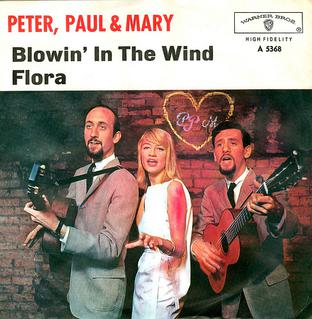 | Blowin’ in the WindPeter, Paul & Mary |
First Charted: June 29, 1963 Peak: 2 US, 2 CB, 2 HR, 15 AC, 13 UK, 25 CN, 11 AU, 6 DF (Click for codes to charts.) Sales (in millions): 1.0 US Airplay/Streaming (in millions): -- radio, 32.9 video, 28.33 streaming |
 | Blowin’ in the WindStevie Wonder |
First Charted: July 16, 1966 Peak: 9 US, 11 CB, 11 RB, 36 UK, 12 CN, 4 DF (Click for codes to charts.) Sales (in millions): -- Airplay/Streaming (in millions): -- radio, 2.1 video, 1.24 streaming |
Awards (Bob Dylan):Click on award for more details. 


Awards (Peter, Paul & Mary):Click on award for more details. 


Awards (Stevie Wonder):Click on award for more details. 
|
About the Song:Robert Allen Zimmerman, aka Bob Dylan, was signed to Columbia Records and released his self-titled debut album in 1962. It “didn’t sell, critics couldn’t stand his voice and he was regarded…as [producer John] Hammond’s folly.” HL However, the follow-up, The Freewheelin’ Bob Dylan, produced “five songs that have become standards of one sort or another – ‘Girl from the North Country’…’A Hard Rain’s A-Gonna Fall,’ ‘Masters of War,’ ‘Don’t Think Twice, It’s All Right,’ and ‘Blowin’ in the Wind.’” HL Rolling Stone not only said “Blowin’ in the Wind” was “Dylan’s first important composition” RS500 but “the most famous protest song ever written.” RS500 In his Encyclopedia of Great Popular Song Recordings, Steve Sullivan calls it “the defining song of folk music’s alliance with the civil rights movement.” SS “While the perspective of passing decades has not been uniformly kind to other social protest songs of its era, the stature of ‘Blowin’ in the Wind’ has not diminished one iota. The questions it poses are eternal and the eloquence with which it presents them remains powerful.” SS “It’s a plea for people to open their eyes and ears to injustice in the world.” SS In Martin Scorsese’s Dylan documentary No Direction Home, Mavis Staples said she was astonished upon first hearing the song that a young white man could write something that so successfully captured the frustration of black people. WK Sam Cooke was inspired by the song to write “A Change Is Gonna Come,” another song strongly associated with the civil rights movement. WK The melody is adapted from the slavery-era, African-American spiritual “No More Auction Block.” WK In The Folk Songs of North America, Alan Lomax exerts that “the song was sung by former slaves who fled to Nova Scotia after Britain abolished slavery in 1833.” WK The “language is rooted as much in Woody Guthrie’s earthy vernacular as in biblical rhetoric. But in a decisive break with the current-events conventions of topical folk songs, Dylan framed the crises around him in a series of fierce, poetic questions that addressed what he believed was man’s greatest inhumanity to man: indifference. ‘Some of the biggest criminals are those that turn their heads away when they see wrong,’ he declared in the Freewheelin’ liner notes.” RS500 The song “introduced most of America to the man whose song-poetry would change the shape of popular music.” SS Critic Andy Gill said, “It remains the song with which Dylan’s name is most inextricably linked.” WK However, it was the folk trio Peter, Paul & Mary who first popularized the song. Before Dylan had even released the song, he performed it in Greenwich Village with Peter, Paul & Mary in the audience. They loved it and arranged to record it. SS They were “an act that could put folk music into the pop charts.” TC They helped Dylan gain recognition as a songwriter and effectively “put protest music into every home in the western world.” TC A rumor circulated in 1963 that “Blowin’ in the Wind” was actually written by Lorre Wyatt, a high school student from Milburn, New Jersey. Dylan recorded the song on July 9, 1962, but didn’t publish it until three weeks later. SJ Because this is highly unusual, it is suggested that Dylan learned the song from Wyatt, recorded it, and then took credit for it after finding out Wyatt hadn’t published it. Supposedly Dylan bought it for $1000. Wyatt himself, however, denies writing the song. SJ In addition, the song appears to have actually been publiedh by Dylan in May 1962 in Broadside, a magazine founded by Pete Seeger about topical songs. WK It has also been recorded by Joan Baez, Johnny Cash, Sam Cooke, Bobby Darin, Marianne Faithfull, the Four Seasons, the Hooters, Etta James, Ziggy Marley, the Chad Mitchell Trio, Elvis Presley, the Supremes, U2, Stevie Wonder, and Neil Young.
Resources:
Related Links:


First posted 8/24/2022; last updated 5/23/2024. |


