Saturday, September 29, 1973

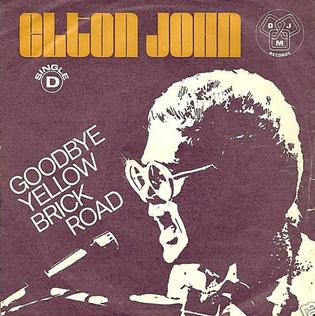
Elton John charted with “Goodbye Yellow Brick Road”

Goodbye Yellow Brick Road

Elton John

Writer(s): Elton John (music), Bernie Taupin (lyrics) (see lyrics here)


Released: September 7, 1973


First Charted: September 29, 1973


Peak: 2 BB, 11 CB, 11 GR, 11 HR, 13 RR, 7 AC, 1 CL, 6 UK, 11 CN, 4 AU, 6 DF (Click for codes to charts.)


Sales (in millions): 2.0 US, 0.2 UK, 2.2 world (includes US + UK)


Airplay/Streaming (in millions): 4.0 radio, 50.73 video, 324.4 streaming

Awards:

Click on award for more details.

About the Song:

The title cut for Elton John’s seventh album, Goodbye Yellow Brick Road, was released as the second single after “Saturday Night’s Alright for Fighting.” While “Saturday” peaked at #12, “Road” went to #2 on the Billboard Hot 100 and topped the charts on three of the other major pop charts in America at the time.

The song was a top singles pick in the October 20, 1973 issue of Billboard which said, “Elton returns to a medium tempo for his large, round sounding production of a man returning to a simple life. At times it’s hard to understand Elton, but the sonic impression is still strong and haunting. The blending of voices with strings on the bridges is beautiful.” BB

Circus magazine’s Janis Schach called the song “delicate and beautiful.” WK All Music Guide’s Stewart Mason has called it “a strong contender for the coveted title of John’s finest song ever.” AMG “Extravagant, but not pretentious,” AMG the “arrangement builds slowly…to a full orchestral climax at the end of each chorus.” AMG “The wordless melisma that decorates the bridge between the verse and chorus melodies is straight out of the Beach Boys playbook.” AMG “It’s very likely his single finest vocal moment.” AMG

The title is a reference to The Wizard of Oz and the yellow brick road. Bernie Taupin, who wrote the lyrics, often wrote about Elton, but this song “about giving up a life of opulence for one of simplicity in a rural setting” SF appears to be more about Taupin as John “has enjoyed a very extravagant lifestyle.” SF Taupin said, “I was going through that whole ‘got to get back to my roots’ thing…I don’t believe I was ever turning my back on success…I think I was just hoping that maybe there was a happy medum way to exist successfully in a more tranquil setting.” SF It is also “evocative of faded Hollywood glamour;” AMG “a clear-eyed, somewhat bitter, but not vindictive kiss-off to a wealthy former paramour.” AMG


Resources:


Related Links:


First posted 4/12/2021; last updated 9/15/2023.

Wednesday, September 19, 1973

Gram Parsons: Top 20 Songs

Gram Parsons

Top 20 Songs

Country-rock singer and guitarist born Cecil Ingram Connor on 11/5/1946 in Winter Haven, FL. Died 9/19/1973. With the International Submarine Band (1968), the Byrds (December 1967 to August 1968), Flying Burrito Brothers (1968-71), and a solo artist (1971-73).


Links:

Awards:


Top 20 Songs


Dave’s Music Database lists are determined by song’s appearances on best-of lists, appearances on compilations and live albums by the featured act, and songs’ chart success, sales, radio airplay, streaming, and awards.

DMDB Top 10%:

1. The Byrds “Hickory Wind” (1968)
2. Gram Parsons “Return of the Grievous Angel” (1974)
3. The Flying Burrito Brothers “Sin City” (1969)

DMDB Top 20%:

4. The Flying Burrito Brothers “Christine’s Tune (Devil in Disguise)” (1969)
5. Gram Parsons “She” (1973)
6. The Byrds “One Hundred Years from Now” (1968)
7. The Flying Burrito Brothers “Wild Horses” (1970)
8. Gram Parsons & Emmylou Harris “Love Hurts” (1974)
9. The Flying Burrito Brothers “Hot Burrito #1” (1969)

Beyond the DMDB Top 20%:

10. Gram Parsons “Brass Buttons” (1974)
11. Gram Parsons “$1000 Wedding” (1974)
12. Gram Parsons “Streets of Baltimore” (1973)
13. Gram Parsons “In My Hour of Darkness” (1974)
14. The Byrds “You’re Still on My Mind” (1968)
15. The Flying Burrito Brothers “The Dark End of the Street” (1969)
16. The International Submarine Band “Luxury Liner” (1968)
17. Gram Parsons “A Song for You” (1973)
18. The International Submarine Band “Blue Eyes” (1968)
19. Gram Parsons “Ooh Las Vegas” (1974)
20. Gram Parsons “The New Soft Shoe” (1973)


Resources and Related Links:


First posted 11/19/2025.

Tuesday, September 11, 1973

Bruce Springsteen released The Wild, the Innocent, & the E Street Shuffle

The Wild, the Innocent, & the E Street Shuffle

Bruce Springsteen

Released: September 11, 1973


Peak: 59 US, 33 UK, -- CN, 60 AU Click for codes to charts.


Sales (in millions): 3.0 US, -- UK, 3.5 world (includes US + UK), 4.33 EAS


Genre: classic rock


Tracks:

Click on a song titled for more details.
  1. The E Street Shuffle
  2. 4th of July, Asbury Park (Sandy)
  3. Kitty’s Back
  4. Wild Billy’s Circus Story
  5. Incident on 57th Street
  6. Rosalita (Come Out Tonight)
  7. New York City Serenade

Total Running Time: 46:43


Other Songs from This Era:

  • Bishop Danced [4:18] (recorded live 1/31/1973 at Max’s Kansas City, NY) T1
  • Santa Ana [4:35] (recorded 7/1/1973) T1
  • Seaside Bar Song [3:33] (recorded 7/24/1973) T1,18
  • Zero and Blind Terry [5:56] (recorded 8/7/1973) T1
  • Thundercrack [8:25] (recorded 8/9/1973) T1
  • The Fever (recorded 1973) 18

Rating:

4.278 out of 5.00 (average of 29 ratings)


Awards:

(Click on award to learn more).

About the Album

“Bruce Springsteen expanded the folk-rock approach of his debut album, Greetings from Asbury Park, NJ, to strains of jazz, among other styles, on its ambitious follow-up, released only eight months later. His chief musical lieutenant was keyboard player David Sancious, who lived on the E Street that gave the album and Springsteen's backup group its name. With his help, Springsteen created a street-life mosaic of suburban society that owed much in its outlook to Van Morrison's romanticization of Belfast in Astral Weeks. Though Springsteen expressed endless affection and much nostalgia, his message was clear: this was a goodbye-to-all-that from a man who was moving on. The Wild, the Innocent & the E Street Shuffle represented an astonishing advance even from the remarkable promise of Greetings; the unbanded three-song second side in particular was a flawless piece of music. Musically and lyrically, Springsteen had brought an unruly muse under control and used it to make a mature statement that synthesized popular musical styles into complicated, well-executed arrangements and absorbing suites; it evoked a world precisely even as that world seemed to disappear. Following the personnel changes in the E Street Band in 1974, there is a conventional wisdom that this album is marred by production lapses and performance problems, specifically the drumming of Vini Lopez. None of that is true. Lopez's busy Keith Moon style is appropriate to the arrangements in a way his replacement, Max Weinberg, never could have been. The production is fine. And the album's songs contain the best realization of Springsteen's poetic vision, which soon enough would be tarnished by disillusionment. He would later make different albums, but he never made a better one. The truth is, The Wild, the Innocent & the E Street Shuffle is one of the greatest albums in the history of rock & roll.” AM

The Songs

Here’s a breakdown of each of the individual songs.

The E Street Shuffle

Bruce Springsteen

Writer(s): Bruce Springsteen


Recorded: May to September 1973 at 914 Sound Recording Studios in Blauvelt, NY


Released: The Wild, the Innocent, & the E Street Shuffle (1973)


About the Song:

This was the first time on record when Bruce was accompanied by the full E Street Band. MG-48 His “idea was to begin with a kind of brass-band sound” MG-48 and the band were definitely “ready to launch into a frenetic R&B peppered with funk, heavily inspired” MG-48 by Major Lance’s 1963 R&B song “The Monkey Time.” Drummer Vini Lopez and bassist Garry Tallent “on the rhythm section are a real groove machine” MG-49 and Springsteen proves “he is not only a talented singer, but also a top-notch rhythm guitarist.” MG-49

The song is about Bruce’s teenage years on the New Jersey music scene. Some of the characters were real people Bruce encountered in Asbury Park. It “is an incredible opening tack and it is hard to see why it was not better received at the time.” MG-49

4th of July, Asbury Park (Sandy)

Bruce Springsteen

Writer(s): Bruce Springsteen


Recorded: 8/9/1973 and 9/23/1973 at 914 Sound Recording Studios in Blauvelt, NY


Released: single (1974), The Wild, the Innocent, & the E Street Shuffle (1973), Live 1975/1985 (live box set, 1986), The Essential (2003), The Essential (2015), Chapter and Verse (2016), Best of (2024)


Peak: 9 CL, 7 DF Click for codes to charts.


Sales (in millions): --


Airplay/Streaming (in millions): -- radio, 2.08 video, 13.28 streaming


Covered by: The Hollies (1975, #85 BB, 86 CB, 45 CL, 27 DF), Air Supply (1985)

Awards:

(Click on award to learn more).

About the Song:

“This beautiful ballad” MG-50 is “imbued with a melancholic atmosphere and dotted with imagery that powerfully evokes a small, old-fashioned seaside resort on the East Coast.” MG-50 “The narrator is whispering sweet nothings to his girlfriend as fireworks light up the ocean.” MG-50 Bruce said, “Sandy was a composite of some of the girls I’d known along the shore. I used the boardwalk and the closing down of the town as a metaphor for the end of a summer romance and the changes I was experiencing in my own life.” MG-50

Kitty’s Back

Bruce Springsteen

Writer(s): Bruce Springsteen


Recorded: 6/28/1973, 7/24/1973, 9/23/1973 at 914 Sound Recording Studios in Blauvelt, NY


Released: The Wild, the Innocent, & the E Street Shuffle (1973)


Peak: 18 CL, 31 DF Click for codes to charts.


About the Song:

This is “a romantic and poignant vision” MG-52 about New York, “told through the story of a young woman who has abandoned everything, boyfriend included, to join the bohemian community in Greenwich Village and live love’s dream with a seductive young dude from Bleecker Street. Jack Knife, the abandoned lover, expresses his immense sadness at seeing his sweetheart go ‘running nightly, lightly through the jungle.’” MG-52

The song “is very different musically from everything Springsteen had recorded up until then, although it does have echoes of the jazzy rock that he had played now and again with a few of his early bands.” MG-52 “The verses alternate between jazzy, soul, and blues-rock groove influences. Instrumentals feature heavily in this piece.” MG-52

Wild Billy’s Circus Story

Bruce Springsteen

Writer(s): Bruce Springsteen


Recorded: 6/25/1973, 6/26/1973, 6/28/1973 at 914 Sound Recording Studios in Blauvelt, NY


Released: The Wild, the Innocent, & the E Street Shuffle (1973)


About the Song:

This is “another striking glimpse into Bruce Springsteen’s childhood on the Jersey Shore.” MG-53 He said, “It is a black comedy based on my memories of the fairs and the Clyde Beatty-Cole Bros Circus that visited Freehold every summer when I was a kid.” MG-53 The song is populated with fascinating characters such as “a fire-eater, a sword-swallower, pudgy Missy Bimbo, a man-beast in his cage, Samson the strongman, and Tiny Tim, the midget.” MG-53 “The song also centers around the themes of seduction and the isolation that people experience when they live on the margins of society.” MG-53

Incident on 57th Street

Bruce Springsteen

Writer(s): Bruce Springsteen


Recorded: 9/23/1973 at 914 Sound Recording Studios in Blauvelt, NY


Released: The Wild, the Innocent, & the E Street Shuffle (1973), live version: January 1987 as B-side of “Fire”


About the Song:

“Incident on 57th Street” “is almost unanimously considered one of the first masterpieces by the New Jersey songwriter.” MG-54 It “is a rereading of Romeo and Juliet,” MG-54 more specifically the 1961 musical adaptation West Side Story with two Latin-American protagonists and a Puerto Rican love interest. However, Springsteen said in 1975 that he’d never seen the movie. MG-54

The song “broaches the theme of the search for redemption. Springsteen was raised a Catholic, and this is a theme that he would come back to throughout his career.” MG-54

Rosalita (Come Out Tonight)

Bruce Springsteen

Writer(s): Bruce Springsteen


Recorded: 9/23/1973 at 914 Sound Recording Studios in Blauvelt, NY


Released: single (1979), The Wild, the Innocent, & the E Street Shuffle (1973), Live 1975/1985 (live box set, 1986), The Essential (2003), Greatest Hits (2009), The Collection (2012), The Essential (2015), Best of (2024)


Peak: 4 CL, 1 DF Click for codes to charts.


Sales (in millions): 0.5 US


Airplay/Streaming (in millions): -- radio, 5.7 video, 36.47 streaming

Awards:

(Click on award to learn more).

About the Song:

Bruce Springsteen released his sophomore album, The Wild, the Innocent, & the E Street Shuffle , just weeks before his 24th birthday. His first album, Greetings from Asbury Park, N.J., had come out just eight months earlier. Nothing from that album hit the charts, although “Blinded by the Light” became a #1 song for Manfred Mann’s Earth Band in 1976.

E Street Shuffle didn’t do any better than its predecessor, selling so poorly that Columbia Records planned to drop him if his next album (which ended up being the blockbuster Born to Run) didn’t sell. Over time, “Rosalita (Come Out Tonight)” which became a classic rock staple and concert favorite, used as the last song before the encore for most of his shows from 1974 to 1984. SF

The song spins the tale of a singer who is love with the titular character but her parents disapprove. Songfacts.com called it “Springsteen’s musical autobiography” SF because the protagonist shuts down his naysayers when he signs a record deal. Rolling Stone’s Ken Emerson lauded it as “a raucous celebration of desire.” WK It may have been a bit more. Springsteen claimed that when he was 17 he had to see his love interest on the sly because her mom had a court order against him. SF He has called it the best love song he ever wrote. SF

George P. Pelecanos of Uncut magazine called it “one of the great rock ‘n’ roll performances, and as close to a perfect song as anyone’s ever recorded.” WK Chris-T-T went so far as to say, “Never mind the Beatles or the Rolling Stones, this is the best rock ‘n’ roll track of all time.” WK

New York City Serenade

Bruce Springsteen

Writer(s): Bruce Springsteen


Recorded: 8/7/1973 at 914 Sound Recording Studios in Blauvelt, NY


Released: The Wild, the Innocent, & the E Street Shuffle (1973)


Peak: 17 CL Click for codes to charts.


About the Song:

In “New York Serenade” Springsteen “shines the spotlight on two East Coast antiheroes: Billy, a minor gangster…and his girlfriend Diamond Jackie, a prostitute.” MG-58 It is about “how these characters from outside New York…view the city. For them, it is a kind of fantasy-filled romance getaway, a frenetic city with music blaring in the streets, creating a typically jazzy atmosphere.” MG-58

The song “is a magnificent fresco, dreamed up by an extraordinary talented 24-year-old…happy to admit…the inspiration of Van Morrison.” MG-59

Resources/References:

  • AM AllMusic.com review by William Ruhlmann
  • ESS EStreetShuffle.com
  • MG Philippe Margotin & Jean-Michel Guesdon (2020). Bruce Springsteen – All The Songs: The Story Behind Every Track. Cassel (an imprint of Octopus Publishing Group Ltd.): Great Britain.
  • SF Songfacts page for “Rosalita”
  • DT Dave Thompson (2011). 1000 Songs That Rock Your World. Krause Publications: Iola, WI. Page 261.
  • WK Wikipedia page for “Rosalita”


Related DMDB Pages:


Last updated 8/3/2025.

Bruce Springsteen “Rosalita” released on his second album

Rosalita (Come Out Tonight)

Bruce Springsteen

This post has been moved here.

Saturday, September 8, 1973

Marvin Gaye hit #1 with “Let’s Get It On”

Let’s Get It On

Marvin Gaye

Writer(s): Marvin Gaye, Ed Townsend (see lyrics here)


First Charted: June 15, 1973


Peak: 12 US, 11 CB, 12 HR, 4 RR, 16 RB, 31 UK, 6 DF (Click for codes to singles charts.)


Sales (in millions): 3.0 US, 0.4 UK, 3.4 world (includes US + UK)


Airplay/Streaming (in millions): 1.0 radio, 189.5 video, 240.22 streaming

Awards:

Click on award for more details.

About the Song:

Billboard magazine called this song “one of the greatest sexual liberation anthems of all time.” BB “The unabashedly erotic ‘Let’s Get It On’” RH topped the Billboard Hot 100 and R&B charts in the U.S., but is often overshadowed by his definitive version of “I Heard It Through the Grapevine” and his politically poignant “What’s Going On.” When it comes to sensuality and sexual explicitness, “Sexual Healing” steals some of the thunder from “Let’s Get It On” because it marked a comeback for Gaye before he was tragically shot by his father.

Ed Townsend, Gaye’s co-writer on the song, had originally conceived it with a religious theme. WK It then became a political song before evolving into what Rolling Stone called “a masterpiece of erotic persuasion.” RS500 In the liner notes for the parent album, Gaye said, “I can’t see anything wrong with sex between consenting anybodies. I think we make far too much of it.” FB

An acquaintance of Gaye’s brought Janis Hunter to the recording session and, according to writer Ben Edmonds, she “compelled him to perform the song to her, and in so doing, it was transformed into the masterpiece of raw emotion we know so well.” TC Gaye married her after his divorce from his first wife.

The song features prominently in the movie High Fidelity. John Cusack’s character runs a record store, giving him access to more obscure music than the general population. Nonetheless, he and his girlfriend proclaim the widely popular “Let’s Get It On” as their song. When Cusack hosts a party at the movie’s conclusion, he is understandably nervous about letting co-worker Jack Black perform, convinced he’ll offend everyone. After all, Black doesn’t hold back in his opinions, such as the famous scene in which he mercilessly berates a customer for asking for Stevie Wonder’s “I Just Called to Say I Love You.” Instead, Black surprises Cusack with a soulful version of “Let’s Get It On,” proving that even the most cynical music fans can’t deny what Gaye called the “aphrodisiac power” RS500 of the song.


Resources:


Related Links:


First posted 6/15/2011; last updated 10/28/2022.