Showing posts with label glam rock. Show all posts

Saturday, July 23, 2022

Glam Rock: Top 50 Songs

Glam Rock:

Top 50 Songs

Glam rock was a genre which emerged in the early 1970s which was characterized as much by fashion as the music itself. Performers wore flamboyant costumes (which often included glitter and platform shoes), makeup, and hairstyles. The look often flirted with andryogyny and fluid gender roles and a camp style. Musically, the genre drew largely from rock and roll, but incorporated cabaret, bubblegum pop, and throwaway pop culture.

The movement was largely British. David Bowie, T-Rex, Mott the Hoople, Sweet, and Slade were among the genre’s most popular artists. Some American artists such as Alice Cooper, Lou Reed, and the New York Dolls also incorporated glam into their music in the 1970s. There were also British artists such as Elton John and Queen who adopted some elements of glam in their ‘70s music. The genre influenced punk rock, goth, new wave, and hair bands.

This list was created by aggregating 18 lists (see sources at bottom of page) focused on the best glam rock songs of all time. Those songs appearing on 3 or more lists were then ranked based on overall Dave’s Music Database status. Then the top 50 of those songs were reranked based on their status specifically on the glam-rock lists.

Click here to see other genre-specific song lists.

1. Mott the Hoople “All the Young Dudes” (1972)
2. T-Rex “Get It On (Bang a Gong)” (1971)
3. Sweet “Ballroom Blitz” (1973)
4. Roxy Music “Virginia Plain” (1972)
5. New York Dolls “Personality Crisis” (1973)
6. Slade “Cum on Feel the Noize” (1973)
7. Alice Cooper “School’s Out” (1972)
8. Slade “Mama, Weer All Crazee Now” (1972)
9. T-Rex “20th Century Boy” (1973)
10. Sweet “Blockbuster” (1973)

11. David Bowie “Starman” (1972)
12. Sparks “This Town Ain’t Big Enough for the Both of Us” (1974)
13. David Bowie “Ziggy Stardust” (1972)
14. David Essex “Rock On” (1973)
15. Lou Reed “Vicious” (1972)
16. David Bowie “The Jean Genie” (1972)
17. Queen “Killer Queen” (1974)
18. T-Rex “Children of the Revolution” (1972)
19. Gary Glitter “Rock and Roll Part 2” (1972)
20. David Bowie “Rebel Rebel” (1974)

21. T-Rex “Hot Love” (1971)
22. Roxy Music “Do the Strand” (1973)
23. Pilot “January” (1975)
24. T-Rex “Telegram Sam” (1972)
25. David Bowie “Queen Bitch” (1971)
26. Queen “Bohemian Rhapsody” (1975)
27. Sweet “Action” (1975)
28. David Bowie “Suffragette City” (1972)
29. Roxy Music “Love Is the Drug” (1975)
30. Lou Reed “Walk on the Wild Side” (1972)

31. Steve Harley & Cockney Rebel “Make Me Smile (Come Up and See Me)” (1975)
32. T-Rex “Metal Guru” (1972)
33. T-Rex “Ride a White Swan” (1970)
34. Sweet “Fox on the Run” (1975)
35. Sweet “Love Is Like Oxygen” (1978)
36. Sweet “Little Willy” (1972)
37. Suzi Quatro “Can the Can” (1973)
38. The Stooges “Search and Destroy” (1973)
39. Elton John “Saturday Night’s Alright for Fighting” (1973)
40. Elton John “Bennie and the Jets” (1973)

41. Elton John “Rocket Man (I Think It’s Gonna Be a Long Time)” (1972)
42. Alice Cooper “Elected” (1972)
43. Lou Reed “Satellite of Love” (1972)
44. Lou Reed “Perfect Day” (1972)
45. Slade “Merry Xmas Everybody” (1973)
46. David Bowie “Space Oddity” (1969)
47. T-Rex “Jeepster” (1971)
48. David Bowie “John, I’m Only Dancing” (1972)
49. Bryan Ferry “Let’s Stick Together” (1976)
50. The Darkness “I Believe in a Thing Called Love” (2003)


Resources/Related Links:


First posted 7/22/2022; last updated 7/23/2022.

Friday, October 19, 1973

David Bowie Pin-Ups released

Pin-Ups

David Bowie


Released: October 19, 1973


Peak: 23 US, 15 UK, -- CN, 4 AU


Sales (in millions): -- US, 0.1 UK, 3.5 world (includes US and UK)


Genre: glam rock/classic rock


Tracks:

Song Title (Writers) [time] (date of single release, chart peaks) Click for codes to singles charts.

  1. Rosalyn (Duncan/Farley) [2:21]
  2. Here Comes the Night (Berns) [3:09]
  3. I Wish You Would (Arnold) [2:49]
  4. See Emily Play (Barrett) [4:11]
  5. Everything’s Alright (Crouch/Konrad/Stavely/James/Karlson) [2:28]
  6. I Can’t Explain (Townshend) [2:11]
  7. Friday on My Mind (Young/Vanda) [2:56] (21 CL, 36 CO)
  8. Sorrow (Feldman/Goldstein/Gottehrer) [2:53] (9/28/73, 69 CB, 18 CL, 6 CO, 3 UK, 1 AU)
  9. Don’t Bring Me Down (Dee) [2:06]
  10. Shapes of Things (Samwell-Smith/McCarty/Relf) [2:53]
  11. Anyway, Anyhow, Anywhere (Townshend/Daltrey) [3:07]
  12. Where Have All the Good Times Gone? (Davies) [2:41]


Total Running Time: 40:30


The Players:

  • David Bowie (vocals, guitar, saxophone, harmonica, Moog synthesizer)
  • Mick Ronson (guitar, piano)
  • Trevor Bolder (bass)
  • Mike Garson (keyboards)
  • Aynsley Dunbar (drums)
  • Ken Fordham (baritone saxophone)
  • G.A. MacCormack (backing vocals)

Rating:

3.283 out of 5.00 (average of 23 ratings)

About the Album:

After establishing himself as a glam-rock superstar with Ziggy Stardust and Aladdin Sane, David Bowie wanted his next project to be an adaptation of George Orwell’s 1949 novel 1984. Under pressure from his record company to get new product out quicker, he released this stopgap covers album. WK

Over time, the album has been frowned on by critics who echo the sentiment of Rolling Stone’s Greg Shaw: “Although many of the tracks are excellent, none stand up to the originals.” WK As All Music Guide’s Bruce Eder said, “Ziggy Stardust and Aladdin Sane had established Bowie as perhaps the most fiercely original of all England’s glam rockers…so an album of covers didn't make any sense.” AMG

The original idea was to release two albums. The first would focus on 1960s’ British hits and the second would focus on American hits. The second project never surfaced. WK Of the songs that made the cut, Bowie said “these songs are among my favourites from the ’64-’67 period of London.” WK The lead single, Sorrow, was a cover of a song first recorded by the McCoys in 1965. ‘Sorrow,’ which benefited from a new saxophone break, was actually a distinct improvement over the original, managing to be edgier and more elegant all at once.” AMG

“Aside from the Easybeats’ Friday on My Mind and the Yardbirds’Shapes of Things, little here was among the biggest hits of their respective artists’ careers.” AMG “The Who’s I Can't Explain and Anyway Anyhow Anywhere were the only ones whose original versions were easily available or played very often on the radio.” AMG

The album opens with the Pretty Things’ high-energy Bo Diddley homage Rosalyn” AMG followed by “a hard, surging rendition of Them’s version of Bert Berns’ Here Comes the Night, filled with crunchy guitars.” AMG “I Wish You Would and ‘Shapes of Things’ were both showcases for Bowie’s and Mick Ronson’s guitars” AMG while Pink Floyd’s See Emily Play “emphasized the punkish (as opposed to the psychedelic) side of the song.” AMG

While Pin-Ups was dismissed as “a quick album of oldies covers to buy some time,” AMG it served its purpose. It “was an artistic statement, of sorts, with some thought behind it” AMG and “marked the swan song for the Spiders From Mars” AMG who’d been so instrumental in establishing Bowie’s sound on Ziggy Stardust and Aladdin Sane. This served as “something of an interlude between the first and second phases of his international career; the next, beginning with Diamond Dogs, would be a break from his glam rock phase, going off in new directions. It's not a bad bridge between the two, and it has endured across the decades.” AMG


Notes: Bonus tracks on the 1990 Rykodisc reissue included covers of “Port of Amsterdam” and Bruce Springsteen’s “Growin’ Up.”

Resources and Related Links:

First posted 2/20/2008; last updated 7/30/2021.

Saturday, June 9, 1973

Lou Reed “Satellite of Love” charted

Satellite of Love

Lou Reed

This page has been moved here.

Saturday, February 17, 1973

Lou Reed charted with “Walk on the Wild Side”

Walk on the Wild Side

Lou Reed

Writer(s): Lou Reed (see lyrics here)


Released: November 8, 1972


First Charted: February 17, 1973


Peak: 16 US, 17 CB, 18 GR, 17 HR, 1 CL, 1 CO, 10 UK, 18 CN, 100 AU, 1 DF (Click for codes to charts.)


Sales (in millions): -- US, 0.2 UK, 0.2 world (includes US + UK)


Airplay/Streaming (in millions): -- radio, 73.87 video, 414.28 streaming

Awards:

Click on award for more details.

About the Song:

Lou Reed, “who never ceased to offend somebody,” UCR references valium, oral sex, hustlers, and whores in what is likely the “the first transvestite rock song that middle America heard.” UCR The song title came from A Walk on the Wild Side by Nelson Algren. Reed was tapped to write songs for a musical based on the novel, but it never came about. RS500

On the resulting song, Reed served as the “narrator brilliantly delivering his cool rap-like observations” UCR about real people including Holly Woodlawn, Candy Darling, Joe Dallesandro, Joe Campbell, and Jackie Curtis. They were all actors and/or transsexuals Reed knew through artist Andy Warhol. WK As Reed said, “I always thought it would be kinda fun to introduce people you see at parties but don’t dare approach.” RS500

He “paints such as vivid picture of deliberate decadence that it can still be shocking…years later.” RY It also serves as “a chillingly stark portrait” RY about the underbelly of New York City, “America’s largest and darkest city.” RY When Reed “invokes the ‘colored girls’ to sing ‘do do-do do-do, do-do-do’ and their voices fade into the lush atmospheric sound of a lazy baritone sax solo, the music suggests the atmosphere of a New York City subway station at three in the morning.” RY

Reed hadn’t found commercial success with his band Velvet Underground or his first solo outing. However, David Bowie idolized Reed and he’d achieved enough clout as “the rising star of British glam-rock” TB to “freely bestow his Midas touch upon other artists who interested him.” RY “The sweet touches in the vocal harmonies, and the quick and deceptively simple arrangements are in large part due to Bowie” TC and his production on the song and Transformer album. It gave Reed his “greatest solo success.” TB


Resources:


Related Links:


First posted 4/28/2020; last updated 9/15/2023.

Friday, November 24, 1972

David Bowie “Ziggy Stardust” released as a B-side

Ziggy Stardust

David Bowie

Writer(s): David Bowie (see lyrics here)


Released: November 24, 1972


Peak: 2 CL, 4 CO, 2 DF (Click for codes to charts.)


Sales (in millions): -- US, 0.2 UK


Airplay/Streaming (in millions): -- radio, 53.1 video, -- streaming

Awards:

Click on award for more details.

About the Song:

David Bowie’s fifth album, The Rise and Fall of Ziggy Stardust and the Spiders from Mars, was the one that made him a superstar. He conceived Ziggy Stardust as a bisexual rock star sent to Earth to stave off an impending apocalyptic disaster. Bowie drew inspiration for the character from Vince Taylor. Bowie met the English singer after he’d had a breakdown and thought he was a cross between a god and an alien. WK

The name of the character was inspired by Norman Carl Odam, a performer known as the Legendary Stardust Cowboy. Bowie also drew inspiration for the character from American singer Iggy Pop and fashion designer Yamamoto Kansai. WK Bowie based the character’s clothing on the Malcom McDowell character in the film version of A Clockwork Orange as well as William Burroughs book Wild Boys. SF The persona became a huge influence on the development of glam rock with its flamboyant costumes and singers who presented themselves as sexually ambiguous. SF

The song “Ziggy Stardust” was written in early 1971 before Bowie even began recording sessions for the Hunky Dory album which preceded Ziggy. It served as the centerpiece of the album. While the character had been introduced earlier in the album, this song focused on his rise and fall. Ziggy wins over fans, but falls from grace as a result of becoming too conceited and egotistical. Bowie said it was “about the ultimate rock superstar destroy by the fanaticism he creates.” SF

The song wasn’t released as a single, but did appear as the B-side of “The Jean Genie,” the lead single from the follow-up album, Aladdin Sane, which also drew from the Ziggy Stardust persona. A 1972 live version of the song was released as a single in France in 1994 to promote the bootleg album, Santa Monica ‘72.

The goth-rock group Bauhaus recorded the song in 1982 and took it to #15 on the UK charts.


Resources:


Related Links:


First posted 7/23/2022; last updated 7/13/2023.


Friday, July 28, 1972

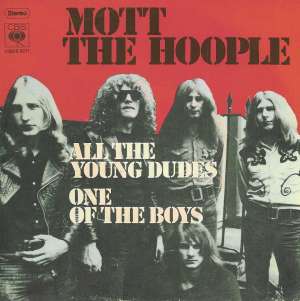
Mott the Hoople “All the Young Dudes” released

All the Young Dudes

Mott the Hoople

Writer(s): David Bowie (see lyrics here)


Released: July 28, 1972


First Charted: August 12, 1972


Peak: 37 US, 34 CB, 32 HR, 2 CL, 3 UK, 31 CN, 1 DF (Click for codes to charts.)


Sales (in millions): --


Airplay/Streaming (in millions): -- radio, 4.2 video, 81.12 streaming

Awards:

Click on award for more details.

About the Song:

In 1972, Mott the Hoople had released four albums over three years but failed to gain any commercial success. David Bowie, who was well established as a solo artist, was interested in writing for other artists. He was a fan of the band and sent them a demo of “Suffragette City,” in hopes of keeping the band together SF but they rejected it. Bassist Pete Watts told Bowie in March that they band had broken up. Two hours later, Bowie contacted him, saying, “I’ve written a song for you since we spoke, which could be great.” WK

Bowie and Watts met a few days later and Watts said, “He hadn’t got all the words but the song just blew me away.” WK Singer Ian Hunter said, “He just played it on an acoustic guitar. I knew straight away it was a hit.” WK Drummer Dale Griffin said, “He wants to give us that? He must be crazy!” WK

Mott the Hoople agreed not to break up. Bowie’s manager, Tony Defries, also signed on the manage the band. Bowie produced the song, singing backup and playing guitar on it as well. SF They recorded “All the Young Dudes” on May 14, 1972. It became what has been called an “anthem of glam rock” WK which was to that genre what the Beatles’ “All You Need Is Love” was to the hippie era. WK Author Dave Thompson called it “the ultimate glam rock rallying cry.” DT

Bowie has said it wasn’t meant as an anthem for glam, but had a darker message about apocalypse. He envisioned Mott the Hoople as a Clockwork Orange-style street gang. SF “With its dirge-like music, youth suicide references and calls to an imaginary audience, the song bore similarities to Bowie’s own ‘Rock ‘n’ Roll Suicide,’ the final track from [Bowie’s classic] Ziggy Stardust” album. WK It has also been called a gay anthem, which fit the androgynous and gender-bending styles of glam rock. Lou Reed said it was, “a rallying call to the young dudes to come out in the streets and show that they were beautiful and gay and proud of it.” WK

Whatever the intent of the song, Mott the Hoople parlayed it into their only top-40 hit in the U.S. and their biggest hit in the UK. Bowie performed the song on his Ziggy Stardust tour and it was recorded for the live album which resulted from that tour. It was also featured on his David Live album released in 1974.


Resources:


Related Links:


First posted 7/23/2022; last updated 4/1/2023.