Showing posts with label Mick Pointer. Show all posts

Monday, January 4, 1988

Marillion released B-Sides Themselves

B-Sides Themselves

Marillion


Recorded: 1982-1987


Released: January 4, 1988

Peak: -- US, 64 UK, -- CN, -- AU, 18 DF Click for codes to charts.


Sales (in millions): --


Genre: neo progressive rock


Tracks:

Click on a song titled for more details.
  1. Grendel [17:15]
  2. Charting the Single [4:48]
  3. Market Square Heroes [3:56]
  4. Three Boats Down from the Candy [4:01]
  5. Cinderella Search [4:21]
  6. Lady Nina [3:43]
  7. Freaks [4:04]
  8. Tux On [5:12]
  9. Margaret (live) [12:17]

Total Running Time: 59:42


The Players:

  • Derek Dick, aka “Fish” (vocals)
  • Steve Rothery (guitars)
  • Mark Kelly (keyboards)
  • Pete Trewavas (bass)
  • Ian Mosley, Mick Pointer, John Martyr (drums)

Rating:

3.666 out of 5.00 (average of 14 ratings)


Awards:

(Click on award to learn more).

About the Album:

Marillion had released four albums at this point, all with Fish as the lead singer. He would leave the band in October 1988, making this his last studio album with the band. This album did not, however, contain any new material. Instead, as the title suggests, this was a collection of B-sides from the singles Marillion had released.

B-sides are often considered throwaways that didn’t past muster for placement on an album. In the case of these songs, they often didn’t make the cut simply because they didn’t quite fit whatever theme the current project had. Some of these songs, including Tux On and Freaks are strong songs that hold up just fine and would have made decent singles. In fact, a live version of “Freaks” was released as the band’s final single from the Fish years.

You can see a full discography of Marillion’s singles here. This page, however, will detail the songs featured on B-Sides Themselves and their original appearances on singles.

The Songs

Here’s a breakdown of each of the individual songs.

Grendel

Marillion


Released: 10/25/1982 as a B-side for “Market Square Heroes,” B-Sides Themselves (1988)


Peak: 12 DF Click for codes to charts.


About the Song:

Considering the 17-minute running time of Grendel, the “Market Square Heroes” single was really an EP and not a single.

Charting the Single

Marillion


Released: 1/31/1983 as the B-side of “He Knows You Know,” B-Sides Themselves (1988)


Peak: 15 DF Click for codes to charts.


About the Song:

This was the B-side of “He Knows You Know,” which was released in January 1983 and reached #35 on the UK charts and #21 on the Billboard album rock tracks chart. “He Knows You Know” was the first single from Marillion’s debut album, Script for a Jester’s Tear.

Market Square Heroes

Marillion


Released: 10/25/1982 as a single, Real to Reel (live, 1984), B-Sides Themselves (1988), Best of Both Worlds (1997), Return to Childhood (Fish live, 2005)


B-sides:Grendel,” “Three Boats Down from the Candy


Peak: 60 UK, 7 DF Click for codes to charts.


About the Song:

This free-standing single was Marillion’s first release on October 25, 1982. The version on B-Sides Themselves is actually a re-recorded version which was used as the B-side of 1984’s “Punch and Judy.”

Three Boats Down from the Candy

Marillion


Released: 10/25/1982 as a B-side for “Market Square Heroes,” B-Sides Themselves (1988)


Peak: 27 DF Click for codes to charts.


About the Song:

The version of Three Boats Down from the Candy featured on B-Sides Themselves is the re-recorded version of the song which was released as a B-side of “Punch and Judy.”

Cinderella Search

Marillion


Released: 4/30/1984 as the B-side of “Assassing,” Real to Reel (live, 1984), B-Sides Themselves (1988)


Peak: 6 DF Click for codes to charts.


About the Song:

The lead single from Marillion’s second album, Fugazi, was “Assassing” in April 1984. It climbed to #22 on the UK charts. The B-side was Cinderella Search, which would also appear on Marillion’s 1984 live album Real to Reel.

Lady Nina

Marillion


Released: 4/7/1985 as the B-side of “Kayleigh,” Brief Encounter (EP, 1986), B-Sides Themselves (1988)


Peak: 30 AR, 30 UK, 2 DF Click for codes to charts.


About the Song:

Marillion’s third album, Misplaced Childhood, was released in 1985. The lead single, “Kayleigh,” gave the band their greatest success, reaching #2 in the UK as well as #74 on the Billboard Hot 100 and #14 on the album rock track chart. The B-side, Lady Nina, would also be featured on the 1986 EP Brief Encounter.

Freaks

Marillion


Released: 8/27/1985 as the B-side of “Lavender,” Brief Encounter (EP, 1986), B-Sides Themselves (1988), The Thieving Magpie (live, 1988), November 1988 as a single (live version)


Peak: 24 UK, 3 DF Click for codes to charts.


About the Song:

Lavender” was released as the second single from Misplaced Childhood. It reached #5 in the UK, making for the band’s second most successful single in its history. The B-side, Freaks, was also released on the 1986 EP Brief Encounter and ended up being the last Fish-era single when a live version of the song was released as a single in November 1988 in support of the double live album The Thieving Magpie. That version got to #24 on the UK chart.

Tux On

Marillion


Writer(s): Fish (lyrics), Mark Kelly, Ian Mosley, Steve Rothery, Pete Trewavas (music) (see lyrics here)

Released: 7/13/1987 as the B-side of “Sugar Mice,” B-Sides Themselves (1988), The Last Straw (Fish live, 2022)


Peak: 1 DF Click for codes to charts.


Sales (in millions): --


Airplay/Streaming (in millions): -- radio, 0.25 video, -- streaming

Awards:

(Click on award to learn more).

About the Song:

Marillion only released four studio albums with Fish on vocals. However, those four albums cemented the band as my favorite of all time. Thankfully, there were also enough B-sides from singles released from 1982 to 1987 to warrant the release of the B’Sides Themselves compilation in January 1988. The release of the double live album The Thieving Magpie in November of that year would then serve as the finale to the Fish era.

As big as Marillion had become for me, the B’Sides Themselves collection introduced me to “new” Marillion songs. I already knew some of the material. “Market Square Heroes” and “Cinderella Search” were featured on the 1984 live album Real to Reel. “Lady Nina” and “Freaks” had been released on the 1986 EP Brief Encounter.

The song that most captured my attention from the collection was “Tux On.” The song was initially released as the B-side of “Sugar Mice,” the second single from 1987’s Clutching at Straws album. The song uses the tuxedo as “the uniform that symbolizes the comfortable life,” taking the listener through various scenarios in which a man might wear a tuxedo, including him lying in state in a coffin.

“’Tux On’ points the way towards the sort of music the band would be producing a couple of albums down the line and dispenses with the neo-prog sensibilities to embrace the poppier side of the band’s psyche. It is a catchy little number nonetheless and shows that Marillion had ambitions beyond their cult status which were finally realised when Misplaced Childhood broke them into the mainstream.” SK

Margaret (live)

Marillion


Released: 6/6/1983 as the B-side of “Garden Party,” B-Sides Themselves (1988)


Peak: 19 DF Click for codes to charts.


About the Song:

The song reached #16 on the UK charts. This live performance of Margaret was recorded on April 7, 1983 at Edinburgh Playhouse and released as the B-side of “Garden Party,” the second single from the Script for a Jester’s Tear album.

Notes:

There were a few B-sides which didn’t make this collection, including the aforementioned “Going Under,” released as the B-side of “Incommunicado.” Beyond that, a live version of “Chelsea Monday” (a song from Script for a Jester’s Tear) was the B-side of 1985’s “Heart of Lothian” and live versions of “White Russian” and “Incommunicado” were released as B-sides of “Warm Wet Circles.” Studio versions of those songs were initially featured on 1987’s Clutching at Straws.

Resources/References:


Related DMDB Pages:


First posted 3/2/2022; last updated 8/5/2025.

Monday, March 12, 1984

Marillion released Fugazi

Fugazi

Marillion


Released: March 12, 1984


Peak: -- US, 5 UK Click for codes to charts.


Sales (in millions): -- US, 0.1 UK


Genre: neo-progressive rock


Tracks:

Click on a song titled for more details.
  1. Assassing [7:01]
  2. Punch and Judy [3:21]
  3. Jigsaw [6:49]
  4. Emerald Lies [5:08]
  5. She Chameleon [6:53]
  6. Incubus [8:30]
  7. Fugazi [8:12]

Total Running Time: 45:56


Other Songs from This Era:

  • Cinderella Search (B-side of “Assassing,” released 4/30/1984)


The Players:

  • Derek Dick, aka Fish (vocals)
  • Steve Rothery (guitar)
  • Mark Kelly (keyboards)
  • Pete Trewavas (bass)
  • Ian Mosley (drums)

Rating:

3.708 out of 5.00 (average of 25 ratings)


Awards:

(Click on award to learn more).

About the Album

Marillion worked diligently to restore progressive rock in the early eighties with debut album Script for a Jester’s Tear, and there was no reason to let up with their sophomore effort. Musically the most marked difference between this album and their first is the percussive, driving beat led by new drummer Ian Mosley. His “spot-on drumming was the perfect foil for Marillion’s meticulous musicianship.” AM Lyrically, where “Script was wistful and grief-stricken, FugaziJC-52

The album title comes from a British Army slang term which means “Fucked Up, Got Ambushed, Zipped In.” American servicemen popularized the term during the Vietnam War. Fish learned about it through a book by Mark Baker called Nam. JC-52 Marillion work awfully hard to match the standard they set with their debut. There are times that it shows; some songs meander a bit more in Marillion’s effort to make them “epics” AM and that the album became “too wordy.” JC-54 Geoff Boswell, a fan, said “Fish swallowed a thesaurus.” JC-54 It also “lacked its predecessor’s cohesion and focus,” AM especially on “the somewhat less-than-stellar Emerald Lies,” WK but this album reaches farther, and in many ways succeeds, more than most bands can ever hope.

The Songs

Here’s a breakdown of each of the individual songs.

Assassing

Marillion

Writer(s): Fish, Mark Kelly, Steve Rothery, Pete Trewavas


Released: 4/30/1984 as a single, Fugazi (1984)


B-Side: “Cinderella Search”


Peak: 22 UK, 6 DF Click for codes to charts.


About the Song:

The lead song, Assassing, kicks in at high gear and won’t let up. It shows the band leaning on a harder-edged sound and moving, ever-so-slightly, away from their prog-rock leanings. It is one of the strongest songs of the album and, not surprisingly was released as the second single. It isn’t as catchy as “Garden Party” or “He Knows You Know,” the singles from Script for a Jester’s Tear, but the song’s relentlessness eventually earworms its way into your brain.

Fish said the song was originally written about ex-bandmate Diz Minnitt, but explanded to also be about former drummer Mick Pointer. “We basically sacked them,” he said. “It’s about how hard it is.” JC-52

Punch and Judy

Marillion

Writer(s): Fish, Mark Kelly, Steve Rothery, Pete Trewavas, Jonathan Mover


Released: 1/30/1984 as a single, Fugazi (1984)


B-sides: “Market Square Heroes” (new version), “Three Boats Down from the Candy” (new version)


Peak: 29 UK, 6 DF Click for codes to charts.


About the Song:

The album’s second song, Punch and Judy, was the lead single from the album. It is a more obvious choice as a single, but surprisingly peaked at #29, compared to “Assassing” at #22. Of course, while Marillion could write memorable songs, they weren’t really meant to be a singles’ band anyway. Script for a Jester’s Tear showcased a band focused on making each song a strong effort, but ultimately contributing to the greater whole of the album.

The song is notable in that it includes Jonathan Mover in the writing credits. After Mick Pointer was fired as the drummer, Jonathan Mover was with the band for a short while. According to Mover, he was fired from the band when Fish started pushing for a concept album and Mover thought it was a bad idea since the current songs, which were not connected thematically, would have to be scrapped.

Thematically, the song is “a cynical meditation on marriage.” JC-53 Fish explained that it was about a husband who physically took out his frustrations on his wife.

Jigsaw

Marillion

Writer(s): Fish, Mark Kelly, Steve Rothery, Pete Trewavas


Released: Fugazi (1984)


Peak: 3 DF Click for codes to charts.


About the Song:

Fish described Jigsaw as being “about the relationship that splits up and forever comes together again [getting] worse each time.” JC-53 “The music on the first two verses seems almost nursery-rhyme like: guitar and keyboards chiming like a child’s xylophone, underlying the sense of conciliation in Fish’s words. The chorus could not be more different, as Ian Mosley batters his skins into submission, and Pete Trewavas’s bass thuds like punches. As it gives way to the solo, Steve Rothery creates one of those soaring, melancholic guitar lines for which he is justifiably lauded.” JC-53

Emerald Lies

Marillion

Writer(s): Fish, Mark Kelly, Steve Rothery, Pete Trewavas, Ian Mosley


Released: Fugazi (1984)


Peak: 6 DF Click for codes to charts.


About the Song:

Emerald Lies describes an accusation of infidelity…and the realization that, though proven false, the accusation has destroyed the relationship. Perhaps the most straight-forward song on thealbum, it nevertheless showcases some superb percussion work by Mr. Mosley.” JC-53

She Chameleon

Marillion

Writer(s): Fish, Mark Kelly, Steve Rothery, Pete Trewavas


Released: Fugazi (1984)


Peak: 1 DF Click for codes to charts.

Awards:

(Click on award to learn more).

About the Song:

She Chameleon describes the whole groupie phenomena, which the band had begun to experience on the Script tour. ‘Who was using who?’ Fish asked.” JC-53 The song is actually a reworking of a track that originated during the Script era. JC-54

Incubus

Marillion

Writer(s): Fish, Mark Kelly, Steve Rothery, Pete Trewavas


Released: Fugazi (1984)


Peak: 2 DF Click for codes to charts.


About the Song:

As before, lead singer Fish has his gift for wording on full display. In Incubus, he sings “darkroom unleashes imagination in pornographic images in which you will always be the star.” It is “a slow-burning track about a porn director whose former lover and lead actress has just opened as the lead in a legit West End play. Spying her spurned former paramour in the audience, she freezes, not knowing whether he’ll reveal her secret to the press.” JC-53

“Much of the track is built on a groove until, the director’s hurt building to a dangerous level, the band takes us into a waltz. The director’s Machieavellian manoeuvres are like a dance – guitar lines – then the bile’s really unleashed! The actress, mute on the stage, writes her own death notices, and he’s watching it all, a glint of pure evil in his eye.” JC-53

Fugazi

Marillion

Writer(s): Fish, Mark Kelly, Steve Rothery, Pete Trewavas, Ian Mosley (see lyrics here)


Released: Fugazi (1984)


Peak: 1 DF Click for codes to charts.


Sales (in millions): -- US, -- UK, -- world (includes US + UK)


Airplay/Streaming (in millions): -- radio, 2.5 video, -- streaming

Awards:

(Click on award to learn more).

About the Song:

Like on their first album, Marillion churn out their best song with the anthemic title cut. It was “a highlight of the band’s live set for many years to follow.” AM The song even explores the same themes as “Script for a Jester’s Tear”as lead singer Fish continues to struggle with substance abuse and failed romance.

The song “details Fish in mid-panic attack on the underground en route to the Marquee in Wardour Street. On a come-down from LSD, Fish said, ‘Viewing the other occupants of the carriage, it summed up the album and my views on life at the time.’” JC-53

“Initially based purely on the observations of the other travellers, Mark Kelly’s piano gives way to steadily more edgy synth lines. From here, we move outside the carriage to consider unhappy relationships, racial unrest, prostitution, and our treatment of war veterans. Then, as the whole world dissolves into a fearful smear of guitar string scrapes, screams, and doom-laden keyboards, Pete and Ian paint a quasi-militaristic regime of cold war nuclear paranoia.” JC-53

“Finally, as Fish desperately askes to be shown inspiration for a way out of this terrible mess, the band become the pipers of the apocalypse and Fish is swept along with the crowd, as it marches blindly on its way to its doom.” JC-54

Notes:

A 1998 reissue includes a second disc with demos of “Punch and Judy,” “She Chameleon,” “Emerald Lies,” and “Incubus;” an alternate mix of “Assassing,” and non-album tracks “Cinderella Search” and “Three Boats Down from the Candy.”

Resources/References:

  • AM AllMusic.com review by John Franck
  • Jon Collins (2003). Separated Out. Helter Skelter Publishing: London, England.
  • WK Wikipedia


Related DMDB Pages:


Last updated 8/4/2025.

Monday, March 14, 1983

Marillion released debut album, Script for a Jester’s Tear

Script for a Jester’s Tear

Marillion


Released: March 14, 1983


Peak: 175 US, 7 UK, 51 CN Click for codes to charts.


Sales (in millions): -- US, 0.3 UK, 0.3 world (includes US and UK)


Genre: neo-progressive rock


Tracks:

Click on a song titled for more details.
  1. Script for a Jester’s Tear [8:42]
  2. He Knows You Know [5:07]
  3. The Web [9:10]
  4. Garden Party [7:17]
  5. Chelsea Monday [8:17]
  6. Forgotten Sons [8:22]

Total Running Time: 46:45


Other Songs from This Era:

  • Market Square Heroes (single, released 10/25/1982)
  • Three Boats Down from the Candy (B-side, released 10/25/1982)
  • Grendel (B-side, released 10/25/1982)
  • Charting the Single (B-side of “He Knows You Know,” released 1/31/1983)
  • Margaret (live) (B-side of “Garden Party,” released 6/6/1983)


The Players:

  • Derek Dick, aka Fish (vocals)
  • Steve Rothery (guitar)
  • Mark Kelly (keyboards)
  • Pete Trewavas (bass)
  • Mick Pointer (drums)

Rating:

3.897 out of 5.00 (average of 23 ratings)


Awards:

(Click on award to learn more).

The Band’s Origins

Marillion formed in 1979 in Aylesbury, Buckinhamshire, England. By the time of the neo-progressive rock band’s first officially released recordings in 1982, only drummer Mick Pointer and guitarist Steve Rothery remained from the original lineup. Fish had joined as the lead singer and lyricist, Mark Kelly as keyboardist, and Pete Trewavas as bassist. This lineup released the October 1982 single “Market Square Heroes” in October 1982, which included “Three Boats Down from the Candy” and the 17-minute epic “Grendel;” all three appeared on the 25th anniversary reissue of the Script album.

In March 1983, they released Script for a Jester’s Tear, “a landmark debut album that would give prog a much-needed shot in the arm.” DE Two singles were released in support of the album – “He Knows You Know” in January 1983 and “Garden Party” in June 1983.

At the Neo-Progressive Rock Forefront

The myth that punk rock killed prog has been overstated; the genre “was doing a job of killing itself. Its founding fathers had either imploded (Yes, ELP), streamlined their sound so much as to be virtually unrecognizable (Genesis, Rush), or faded into commercial irrelevance (Caravan, Camel).” DE Marillion was “regarded as the pre-eminent force of this neo prog movement,” MD a banner Fish wasn’t excited to hoist. “I never saw us as being champions of anything…We were just doing what we did.” DE As Trewavas said, “We weren’t necessarily a rock band, we certainly weren’t a pop band. But we were selling out clubs like the Marquee, and we had quite a fan base.” DE They weren’t the first of their kind, “but they were certainly the most successful, and arguably the most important.” DE

Detractors have accused Marillion of copying early Genesis when they were fronted by Peter Gabriel, a comparison not without merit considering both band’s tendencies toward complicated imagery and dramatic flair, not to mention the theatrical stage presences of their frontmen.

Regarding the musical similarities, Fish said, “I look back on it now and a lot of those criticisms were justified. I mean, ‘Grendel’ [the 17-minute epic featured on the ‘Market Square Heroes’] was ‘Supper’s Ready’ [a nearly 23-minute song from Genesis’ 1972 Foxtrot album]. We were holding onto the skirts of our influences, trying to find the confidence to break away from it.” DE “Mark Kelly’s keyboard textures and Steve Rothery’s restless guitar work” DE also “paid lip service to their influences.” DE Even so, “this was new music for a new decade” DE as Marillion reignited interest in progressive rock.

About the Album

In Jon Collins’ book Separated Out, he describes the album as “ambitious, varied, moody, dramatic, lyrical, accomplished.” JC-39 The songs “recounted a series of stories relating to a character in a particular situation…Though never mentioned explicitly, the character was the jester, representing the hedonistic alter-ego of Derek Dick,” JC-39 i.e. Fish. The character of the crying jester would serve as the inspiration for the album title and its artwork.

A large part of the band’s appeal was due to Fish, who Rothery called “a very forceful frontperson.” DE The songs on the album completely satisfy as Fish’s poetic and introspective lyrics require repeat listening to completely absorb. Fish always has something to say and is never at a loss for a clever way to do so.

Musically, it sounds like the rest of the band shuffled through instrumental bits and pieces until they found suitable background noise to accommodate whatever Fish retrieved from what one guesses is a vast collection of journals and diaries. That isn’t to say that the music doesn’t adequately complement the lyrics (the title track exemplifies how the music can enhance the drama of the vocals), just that neither appears to have been crafted with the other in mind.

The Songs

Here’s a breakdown of each of the individual songs.

Script for a Jester’s Tear

Marillion

Writer(s): lyrics: Derek Dick (Fish); music: Derek Dick (Fish), Steve Rothery, Pete Trewavas, Mick Pointer, Mark Kelly (see lyrics here)


Released: Script for a Jester’s Tear (1983)


Peak: 1 DF Click for codes to charts.


Sales (in millions): --


Airplay/Streaming (in millions): -- radio, 4.2 video, 4.97 streaming

Awards:

(Click on award to learn more).

About the Song:

The lead track from Marillion’s debut album of the same name was simultaneously the oldest and newest amongst the batch of songs which comprised the album. It was the oldest in that it owed its origins to “The Crying Jester,” the first song Fish ever wrote. That was “a total rip-off of a Jon Anderson song…written on the night that Keith Moon died: he was…the crying jester.” JC-39

However, it was also the newest in that the song that the actual song “Script for a Jester’s Tear” was newer than any of the other songs on the album, all of which had been around for a year or more. Lead singer Derek Dick, better known as Fish, said the song was inspired by his turbulent love life. “I was getting involved in my first serious – and I mean really serious – relationship and all the questions and issues that brought with it. There was a lot of introspection going on in the lyrics. If I look back, it was put across in a very naïve way.” DE

The “poignant title track” JF “is a showpiece of Marillion musicianship.” JC-39 AllMusic.com’s John Franck said, “Fish leads his band of merry men on a brokenhearted tour de force that culminates with the singer decrying that ‘the game is over.’” JF The song starts “with a piano-led lamentation that then transitioned into a playful Medieval-styled mid-section that conjured an image of a bustling king’s court. The mood then turned gloomy and dark with marked flourishes of distorted guitar alongside lush organ, then bleeding into an epilogue of anthemic guitar ad-lib as well as glassy chimes and bells.” TC

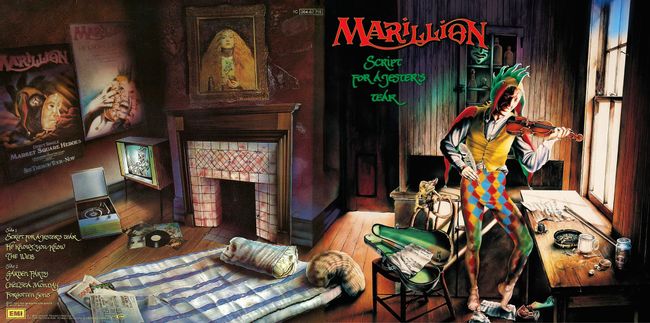
The title song not only served as the album’s focal point, but the inspiration for the accompanying artwork. The artist, Mark Wilkinson, said Fish wanted to portray a struggling writer who looked like a jester. “I then…set him in a bedsit surrounded by lots of objects to portray that sort of existence,” MD such as sheet music, records on the floor, an ashtray, an empty coffee cup, and crumpled paper.

He Knows You Know

Marillion

Writer(s): Lyrics by Derek Dick (Fish). Music by Marillion (Dick/ Kelly/ Mosley/ Rothery/ Trewavas.


Released: 1/31/1983 as a single, Script for a Jester’s Tear (1983)


B-side: “Charting the Single”


Peak: 21 AR, 35 UK, 2 DF Click for codes to charts.


About the Song:

This “rockin’ stomper” CR was the first single and the only cut on the album to come in under seven minutes. Lyrically, it “sweated junkie paranoia from its every pore” DE while musically it was “vibing off something more sinister and metallic, courtesy of the scathing guitar as well as punchy bassline.” CR

Fish explained that the song was “about someone who went from nervous exhaustion, through depression then full-scale drug abuse.” JC-39 It was inspired by his own excesses as well as a friend’s. JC-39

The Web

Marillion

Writer(s): Lyrics by Derek Dick (Fish). Music by Marillion (Dick/ Kelly/ Mosley/ Rothery/ Trewavas.


Released: Script for a Jester’s Tear (1983)


Peak: -- Click for codes to charts.


About the Song:

On this “nine-minute, textured epic,” CR “Fish’s lyrics veered between rage, frustration, and heartbreak.” DE “With its spider-like guitar plucks, keyboard melodies, and heat-of-the-moment guitar interlude” CR this “was a prog bedsit anthem.” DE

The song was one of the band’s oldest, starting life as an instrumental. Fish took some of the lyrical inspiration from Penelope, wife of Odysseus. She said she’d choose a new husband after finishing a death shroud for Odysseus. To stall, she would undo her work each night. JC-39

Garden Party

Marillion

Writer(s): Lyrics by Derek Dick (Fish). Music by Marillion (Dick/ Kelly/ Mosley/ Rothery/ Trewavas.


Released: 6/6/1983 as a single, Script for a Jester’s Tear (1983)


B-side: “Margaret (live)”


Peak: 16 UK, 4 DF Click for codes to charts.


About the Song:

The second single from the album “showcases Marillion at the peak of its powers.” JF Fish lashes out at the cultural elite with phrases like “smiles polluted with false charm” and “social climbers polish ladders, wayward sons again have fathers.” “It was the anti-Brideshead Revisited; a furious, sarcastic class-war anthem that punched and jabbed like a Muirhouse street fighter.” DE

“Here, the influence of Rush was very apparent, especially in Fish’s vocal timbre and phrasing that recalled that of Geddy Lee, as well as the rhythm section’s symphonic shots and overall structure.” CR Fish once commented, “it’s our most Genesis-y song!” JC-40

Chelsea Monday

Marillion

Writer(s): Lyrics by Derek Dick (Fish). Music by Marillion (Dick/ Kelly/ Mosley/ Rothery/ Trewavas.


Released: Script for a Jester’s Tear (1983)


Peak: 3 DF Click for codes to charts.


About the Song:

This “was initially a bit bluesy and starry, then breaking into a stellar mid-song guitar-led instrumental interlude, and ending in a piano coda.” CR

Fish was inspired to write this “tale of a doomed rich girl” DE because of a newspaper headline he read on “one of the amphetamine-fuelled early morning walks through London he had taken to going on.” DE He said it was about “a female character drowning in romanticism, unable to cope with reality.” JC-40

Forgotten Sons

Marillion

Writer(s): Lyrics by Derek Dick (Fish). Music by Marillion (Dick/ Kelly/ Mosley/ Rothery/ Trewavas.


Released: Script for a Jester’s Tear (1983)


Peak: 2 DF Click for codes to charts.


About the Song:

This song “concludes the opus magnificently.” JF Fish attacks warmongers “who order desecration, mutilation, verbal masturbation in their guarded bureaucratic wombs.” It “was ostensibly a protest song about the situation in Northern Ireland, though it could be read as a furious critique of the Thatcher government.” DE Fish said it was “about government manipulation” and how his cousin got injured during a riot. JC-40

Musically, it displays “vestiges of the band’s Punk and Post-Punk beginnings; then proceeded to the mid-section in a gracefully flowing rhythm; and ultimately, wrapped up the entire jester’s show with the majestic Yes/ELP/Styx-reminiscent, horn-adorned denouement.” CR

Notes:

A reissue includes a second disc with a demo of “He Knows You Know,” an alternate version of “Chelsea Monday,” and non-album tracks “Market Square Heroes” (two versions), “Three Boats Down from the Candy,” “Grendel,” and “Charting the Single.”

Resources/References:


Related DMDB Pages:


First posted 3/10/2011; last updated 8/4/2025.