Showing posts with label Johnnie Johnson. Show all posts

Monday, April 21, 2008

50 years ago: Chuck Berry charted with “Johnny B. Goode”

Johnny B. Goode

Chuck Berry

Writer(s): Chuck Berry (see lyrics here)


First Charted: April 21, 1958


Peak: 8 US, 11 CB, 15 HR, 2 RB, 1 DF (Click for codes to charts.)


Sales (in millions): 1.0 US, -- UK, 1.0 world (includes US + UK)


Airplay/Streaming (in millions): 2.0 radio, 26.6 video, 225.92 streaming

Awards:

Click on award for more details.

About the Song:

With his rags-to-riches song “Johnny B. Goode,” Chuck Berry created a character who symbolizes an Elvis Presley-type who comes from humble beginnings and whose mother promises her son that his name will be in lights someday. DM Berry says the improvised tale of a young man who plays “his guitar all the way to stardom” TC is “more or less” his story, RS500 with a few details changed.

The character is named after pianist TC Johnnie Johnson. Berry joined Johnson’s group, the Sir John Trio, in 1953, soon becoming the focal point as the lead singer. SF Johnson wrote many of Berry’s hits on piano and then Berry converted them to guitar. TC Berry said he originally wrote “Johnny B. Goode” for Johnson. SS

The name “Goode” came from the street where Berry grew up, TB 2520 Goode Avenue, AH one nowhere close to the song’s setting in a cabin “deep down in Louisiana, close to New Orleans.” Berry grew up in St. Louis and proclaimed, “I don’t think I’ve actually seen a real log cabin, much less lived in one!” SJ

Berry was not illiterate like the song’s character. He went to beauty school and graduated with a hairdressing and cosmetology degree. RS500 Lyrically, “that little colored boy could play” was changed to “that little country boy could play,” because, as Berry said, “I thought it would seem biased to white fans” DM and “it wouldn’t get on the radio.” RS500

Music historian Steve Sullivan says, “No other record defines the very essence of rock ‘n’ roll like ‘Johnny B. Goode.’” SS It “established the sound of the rock and roll guitar.” PW That famous guitar intro is nearly a note-for-note copy of the opening solo in Louis Jordan’s 1946 “Ain’t That Just Like a Woman,” played by guitarist Carl Hogan. He wasn’t the first to play it either. The riff dates back to a 1918 recording of “Bluin’ the Blues” by Wilbur Sweatman’s Jazz Orchestra. AH It also appeared in songs by Blind Blake, Count Basie, Blind Lemon Jefferson, and others before Jordan’s record. AH Rock critic Dave Marsh says “You can’t copyright guitar licks and maybe that’s good, because if you could, …we’d lose not just the Beach Boys, but essential elements of the Beatles, the Rolling Stones, Bob Dylan, Bob Seger, and Bruce Springsteen.” DM


Resources:


Related Links:


First posted 7/13/2014; last updated 4/2/2023.

Saturday, August 20, 2005

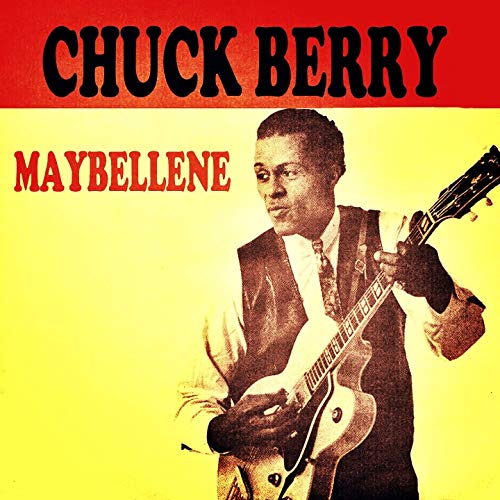
50 years ago: Chuck Berry “Maybellene” hit #1 on R&B chart for 1st of 11 weeks

Maybellene

Chuck Berry

Writer(s): Chuck Berry, Russ Fratto, Alan Freed (see lyrics here)


Released: July 1955


First Charted: August 6, 1955


Peak: 5 US, 5 CB, 4 HR, 111 RB, 3 DF (Click for codes to charts.)


Sales (in millions): 1.0 US


Airplay/Streaming (in millions): -- radio, 8.38 video, -- streaming

Awards:

Click on award for more details.

About the Song:

Boogie pianist Johnnie Johnson had a gig booked for New Year’s Eve 1952 to play the Cosmopolitan Club in St. Louis. TC When a band member had a stroke, AH he called “untried guitarist Chuck Berry as a stopgap replacement.” TB He barely knew the young man who had “already served a term in prison for armed robberty, was massively ambitious, and was skinny as a rake” AH but he knew Berry could sing and play guitar.

That night Berry played the “uptempo country tune” SS “Ida Red” “about a duel between a Ford and a Cadillac.” TC It had been recorded by Roy Acuff, Bob Wills, and Cowboy Copas SS but, according to Okeh Records where Acuff cut the song, it was as “old as the hills.” DM Johnson said “the audience went crazy. We had to play that song again, maybe two or three times.” TB Some experts have called it the beginning of rock and roll. TB

Why? “This particular black man playing country music was more or less the embodiment of rock and roll.” AH By 1955, Berry went to Chicago to see blues great Muddy Waters who encouraged Berry to talk to Leonard Chess about a recording contract. SS At the first session, Berry recorded a reworked version of “Ida Red,” also incopraiting parts of “Oh Red” by the Harlem Hamfats and “Hot Rod Racer” by Arkie Shibley & His Mountain Dew Boys. The “new” song was called “Maybellene,” after the cosmetics company, at Chess’ suggestion. AH It “was the debut of the single most important songwriter in rock and roll history.” AH

It took 36 takes to record SS the “frustrated love song that’s as much about the highway as it is about girls.” DM The “rapid-fire wordplay…that became a Berry trademark is as exciting as its driving rhythm, generationg an unstoppable momentum, hurtling down the open road much like the Caddy and V-8 Ford in this song.” SS

It would be “the most important single record Chess ever put out” AH and “when it comes to rock and roll, Chuck Berry may be the single most important figure who ever lived.” AH To get the song played on the radio, Chess engaged in payola, which meant he gave DJ Alan Freed and his associate Russ Fratto two-thirds of the publishing income and songwriting credit. TC It became a hit, “kick-starting the rock ‘n’ roll revolution.” TB


Resources:


Related Links:


First posted 3/24/2023; last updated 3/31/2023.