


S.F. Sorrow |
|
Released: December 20, 1968 Peak: -- Click for codes to charts. Sales (in millions): -- Genre: psychedelic rock |
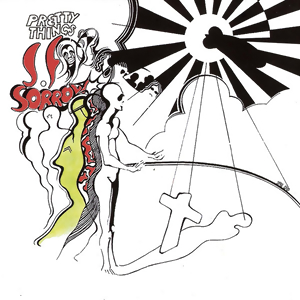
Tracks:Song Title [time]
Total Running Time: 40:59 The Players:
|
Rating: 4.197 out of 5.00 (average of 16 ratings)
Awards:(Click on award to learn more).
|


The Pretty Things“The Pretty Things were among the original British Invasion bands, sporting a ragged, bluesy R&B sound far heavier than the Stones (with a bad boy reputation to match).” PK Like their counterparts – The Rolling Stones, The Kinks, The Who, and The Beatles – they were “inspired by the thriving psychedelic scene” RD and were soon “brushing aside their roots for a flower-power psychedelic sound.” PKUnfortunately, the group never found anything close to the success of its peers, although “their early songs have their admirers – David Bowie covered a few of them on his 1973 Pin-Ups album.” PK However, it was with their album S.F. Sorrow that the band left their mark.” PK The First Rock OperaS.F. Sorrow was barely noticed when it first came out. It is “one of those albums that gets bandied about as a long lost classic that nobody actually owns or has even heard. Yet while it may not be quite the immortal classic some have talked it up as, it’s nonetheless one of the cooler artifacts of the UK psychedelic heyday.” PK For fans of this era, “this album is every bit as essential as the Zombies’ Odessey & Oracle, [The Small Faces’] Ogdens’ Nut Gone Flake, and the work of the Who and the Kinks.” PKMore importantly, “is now recognized as the first rock-opera;” TB that is, “the first full-length ‘concept album’” PK and the inspiration for Pete Townshend to write Tommy. PK It “was a daring project that provided the blueprint for all future rock operas.” RD Part of the problem, though, is that the album struggled to find an audience because the rock opera concept was so new that the record company, EMI, didn’t know how to market the album. It also got overshadowed by the release of Tommy just a few months later. PK The ConceptThe album “loosely tells the story of a lonely kid named [Sebastian F.] Sorrow,” PK following him “from birth to death, with love, work, war, and burning airship disasters in between.” TB It was based on a short story written by singer Phil May about World War II that featured “a central character who was an amalgam of May himself and his foster father, Charlie.” TBGuitarist Dick Taylor, however, says that making a rock opera wasn’t the plan when they began recording. He said, “We’d recorded two tracks, ‘Bracelets of Fingers’ and ‘I See You’ before the concept came up.” TB
ExperimentationThe album was focused on experimentation from the beginning. Taylor said, “I’d bought a bagpipe chanter in a junkshop, which turned out to be in the right key for the tooty bits in ‘Bracelets of Fingers.’” TB He said, “Our basic principle…was that if it made a noise we would bring it to the studio and find a way to incorporate it into a track.” TB “The pegs and strings from an old upright piano, for example, were scavenged to create a home-made zither which provided eerie twanging sounds on ‘Death.’” TB “Te story-telling element lent itself naturally to the inclusion of unusual sounds to represent events in Sorrow’s life.” TBThe Recording and the MusicThe album was “recorded during a druggy stay at Abbey Road during the Summer of Love.” RD It was produced by Norman Smith, who also notably engineered Sgt. Pepper’s Lonely Hearts Club Band and Pink Floyd’s debut Piper at the Gates of Dawn). While done on a shoestring budget, “it sounds great – densely packed but never obscuring the band’s sharp performances.” PKSmith helped bring the story “to life through a kaleidoscope of vocal collages, Middle Eastern instrumentation, and fuzzy guitar. The sounds range from the breathtaking a cappella intro of ‘Bracelets of Fingers’ and the graceful sitar on ‘Death’ to the lush vocal harmonies of ‘The Journey’ and the dense guitar of ‘Old Man Song.’” RD “Musically it ranges from shimmering pop (the title track) to melodic beauty (‘Trust,’ ‘Loneliest Person’) to trippy weirdness (‘Baron Saturday’). Like similar attempts at easing into psychedelia by traditional British rockers – the Small Faces’ Ogdens’ Nut Gone Flake being the closest example, though the Stones’ Satanic Majesties Request fits as well – S.F. Sorrow shows signs of tension between the band’s harder-edged tendencies and the melodic, experimental demands of the Summer of Love. But the tension works in the band’s favor, giving many of the songs a guitar-driven edge that prevents them from becoming dated relics.” PK |
Reviews:
Related DMDB Links:
First posted 9/5/2025. |


No comments:
Post a Comment