Showing posts with label Rick Chertoff. Show all posts

Tuesday, February 21, 1995

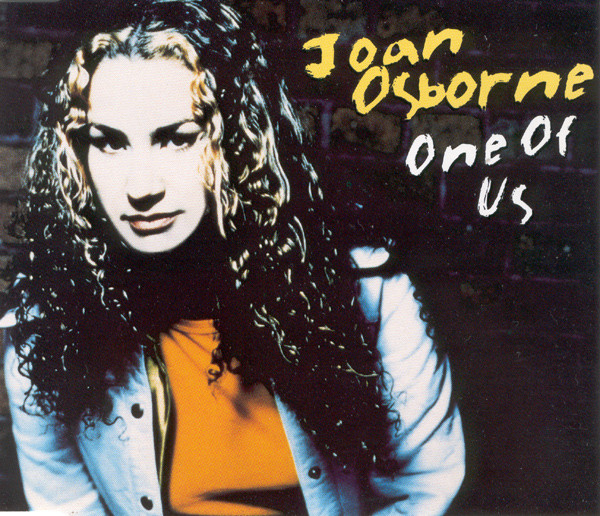
Joan Osborne “One of Us” released

One of Us

Joan Osborne

Writer(s): Eric Bazilian (see lyrics here)


Released: February 21, 1995


First Charted: September 30, 1995


Peak: 4 US, 3 CB, 3 RR, 19 AC, 16 A40, 16 AA, 26 AR, 7 MR, 6 UK, 11 CN, 15 AU, 3 DF (Click for codes to singles charts.)


Sales (in millions): 0.5 US


Airplay/Streaming (in millions): -- radio, 50.9 video, 137.32 streaming

Awards:

Click on award for more details.

About the Song:

Rick Chertoff, Eric Bazilian, and Rob Hyman became friends while attending the University of Pennsylvania. Chertoff would go on to produce the Kinks, the Alan Parsons Project, and Air Supply for Arista Records before moving to Columbia. There he signed Cyndi Lauper and brought in Bazilian and Hyman as backing musicians for her debut album, 1983’s She’s So Unusual. The exposure helped them launch their band, the Hooters. Their 1985 major-label debut, Nervous Night, was a double-platinum seller fueled by three top-40 hits. It proved to be the band’s commercial peak and by 1993 it looked like they’d released their final album (although they would make a comeback in 2010).

Meanwhile, Rick Chertoff started his Blue Gorilla label at Polygram in 1992. The label released Relish, the 1995 major-label debut for singer/songwriter Joan Osborne. He brought in Bazilian for some songwriting duties, including “One of Us.” Bazilian said, “I wrote that song one night – the quickest song I ever wrote – to impress a girl. Which worked, because we’re married and have two kids.” WK He wrote it in January 1994 when his future wife asked him to record something. He said, “You can’t just sing, you have to write the song, you have to discuss the concept, you have to re-write then decide you were better in the first place.” SF Despite her protests, he obliged and, as he said, “the verses came out in the first pass, the chorus came out in the second pass.” SF

He played it for Rick and Joan the next day and they recorded a demo of her singing it. He said, “When I got into my car and popped the cassette in, I started practicing the Grammy speech that I should've gotten to give.” WK It didn’t win, but was nominated for Song of the Year, Record of the year, and Best Female Pop Vocal.

The song is “a simple, direct statement of faith, honest and unadorned, one framed in a near-perfect chorus and delectable Neil Young-ish guitar riff.” AMG Bazilian said it wasn’t about advocating any specific religious belief. SF It “was more about what happens to you when you look at something that has completely changed your world view, which could be meeting God, it could be meeting an alien, it could be a near-death experience.” SF


Resources:


First posted 9/6/2022.

Saturday, June 9, 1984

Cyndi Lauper hit #1 with “Time after Time”

Time After Time

Cyndi Lauper

Writer(s): Rob Hyman, Cyndi Lauper (see lyrics here)


Released: January 27, 1984


First Charted: March 24, 1984


Peak: 12 US, 11 CB, 13 RR, 13 AC, 10 AR, 1 CO, 3 UK, 13 CN, 6 AU, 3 DF (Click for codes to singles charts.)


Sales (in millions): 1.5 US, 0.85 UK, 2.45 world (includes US + UK)


Airplay/Streaming (in millions): 2.0 radio, 433.44 video, 409.07 streaming

Awards:

Click on award for more details.

About the Song:

Cyndi Lauper won the Grammy for Best New Artist in 1985. She landed the big four nominations that year – the others being for Album of the Year (She’s So Unusual), Record of the Year (“Girls Just Want to Have Fun”), and Song of the Year (“Time After Time”). “Girls Just Want to Have Fun” introduced the world to the quirky singer who Newsweek called “a new-wave Gracie Allen.” FB It was an “ebullient song that…branded her in the eyes of some as a clever novelty who would fade after one hit.” FB It was her second single, the “poignant ‘Time After Time,’” FB which made it clear that Lauper was an artist to be enjoyed and taken seriously. Slant magazine’s Sal Cinquemani said it may be “Lauper’s greatest moment.” WK

Lauper’s producer, Rick Chertoff, was friends with the Philadelphia-based band the Hooters. He brought them in as Lauper’s backup band and, when he insisted the album needed one more song, tapped the band’s Rob Hyman to help Lauper write it. Both songwriters were struggling with their romantic relationships, but managed to craft what has been considered one of the best love songs of all time. WK

Hyman said, “it’s a deceptively simple song. The verses are just a little repeating three-note motif – almost like a nursery rhyme…The mood of the lyrics came from both of us…We realized it wasn’t such a bouncy song, but it was a little more bittersweet and a little deeper in its feeling…so the music started to change.” SF Nerve said “Lauper’s most enduring masterpiece hits at the very essence of commitment…she captures real romance in the most simple and straightforward of lines.” WK

Blogcritics’ Pam Avoledo speculated that in the song, Lauper views herself as “a difficult person, unworthy of love. She runs away and shuts people out. However, her devoted boyfriend who loves her unconditionally is willing to help her through anything. The relationship is given depth. The couple’s intimacy and history is apparent. They’ve been together for a long time. They love and have seen each through every tough part of their life.” WK


Resources:

  • DMDB encyclopedia entry for Cyndi Lauper
  • FB Fred Bronson (2003). The Billboard Book of Number One Hits (5th edition). Billboard Books: New York, NY. Page 589.
  • SF Songfacts
  • WK Wikipedia


Related Links:


First posted 2/2/2021; last updated 10/28/2022.