Showing posts with label Perez Prado. Show all posts

Saturday, April 30, 2005

50 years ago: Perez “Prez” Prado hit #1 with “Cherry Pink and Apple Blossom White”

Cherry Pink and Apple Blossom White

Perez “Prez” Prado

Writer(s): Jacques Larue, Louis Gugliemi, Mack David (see lyrics here)


First Charted: January 31, 1955


Peak: 110 US, 11 HP, 2 CB, 18 8, 12 UK, 13 AU (Click for codes to charts.)


Sales (in millions): 1.0 US, -- UK, 1.0 world (includes US + UK)


Airplay/Streaming (in millions): -- radio, 1.5 video, -- streaming

Awards:

Click on award for more details.

About the Song:

The song was originally written in 1950 as “Cerisiers Roses et Pommiers Blanc” with lyrics by Jacques LaRue and music by Louis Gugliemi (Louiguy). The first version was released that year by André Claveau avec Jo Boyer et son orchestra. Mack David, brother of famous lyricist Hal David, gave it English lyrics in 1951. SF Georgia Gibbs, backed by an orchestra conducted by Glenn Osser, released her version of the song in August 1951.

However, the most popular recording was an instrumental by the organist, pianist, and arranger Damasco Perez Prado, born in Cuba in 1916. SS “With his goatee and lacquered pompadour, [he] was just about the hippest thing on two legs.” TB Known as “The King of Mambo,” Prado has been credited as the man who “truly invented the mambo as a distinct musical genre.” SS

He first recorded “Cherry Pink and Apple Blossom White” in 1951. When it was chosen for the movie Underwater! with Jane Russell dancing to the song, he rerecorded it. The “smoothly danceable instrumental” SS featured trumpeter Billy Regis. It spent 10 weeks at #1 and Billboard named it the song of the year.

The song has the distinction of being the last #1 before what Billboard magazine deemed the start of the rock era: when Bill Haley’s “Rock Around the Clock” hit #1. Alan Dale also charted with the song in 1955, reaching #14 with his vocal version. Prado and British trumpeter Eddie Calvert both went to #1 with the song in the United Kingdom. The song returned to the UK charts in 1982 when Modern Romance took their vocal version to #20. Others who’ve recorded the song include Chet Atkins, Pat Boone, Petula Clark, Bing Crosby, Xavier Cugat, the Fabulous Thunderbirds, Harry James, Liberace, Billy Vaughn, and Lawrence Welk. WK


Resources:


First posted 3/14/2021; last updated 3/24/2023.

Saturday, September 4, 1999

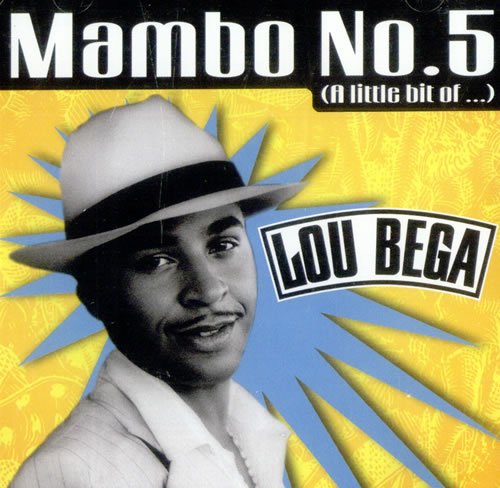
Lou Bega “Mambo No. 5” hit #1 in UK

Mambo No. 5 (A Little Bit of…)

Lou Bega

Writer(s): Dámaso Pérez Prado, Lou Bega, Zippy Davids (see lyrics here)


Released: April 19, 1999


First Charted: August 7, 1999


Peak: 3 US, 15 RR, 26 AC, 2 A40, 12 UK, 111 CN, 18 AU, 8 DF (Click for codes to singles charts.)


Sales (in millions): -- US, 1.15 UK, 6.0 world (includes US + UK)


Airplay/Streaming (in millions): 0.3 radio, 478.5 video, 402.23 streaming

Awards:

Click on award for more details.

About the Song:

Pérez Prado was a Cuban bandleader who popularized the mambo in the 1950s. He even topped the US and UK charts with a cover of “Cherry Pink and Apple Blossom White” in 1955. In the mid-‘90s, his music was embraced by “the rejectionists and crate-diggers of post-industrial music” FT who discovered his music in charity shops and thrift stores. A compilation assembled by curator Irwin Chusid included some of Prado’s mambo recordings, helping the music cross back into the “semi-mainstream becoming mainstays of the ‘spage age pop’ compilations and easy listening clubs that sprung up in the mid-90s.” FT

Amidst a love affair with Latin music in 1999, the United States saw Ricky Martin, Jennifer Lopez, Enrique Igleasias, and Carlos Santana all soar to the top of the charts. In Europe, the German-born Lou Bega born to one parent from Uganda and another from Italy became an unlikely revivalist of Prado’s music. The singer, rapper, and trumpeter released a cover of Prado’s “Mambo No. 5,” an instrumental originally written in 1949. It became a #1 hit in Germany and then imports started selling in the UK and after it was released officially it went to #1. It had similar success throughout Europe, most notably in France where it spent 20 weeks at #1. In the United States, it was his only top-40 hit, reaching #3.

The song wasn’t a straight remake. “Whatever suavity and quiet confidence the mambos of the 40s and 50s exuded are of no interest to Lou Bega.” KT He refashions the song into “a sort of mock-Latin Benny Hill, rasping and chuckling his way through his list of ladies.” KT all of whom he claimed to have been actual old flames. KL The newly-added lyrics and ‘80s style synthesizers showed “he had a devilish ear for what would make an office party swing.” KT Science even deterimined it to be one of “the most catchy songs ever.” KT Bega said, “Mambo makes you happy, Latin music makes you happy. It’s sexual, it’s erotic, energetic; I think that’s the point.” SF

The song became the subject of a copyright trial with the Federal Court of Justice of Germany ultimately ruling it was a song written by Prado and Bega.


Resources:

  • DMDB encyclopedia entry for Lou Bega
  • FT Freaky Trigger (11/26/2014). “Popular” by Tom Ewing
  • KL Jon Kutner and Spencer Leigh. (2005). 1000 UK Number One Hits. Omnibus Press: London, UK. Pages 486-7.
  • SF Songfacts
  • WK Wikipedia


First posted 10/22/2022.