Showing posts with label Harry Carroll. Show all posts

Friday, December 14, 2018

100 years ago: “I’m Always Chasing Rainbows” hit #1

I’m Always Chasing Rainbows

Charles Harrison

Writer(s): Frederick Chopin (music), Harry Carroll (music), Joseph McCarthy (words) (see lyrics here)


First Charted: November 8, 1918


Peak: 15 US, 3 GA, 12 SM (Click for codes to charts.)


Sales (in millions): 1.0 (sheet music)


Airplay/Streaming (in millions): -- radio, 0.17 video, -- streaming

Awards:

Click on award for more details.

About the Song:

Harry Carroll adapted the music from the melody of Frédéric Chopin’s “Fantaisie Impromptu in C sharp minor.” It was “one of the first instances of a popular song being lifted from a famous classical composition.” TY2 Joseph McCarthy added lyrics “about things always going wrong.” SM The singer has tried to find happiness, but says “my dreams have all been denied.” He then asks, “Why have I always been a failure / What can the reason be? / I wonder if the world’s to blame / I wonder if it could be me?” TY2

The song was introduced in the Broadway show Oh Look, SM sung by vaudeville dancer, actor, and comedian Harry Fox DJ and the identical twins Rose and Jenny – known as the Dolly Sisters. SM

The version that reached #1 on the charts, however, was by Charles Harrison. His was one of four versions to chart in 1918. The others were by Fox (#5), Prince’s Orchestra (#6), and Sam Ash (#9). PM The song was also featured in the movie musicals Ziegfeld Girl (1941), sung by Judy Garland, The Merry Monahans (1944), and The Dolly Sisters (1945).

The latter version was sung by Betty Grable and revived interest in the song, leading to three more chart versions in 1945-46 by Perry Como (#5), Helen Forrest & Dick Haymes (#7), and Harry James’ Orchestra with Erno Rapee on vocals (#9). PM Other versions have been recorded by Julie Andrews, Tony Bennett, Henry Burr, Diahann Carroll, Petula Clark, Alice Cooper, Bing Crosby, Sammy Davis Jr., Benny Goodman, Al Jolson, Liberace, Guy Lombardo, Harry Nilsson, Debbie Reynolds, Frank Sinatra, Jo Stafford, and Barbra Streisand. WK


Resources:


Related Links:


First posted 3/20/2023.

Tuesday, July 15, 2014

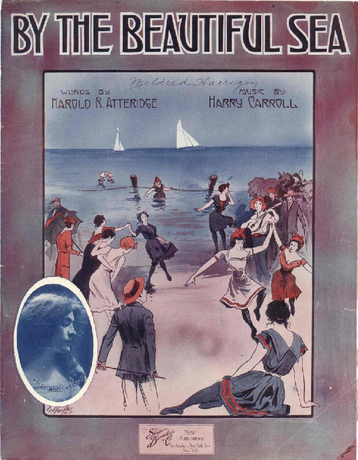
100 years ago: “By the Beautiful Sea” hit #1

By the Beautiful Sea

Heidelberg Quintet

Writer(s): Harold R. Atteridge (words), Harry Carroll (music) (see lyrics here)


First Charted: July 15, 1914


Peak: 16 US, 112 GA, 110 SM (Click for codes to charts.)


Sales (in millions): 1.0 (sheet music)


Airplay/Streaming (in millions): -- radio, 0.17 video, -- streaming

Awards:

Click on award for more details.

About the Song:

“This was a story about a happy couple, Joe and Jane who love the summer and anything that Joe suggests, Jane would always think it was best for her, so he’d get his Ford, holler all aboard and off they would go for day out by the beautiful sea…It was only in verse two that their sordid little affair came to light.” SM While extramarital affairs were nothing new, it was “surprising…that the subject was part of a poular song.” TY2

The Stanford Four introduced the song in vaudeville. DJ To publicize the song, the publisher hired a group of boys in sailor suits to perform the song at Coney Island. TY2 The song was further popularized by Muriel Window who integrated the song into the revue The Passing Show of 1914. TY2 It went on to chart three times in 1914. Prince’s Orchestra took the song to #6 and there were chart-topping version by Ada Jones & Billy Watkins as well as by the Heidelberg Quuintet. PM The latter was the first to chart and spent more weeks at #1.

“By the Beautiful Sea” was the second #1 song for the Heidelberg Quintet, but their lineup was different than when they hit #1 with “Waiting on the Robert E. Lee.” Billy Murray, Steve Porter, William F. Hooley (all members of the American Quartet as well), and Will Oakland were all still members but John Bieling had been replaced by Robert Armour. “The vocals on this song were dominated by Billy Murray with all the other members joining in background harmonies only. Will Oakland’s high counter tenor voice could not be heard at all.” SM

The song was also used in the films The Story of Vernon and Irene Castle (1939), Coney Island (1943), Atlantic City (1944), and Some Like It Hot (1959). DJ Judy Garland and Gene Kelly performed it in the 1942 movie For Me and My Gal. TY2


Resources:


First posted 2/27/2023.


Friday, July 5, 2013

100 years ago: “The Trail of the Lonesome Pine” hit #1

The Trail of the Lonesome Pine

Henry Burr & Albert Campbell

Writer(s): Ballard MacDonald (words), Harry Carroll (music) (see lyrics here)


First Charted: June 21, 1913


Peak: 13 US, 11 GA, 16 SM (Click for codes to charts.)


Sales (in millions): 1.0 (sheet music)


Airplay/Streaming (in millions): -- radio, 0.02 video, -- streaming

Awards:

Click on award for more details.

About the Song:

This song about the old west was inspired by the 1908 novel by John Fox, SM which was set in the Cumberland Mountains of Kentucky. It “appears to be a ‘cowboy’ song, but it is set in the Blue Ridge Mountains of Virginia.” TY2 The singer tells us about his girl, who lives in a cabin in the mountains “where a lonesome pine stands.” TY2 He plans to marry her, but meanwhile is waiting underneath that pine tree. They carve their names “under the moonlight in the Blue Ridge Mountains of Virginia on the trail of the lonesome pine.” SM

Muriel Window interpolated the song into The Passing Show of 1914. TY2 Henry Burr teamed up with Albert Campbell, his cohort in the Peerless Quartet, for a #1 version of the song. Between them they scored a whopping 34 #1 songs. Burr topped the charts 16 times on his own and eight times with Campbell, who had three #1’s of his own. With the Peerless Quartet, they had seven songs reach the pinnacle. PM

Elsie Baker and James F. Harrison also recorded the song, taking it to #9 that same year. PM The song was also featured in the stage play The Trail of the Lonesome Pine and its 1936 film adaptation. WK In 1937, Laurel & Hardy sang a “delightful and comic” TY2 version of the song in the movie Way Out West In 1975, their version got to #2 in the UK, thanks to its inclusion on Laurel & Hardy – The Golden Age of Hollywood Comedy, an album of dialogue and songs. WK DJ John Peel championed the song on his Radio 1 evening show. WK

The song is popular in square dancing and was the favorite song of novelist, playright, and poet Gertrude Stein. WK


Resources:


Related Links:


First posted 2/27/2023.