Showing posts with label Trevor Horn. Show all posts

Saturday, May 20, 2023

Yes et al: Top 100 Songs/Top 20 Albums

Yes et al

Top 100 Songs

Progressive rock group formed in London in 1968. The original members were:

  • Jon Anderson (vocals: 1968-80, 1983-88, 1990-2004)
  • Chris Squire (bass: 1968-2015). Died in 2015.
  • Tony Kaye (keyboards: 1968-71, 1982-94)
  • Peter Banks (guitar: 1968-70)
  • Bill Bruford (drums: 1968-72, 1990-92)

Future members included:

  • Steve Howe (guitar: 1970-81, 1990-92, 1995-present)
  • Rick Wakeman (keyboards: 1971-74, 1976-80, 1990-92, 1995-96, 2002-04)
  • Alan White (drums: 1972-2022)
  • Patrick Moraz (keyboards: 1974-76)
  • Geoff Downes (keyboards: 1980-81, 2011-present)
  • Trevor Horn (vocals: 1980-81)
  • Trevor Rabin (guitar, vocals, keyboards: 1982-94)
  • Billy Sherwood (bass, keyboards, guitar: 1997-2000, 2015-present)
  • Igor Khoroshev (keyboards: 1997-2000)
  • Benoit David (vocals: 2008-12)
  • Oliver Wakeman (keyboards: 2008-11)
  • Jon Davison (vocals: 2012-present)
  • Jay Schellen (drums: 2022-present)

Anderson, Bruford, Wakeman, Howe also recorded together from 1988-92, but under their names as they didn’t have rights to use the Yes moniker. Downes and Horn worked together in the Buggles before joining Yes. Howe and Downes formed Asia after departing from Yes in 1981. Howe was also in the short-lived GTR in 1986.

Click here to see other acts’ best-of lists.


Spotify Podcast:

Check out Dave’s Music Database podcast: The Best of Yes based on this list. It debuts October 5, 2021 at 7pm CST. New episodes based on Dave’s Music Database lists are posted every Tuesday at 7pm CST.

Awards:


Top 100 Songs


This list was created by tallying the number of appearances songs had on Yes compilations and live albums as well as best-of lists focused on Yes songs. The top 100 ranking songs were then re-ranked according to their overall status on Dave’s Music Database, which integrates best-of lists as well as chart success, sales, radio airplay, streaming, and awards. A few lists incorporated some Yes-related material, hence the inclusion of songs by the Buggles, Asia, GTR, Jon Anderson (solo), and Anderson, Bruford, Wakeman & Howe.

DMDB Top 2%:

1. Owner of a Lonely Heart (1983)
2. Roundabout (1971)
3. Video Killed the Radio Star (The Buggles, 1979)

DMDB Top 5%:

4. I’ve Seen All Good People (1971)
5. Heat of the Moment (Asia, 1982)

DMDB Top 10%:

6. And You and I (1972)
7. Starship Trooper (1971)
8. Long Distance Runaround (1971)
9. Leave It (1983)

DMDB Top 20%:

10. Only Time Will Tell (Asia, 1982)

11. Yours Is No Disgrace (1971)
12. Wonderous Stories (1977)
13. Love Will Find a Way (1987)
14. Going for the One (1977)
15. Rhythm of Love (1987)
16. America (1972)
17. Heart of the Sunrise (1971)
18. Don’t Cry (Asia, 1983)
19. Go (Asia, 1985)
20. The Smile Has Left Your Eyes (Asia, 1983)

21. It Can Happen (1983)
22. Lift Me Up (1991)
23. Changes (1983)
24. When the Heart Rules the Mind (GTR, 1986)

Beyond the DMDB Top 20%:

25. Don’t Kill the Whale (1978)
26. Soon (1974)
27. Hold On (1983)
28. Close to the Edge (1972)
29. Days Like These (Asia, 1990)
30. Wildest Dreams (Asia, 1982)

31. Shoot High Aim Low (1987)
32. The Calling (1994)
33. Siberian Khatru (1972)
34. Amazing Grace (1976)
35. Time and a Word (1970)
36. Our Song (1983)
37. Cage of Freedom (Jon Anderson, 1984)
38. Every Little Thing (1969)
39. South Side of the Sky (1971)
40. Sole Survivor (Asia, 1982)

41. Open Your Eyes (1997)
42. Brother of Mine (Anderson, Bruford, Wakeman & Howe; 1989)
43. I Would Have Waited Forever (1991)
44. Make It Easy (1982)
45. Walls (1994)
46. Final Eyes (1987)
47. Tempus Fugit (1980)
48. We Have Heaven (1971)
49. Fly from Here: We Can Fly (2011)
50. Homeworld (The Ladder) (1999)

51. Awaken (1977)
52. Sweet Dreams (1970)
53. Big Generator (1987)
54. Run with the Fox (Chris Squire & Alan White, 1981)
55. The Clap (1971)
56. The Fish (Schindleria Praematurus) (1971)
57. City of Love (1983)
58. The Gates of Delirium (1974)
59. Holy Lamb (1987)
60. Survival (1969)

61. Saving My Heart (1991)
62. Ritual (Nous Sommes du Soleil) (1973)
63. No Opportunity Necessary, No Experience Needed (1970)
64. Perpetual Change (1971)
65. Dear Father (1970)
66. Then (1970)
67. Does It Really Happen? (1980)
68. The Revealing Science of God (Dance of the Dawn) (1973)
69. Turn of the Century (1977)
70. Looking Around (1969)

71. Something’s Coming (1969)
72. Hearts (1983)
73. Love Conquers All (1991)
74. Astral Traveller (1970)
75. Sound Chaser (1974)
76. Money (That’s What I Want) (1978)
77. Without Hope You Cannot Start the Day (1991)
78. I’m Down (1976)
79. Sweetness (1969)
80. The Ice Bridge (2021)

81. Mood for a Day (1971)
82. The More We Live – Let Go (1991)
83. Into the Lens (1980)
84. Order of the Universe (Anderson Bruford Wakeman Howe, 1989)
85. To Be Over (1974)
86. Machine Messiah (1980)
87. Parallels (1977)
88. Onward (1978)
89. Run Through the Light (1980)
90. Miracle of Life (1991)

91. Mind Drive (1997)
92. Release Release (1978)
93. Everydays (1970)
94. Lightning Strikes (1999)
95. On the Silent Wings of Freedom (1978)
96. State of Play (1994)
97. Talk (Part 2 of “Endless Dream”) (1994)
98. Masquerade (1991)
99. Dare to Know (2021)
100. Arriving UFO (1978)


Yes: Studio Albums Ranked


Dave’s Music Database lists are determined by album’s appearances on best-of lists as well as chart success, sales, critics’ ratings, and awards. Also factored in are the status of each album’s songs in Dave’s Music Database for songs.

1. Fragile (1971)
2. Close to the Edge (1972)
3. The Yes Album (1971)
4. 90125 (1983)
5. Tales from Topographic Oceans (1973)
6. Relayer (1974)
7. Going for the One (1977)
8. Big Generator (1987)
9. Drama (1980)
10. Tormato (1978)

11. Union (1991)
12. Fly from Here (2011)
13. Talk (1994)
14. Anderson Bruford Wakeman Howe (1989)
15. Time and a Word (1970)
16. Yes (1969)
17. Heaven & Earth (2014)
18. The Ladder (1999)
19. Magnification (2001)
20. KeyStudio (2001 – studio cuts from 1996’s Keys to Ascension and 1997’s Keys to Ascension 2)

21. Open Your Eyes (1997)


Resources and Related Links:

First posted 7/24/2021; last updated 5/20/2023.

Wednesday, June 22, 2011

Yes Fly from Here released

Fly from Here

Yes


Released: June 22, 2011


Peak: 36 US, 30 UK, -- CN, -- AU


Sales (in millions): -- US, -- UK, -- world (includes US and UK)


Genre: progressive rock


Tracks:

Song Title (Writers) [time] (date of single release, chart peaks) Click for codes to singles charts.

  1. Fly from Here: Overture (Downes, Horn, Squire) [1:54]
  2. Fly from Here Pt. I: We Can Fly (Downes, Horn, Squire) [6:00] (6/13/11, --)
  3. Fly from Here Pt. II: Sad Night at the Airfield (Downes, Horn) [6:41]
  4. Fly from Here Pt. III: Madman at the Screens (Downes, Horn) [5:17]
  5. Fly from Here Pt. IV: Bumpy Ride (Howe) [2:15]
  6. Fly from Here Pt. V: We Can Fly (Reprise) (Downes, Horn, Squire) [1:40]
  7. The Man You Always Wanted Me to Be (Squire, Gerard Johnson, Simon Sessler) [5:01]
  8. Life on a Film Set (Downes, Horn) [4:57]
  9. Hour of Need (Howe) [3:07]
  10. Solitaire (Howe) [3:30]
  11. Into the Storm (David, Horn, Howe, Squire, Wakeman, White) [6:49]


Total Running Time: 47:28


The Players:

  • Benoit David (vocals)
  • Steve Howe (guitar, backing vocals)
  • Chris Squire (bass, backing vocals)
  • Alan White (drums)
  • Geoff Downes (keyboards)
  • Trevor Horn (backing vocals, additional keyboards)
  • Oliver Wakeman (keyboards)

Rating:

3.242 out of 5.00 (average of 12 ratings)


Quotable: Good news for fans of 1980 album Drama. Bad news for fans of classic Yes.

About the Album:

“Fly from Here is the band’s first studio album since the release of Magnification (2001), the longest gap to date between two Yes studio albums.” WK This also marks only the second time in Yes history that Jon Anderson is not the lead singer. He “suffered a series of asthma attacks in 2008 and the band’s 40th anniversary tour was put on hold. Over time, Anderson grew apart from the rest of the band since he wanted to rest and the other guys really wanted to tour. Enter Canadian singer BenoĆ®t David who had fronted the Yes tribute band Close to the Edge” JG “for over ten years.” WK

“The absence of Jon Anderson is well-felt” UR although “the optimistic platitudes found in the lyrics faintly mirror the Anderson poetry of old, even if it comes in a more generic form: ‘Every day that you waste is once more that you’ve lost,’ ‘Turn yourself around / turn your life around / turn your world around / turn this ship around’ and ‘I want to be the one / who always gives you shelter.’ Tolstoy in motion, it is not. Yes’ extended works always promise to be more than a string of unrelated ideas, but just know that this isn’t the ‘Gates of Delirium.’” JG

The only other time Anderson wasn’t on a Yes album was for 1980’s Drama. Trevor Horn served as the vocalist then and is actually back again, this time in a production capacity. He also produced 1983’s 90125 and 1987’s Big Generator. Incidentally, David “sounds more like Trevor Horn than Jon Anderson.” HD

This album also marks the return of keyboardist Geoff Downes, whose only other album with Yes was Drama. Oliver Wakeman, the son of longtime Yes keyboardist Rick Wakeman, toured with Yes in recent years and even contributed some writing and recording on Fly from Here before Downes stepped in to handle “most of the keyboards.” WK The “piano and keyboards are in much more of a supporting role, but Geoff Downes plays very well and adds new layers to the soundscape.” HD His work has also been said to be “less effective and less impressive when compared to the synth job he did for Drama.” UR

Bassist Chris Squire (the only Yes member featured on all of their albums), guitarist Steve Howe, and drummer Alan White round out the lineup. All three were part of the classic Yes lineup from 1971 to 1979 and the 1980 Drama album, originally assumed to be the band’s last hurrah. However, Squire and White kept the band going through the 1980s with Trevor Rabin on guitar. The trio reunited in 1997 and have worked together since.

Depending on one’s point of view, “Squire’s bass lines are very strong” HD or “he sounds old and slow.” UR White’s “drumming on the album is surprisingly muted and inoffensive in the mix, and keeps the beat effectively.” HD

This album also ties to the Drama era because of the title cut which is based on a song from that era. “Downes and Horn had first approached Yes with a demo of their song ‘We Can Fly from Here’ in 1980, prior to joining the band.” WK It was “recorded as a studio demo, and left off Drama, but was performed on the album’s supporting 1980 tour. A live version from that year appears on The Word Is Live (2005). After Yes disbanded in 1981, Horn and Downes recorded another demo of the song (this time as a two-part suite) for possible inclusion on The Buggles’ second album Adventures in Modern Recording (1981) but it was also left off the album.” WK It was, however, included on a 2010 reissue of the album.

“This new Yes version will mark the first airing of a finished studio recording of Fly from Here, with Parts I and II based on the earlier two parts of the song. According to Squire, the title track will be the band’s eleventh epic piece, their first in 15 years, which clocks in at nearly 25 minutes.” WK The suite is “much more focused on vocals over instrumental passages, but this works in its favor and is surprisingly refreshing. Given its beginnings as a Buggles composition, it makes sense that it’s more vocal-centric.” HD

It “has a steady rise and fall not unlike Drama’s opener ‘Machine Messiah’, making sure that every note and lyric serves its scene-setting purpose. There’s something about this carefully-measured approach to writing extended progressive rock, one that flies in the face of the more organically-minded elastic forms of Tales from Topographic Oceans and Relayer, that feels slightly stifling.” JG

“Steve Howe is less present both compositionally and aurally in this suite…In previous Yes albums he often collaborated with Jon to compose a lot of the songs, so perhaps Jon’s absence is detracting from his contributions.” HD His playing on the piece has been described both as “spectacular” HD and “mediocre, with no standout solo or new technique.” UR

The suite “begins with an overture that introduces several key motifs of the piece, predominantly those later heard in ‘Madman at the Screens’.” HD The piece is marked by “dynamic and containing contrasting piano and guitar” HD and some “very Drama-esque snare hits accentuate the rhythm.” HD

“In the next section, We Can Fly, ambient sound effects and soft piano introduce the first vocals on the album.” HD One review says, “Benoit's voice is lifeless, uninspired and boring” UR while another says “Benoit has a truly beautiful voice” HD and that “his harmonies with Chris and Steve also work very well. Anderson purists may dislike the difference in the sound of the vocals without Jon…but…compositional strength…definitely isn’t lacking here.” HD

“The main chorus, with Chris and Steve providing strong backing vocals, is very impressive and memorable. Not only is this a testament to the skill of the musicians, but Trevor Horn’s excellent production. Trevor creates a very subtle and well-balanced mix that compliments the music perfectly.” HD

“The second part, Sad Night at the Airfield, begins with understated acoustic guitar and vocals, the melody almost melancholic, but soon builds into a plaintive threnody, a tonal shift which completely alters the feel of the piece, and the song continues to alternate between these two themes.” HD

“Madman at the Screens expands on the themes introduced in the overture with more vocals from Benoit. Along with the vocals, the bass lines and keyboards really carry this section, and it has a more aggressive edge. Concluding the section is the main piano and vocal-led theme from earlier.” HD

“Bumpy Ride is the most progressive section in the suite, though it is very brief.” HD It has moments reminiscent of “‘Tempus Fugit’ on Drama.”

“In We Can Fly Reprise the chorus from the first section is briefly revisited. The re-emergence of this theme is truly stunning and powerful, concluding the suite beautifully.” HD

“The second half of Fly from Here is tame and unassuming by comparison. Howe’s distorted power chords and White’s tricky meters largely go into hiding on tracks like ‘The Man You Always Wanted Me to Be’ and ‘Hour of Need’…These songs are representative of Yes’ purgatory state, one that flirts with concise pop forms but is afraid to fully commit to them.” JG

The Man You Always Wanted Me to Be “is much more acoustic and light. Chris sings lead vocals on this track, and sounds quite good.” HD His “vocal delivery obviously comes from a personal place” JG and “Benoit provides excellent harmony. While it’s not the most amazing composition, the musicianship elevates it to a good track.” HD

Life on a Film Set is also a reworking of a song from around the Drama era. The Buggles’ reissue of Modern Recording also featured a demo called “Riding a Tide”, upon which “Film Set” is based. WK “Though it probably wasn’t written with Yes in mind, it seems to fit the Squire/Howe/White approach like a glove even if the song isn’t impressively memorable” JG and “seems to meander and ends before it can really get anywhere interesting.” HD

“Hour of Need begins with excellent acoustic guitar and pleasant vocals” HD “Howe’s lyrics…are cynicism without a target – ends justifying means, mouths to feed, so on.” JG

“Solitaire is “an acoustic solo piece by Steve Howe” WK “in the vein of ‘The Clap’ and ‘Mood for a Day’ and is easily as enjoyable as those two songs.” HD It also marks “one of the first Howe solo tracks to be used on a Yes album since 1991’s Union.” JG

“Into the Storm is probably the strongest ensemble song aside from the title track.” HD It’s here where “Yes sounds the most surefooted and perked.” JG “It’s more of an upbeat rocker.” HD “The harmonies between David, Squire and Howe are very enjoyable, and there’s even a catchy synth riff.” HD Howe and the keyboardist (whether its Wakeman or Downes), “match on a theme centered on a broken chord, one that gives the song drive and the album some much-needed momentum. As far as the lyrics go, you can say that humility has finally arrived to Yes: ‘One thing I learned from all these years / as stupid now as we were at first / maybe that’s the way it goes / when you try to change the world.’” JG

“The entire sound is reminiscent of Drama, yet where Drama had a harder edge, Fly from Here is softer, taking you through sweeping vistas of themes and melodies that will remain ingrained in your mind long afterwards.” HD As one detractor says, though, at least Drama “had some good rock songs. This album…doesn’t have a single good song.” UR “Most Yes fans have been used to bad albums from about 1983 to the present. This is one of the worst.” UR

However, another reviewer says, “Fly from Here is not a disaster. It has too much enthusiasm for itself to sink like some of Yes’ more embarrassing transitional albums. At the same time, it’s overall less tuneful than The Ladder or Magnification and less moody and compelling than their ‘70s work.” JG However, “the real question is: does this lineup of Yes have potential? They do.” JG


Notes: The Japanese version includes a second, longer version of “Hour of Need.” In 2018, a new version of the album (known as Fly From Here: Return Trip) was released with Trevor Horn’s vocals instead of Benoit David. The new version also included the previously unreleased track “Don’t Take No for an Answer.”

Resources and Related Links:

First posted 6/7/2011; updated 7/25/2021.

Sunday, May 12, 2002

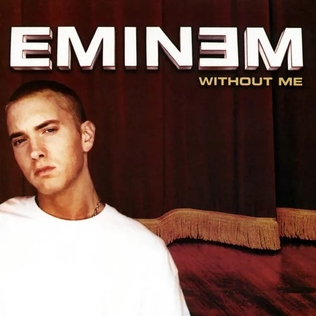
Eminem released “Without Me”

Without Me

Eminem

Writer(s): Marshall Mathers, Jeffrey Bass, Kevin Bell, Anne Dudley, Malcolm McLaren, Trevor Horn (see lyrics here)


Released: May 12, 2002


First Charted: May 10, 2002


Peak: 2 US, 11 RR, 13 RB, 15 AR, 11 UK, 4 CN, 15 AU, 21 DF (Click for codes to charts.)


Sales (in millions): 7.0 US, 1.8 UK, 9.01 world (includes US + UK)


Airplay/Streaming (in millions): 0.2 radio, 1027.8 video, 1311.64 streaming

Awards:

Click on award for more details.

About the Song:

“Without Me” was released as the lead single for American rapper Eminem’s fourth album, The Eminem Show. It reached #1 in fifteen countries. The song features “catchy lyrics, the bizarre music video, and…extremely dense rhyming schemes.” JR In a Rolling Stone album review, Kris Ex describes the song as “a fun-loving, barb-laden romp on which he flits from one topic to the next like a bumblebee with ADD.” RS

The song received Grammy nominations for Record of the Year and Best Male Rap Solo Performance and won the Grammy for Best Music Video. It also won four MTV Video Music Awards, including Video of the Year. The video features him with Dr. Dre as parodies of Batman and Robin. They “rescue” a young boy from listening to The Eminem Show, which has a parental advisory on it.

The song was intended as a sequel to “The Real Slim Shady” from The Marshall Mathers LP. Eminem boasts that he is back to save the world, explaining how the music industry and culture in general was boring without him. He also mocks then Vice-President Dick Cheney and his wife Lynne, the latter specifically for her comments that Eminem was “degrading and violating [women] to new levels.” JR

He also lashes out at his mother Debbie, who sued him for being mentioned in “My Name Is” from The Slim Shady LP. He tackles the FCC, Limp Bizkit, and Moby. He refers to the latter as a techno artist and says no one listens to techno. JR He also parodies Prince changing his name to a symbol and mocks comparisons of himself to Elvis Presley as a white artist milking a traditional black art form for success.


Resources:


Related Links:


First posted 2/12/2021; last updated 6/25/2023.

Saturday, January 28, 1984

Frankie Goes to Hollywood hit #1 in the UK with “Relax”

Relax

Frankie Goes to Hollywood

Writer(s): Peter Gill, Holly Johnson, Brian Nash, Marc O’Toole, Paul Rutherford (see lyrics here)


Released: October 24, 1983


First Charted: November 26, 1983


Peak: 10 US, 13 CB, 22 GR, 10 RR, 15 UK, 11 CN, 5 AU, 9 DF (Click for codes to singles charts.)


Sales (in millions): 1.0 US, 2.15 UK, 3.20 world (includes US + UK)


Airplay/Streaming (in millions): -- radio, 41.8 video, 203.99 streaming

Awards:

Click on award for more details.

About the Song:

“Merseyside-based group Frankie Goes to Hollywood…first premiered this track on pivotal [UK] music show The Tube. It sounded like late-Seventies funk. So they hooked up with producer Trevor Horn” MG who had a smash with the Buggles’ “Video Killed the Radio Star,” which he called “a single that you could dance to.” TC He crafted three versions before they hit on the fourth and final cut which only featured member Holly Johnson, with the exception of the sound of the rest of the band jumping into a swimming pool. MG

With its “heavy breathing and the stuttering musical passages, [‘Relax’] owed a debt to Giorgio Moroder’s singles with Donna Summer” TC with “a more mechanical, disco-based sound.” LW The song had stalled within six weeks of its release after a peak at #55. Then its fortunes reversed. DJ Mike Reid had been playing the song, but abruptly stopped – supposedly on air midway through the song – after reading the lyrics. He considered the “sexually orientated lyrics” MG “overtly obscene,” LW despite Johnson’s unbelievable claim that the song, with its “joyful, tongue-in-cheek lasciviousness,” TC wasn’t about sex. LW The BBC then banned the song from daytime radio airplay. DR

Coupled with the news of Johnson’s open homosexuality, TC the controversy generated curiosity about the song, “ensuring its swift rise from #35 into the [UK] top ten (#6) the following week, and on to #1 two weeks later.” MG The song got another boost, going back to #2, when the follow-up single, “Two Tribes,” soared to #1. “Relax” spent 48 consecutive weeks on the UK chart. After it re-entered and was reissued in 1993, it racked up a total of 59 weeks on the chart. MG

The band will also “be remembered for the record’s unique marketing technique: the t-shirts. Paul Morley, co-director with Horn of ZTT Records, dreamt up the idea, and sold it to the band for £200-300. Soon everybody had snapped up a t-shirt, emblazoned with phrases such as ‘Frankie Says ‘Relax!’” MG


Resources:


First posted 11/13/2019; last updated 11/25/2022.

Saturday, January 21, 1984

Yes hit #1 with “Owner of a Lonely Heart”

Owner of a Lonely Heart

Yes

This post has been moved here.

Monday, August 18, 1980

Yes Drama released

Drama

Yes


Released: September 18, 1980


Peak: 18 US, 2 UK, 41 CN, 69 AU


Sales (in millions): -- US, 0.06 UK


Genre: progressive rock


Tracks:

Song Title (Writers) [time] (date of single release, chart peaks) Click for codes to singles charts.

  1. Machine Messiah [10:18]
  2. White Car [1:18]
  3. Does It Really Happen? [6:27]
  4. Into the Lens (I Am a Camera) [8:31] (8/6/80, --)
  5. Run Through the Light [4:41] (1/81, --)
  6. Tempus Fugit [5:12]

All songs written by Downes, Horn, Howe, Squire, and White.


Total Running Time: 36:30


The Players:

  • Geoff Downes (keyboards)
  • Trevor Horn (vocals, bass)
  • Steve Howe (guitar, mandolin, backing vocals)
  • Chris Squire (bass, backing vocals, piano)
  • Alan White (drums, percussion, backing vocals)

Rating:

3.101 out of 5.00 (average of 8 ratings)

About the Album:

After 1978’s Tormato, singer Jon Anderson and keyboardist Rick Wakeman were “enthusiastic about creating a new album, and the rest of the band was lukewarm over the idea, given the relative failure of the last album. This in turn discouraged both Anderson and Wakeman, with the latter at times refusing to leave his room, and both men dejectedly spending time at a local bar. They quit the band soon afterwards.” WK

Remaining members Chris Squire (bass), Steve Howe (guitar), and Alan White (drums) opted to continue without them. “Trevor Horn and Geoff Downes of The Buggles, who had recently had a number one hit in the UK with ‘Video Killed the Radio Star’, and were managed by Yes’ long-time manager Brian Lane, were working in an adjacent studio, and, being Yes fans, introduced themselves. As it happened, Squire owned and enjoyed their first album, and the pair were invited to sit in during rehearsals. They were soon asked to join the band.” WK

The resulting album, 1980’s Drama, “featured a harder-edged Yes with a distinct new wave flavour (in no small part due to the two new recruits).” WK “For classically inclined fans, it was a jarring departure; but it was a harbinger of Yes and Asia albums to come. A newly emboldened Chris Squire lays down aggressive rhythms with Alan White, and Steve Howe eschews his usual acoustic rags and flamenco licks for a more metallic approach, opting for sheets of electric sound.” PC

“Perhaps to ensure that some of the old glory was there, Roger Dean was commissioned to design his first Yes cover in five years, and Eddie Offord, who had co-produced the band in their 1971-1974 heyday, returned to the studio for assistance.” WK

“Although the songs are all group credited, Into the Lens and White Car are basically Buggles compositions (an alternate version of ‘Into the Lens’ appeared on the second Buggles album Adventures in Modern Recording as ‘I Am a Camera’; the song is based on Christopher Isherwood’s Berlin stories.” WK

Does It Really Happen?, Run Through the Light and Tempus Fugit with its “manic ska inflections” PC “were developed by Squire, White and Howe before Horn and Downes joined the band; Horn added lyrics.” WK

The “doom-laden” PC “Machine Messiah was based on another Buggles composition, but with considerable input from the other three, and therefore the only truly group composition on the album.” WK

“The two demo songs ‘We Can Fly from Here’ and ‘Go Through This’ did not end up on the album, although the band did play both of them on the subsequent tour. Live recordings of these songs were released on The Word Is Live.” WK

“Drama fared very well in the UK charts, reaching #2 there, but American audiences were not so sure, with Drama becoming Yes’ first album there in years to not reach the Top 10 or go gold. Still, the US tour was a big success. They were not so lucky on the UK leg, with some fans angry over Anderson’s replacement and Horn’s voice suffering from his first experience of major touring, as well as his efforts to match Anderson’s higher register. Horn subsequently quit the band” WK and “went into production; Howe and Downes joined Asia, and Squire and White toyed and then gave up on a pair-up with Robert Plant and Jimmy Page, which was to be titled XYZ (i.e., Ex-Yes and Zeppelin).” PC The Yes story wasn’t over yet, though – a new lineup would emerge in 1983 with the band’s most successful album yet – 90125.


Notes: A 2004 reissue added single versions of “Into the Lens” and “Run Through the Light,” tracking sessions for “Tempus Fugit” and “White Car,” and the songs “Have We Really Got to Go Through This,” “Song No. 4 (Satellite),” “Dancing Through the Light,” “Golden Age,” “In the Tower,” and “Friend of a Friend.”

Resources and Related Links:

First posted 6/7/2011; updated 7/25/2021.