


 | Aural Fixation:Why Radio Still Matters |
 |
“Aural Fixation” is a music-themed column I wrote for PopMatters.com from 2011-2013. They are no longer online there, but I have reformatted them here at the DMDB blog with additional videos, photos, and links, such as where to buy referenced albums. I have also used the title “Aural Fixation” for any essays I have written outside of PopMatters.com as well. To see the essays, check out the Dave’s Music Database Aural Fixation page.
The essays from PopMatters.com have been gathered in book form as Aural Fixation: Essays from a Music Obsessive. Essays written from 2009 to 2011 have been gathered in the book No One Needs 21 Versions of “Purple Haze”. You can purchase the essays in book format here. |
My kids roused me out of bed on Father’s Day morning to come eat breakfast. I suspect my wife did all the cooking, but the handmade cards stuffed in the donut box were original work. Among my gifts was a book called The Hits Just Keep on Coming: The History of Top 40 Radio. Nary a holiday slips by without me shredding the wrapping paper from some music-related book. My family knows me well. My history with radio began in the 1970s in my pre-teen years. Walt Bodine, a staple of Kansas City radio for more than 70 years before his death just a few months ago, did a call-in show on various topics. One night focused on left-handedness. I dialed in to share my earth-shattering talent for capably manipulating right-handed scissors despite being a Southpaw. Before you scratch your head too much over why a kid was listening to an AM talk radio call-in show hosted by a guy more than four decades his senior, I blame my father. He faithfully listened to sports and talk radio. As a kid, I could have rattled off the entire rosters of the Royals late-‘70s and early ‘80s baseball teams. I still watch televised Chiefs football games with the sound turned down. Why? I subscribe to Dad’s philosophy of listening to the local (and biased) radio announcers instead of the national television broadcasters. Radio was a staple of my dad’s young life in rural Georgia in the 1930s and ’40s. When my brother and I took him out for a barbeque dinner to celebrate Father’s Day, I asked him about his memories of radio. He recalled his mom listening to farm reports while he followed adventure-oriented serials like Jack Armstrong, the All-American Boy and The Adventures of Superman. At night he could pick up AM stations as far away as Chicago. Even today he follows University of Georgia football games via internet radio and webcasts. 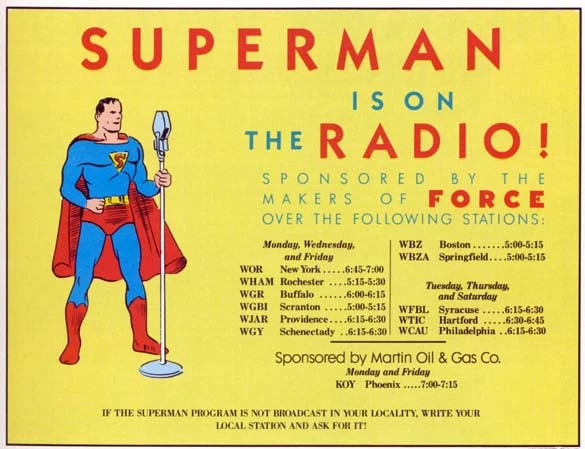 While Walt Bodine made for my earliest radio memory, my focus shifted away from the talk, sports, weather, and news of AM radio. Before I made it to high school, I was a devotee of Q-104, the local top 40 FM station. My listening habits moved to my bedroom instead of the family’s living room. Now I could privately listen to whatever I wanted whenever I wanted. In an era when radio is regularly proclaimed deceased, Terry O’Reilly of CBC argues that it is the ultimate survivor (cbc.ca, “Radio Is Dead. Long Live Radio.” 26 January 2013). It was the first-ever broadcast medium, launched in the United States in the 1920s. It has survived through competition from motion pictures, television, VCRs, and the Internet. Even as it now faces threats from streaming and satellite radio, traditional terrestrial radio offers what those other mediums can’t – an intimate experience listening to music spun by a local DJ. As blogger Mark Edwards says, “Local matters. While customers may enjoy…creating custom music channels on Pandora, that doesn’t mean they’ve lost interest in what’s happening next door, down the street, and in the heart of where they live” (Markontheweb.blogspot.com, “Is Local Radio Dead? In Some Ways It Is, But Owners Don’t Know It Yet”, 7 November 2011). Brett Moss, the gear & technology editor at Radio World, discusses how “stations where the content changes every day…can’t be replicated by a Pandora” (rwonline.com, “The Inside Debate: Is Radio Dead?”, 18 April 2011). While his comments refer more to talk, sports, and news formats, they have relevancy for music-related stations as well. Even as stations are gobbled up by conglomerates like Cumulus and Clear Channel, their real flavor comes from local personalities. Companies like Pandora and I Heart Radio bank on the notion that people only listen to radio for the music. Another voice in the Radio World article notes that such thinking ignores what happens between songs. While streaming and satellite radio allow a listener to tailor song choices, they can’t deliver the local angle. The DJ on a music station serves as the ultimate party host, promoting and appearing at the hot upcoming events.  More than thirty years after my first radio appearance, I got another invite to the party. Last summer Slacker, the morning DJ at KCFX 101 The Fox, interviewed me (hear it here!) about my book, The Top 100 Songs of the Rock Era. I’d be hard-pressed to find a station more local. It is walking distance from my house.  How successful radio meets listeners’ needs is ultimately what will determine its fate. However, before people are too hasty to declare radio’s demise, it should be noted that a Hollywood Reporter article from last August (“CBS Radio Chief Exec: Sorry, Radio Is Far From Dead”, 23 August 2013) cited that over 92% of the U.S. population still regularly listens to broadcast radio. Ryan Matthew Pierson reported at lockergnome.com that in 2011 radio listenership had increased by 2% in the UK (“Is Local Radio Dead?”, 3 November 2011). The key is to use modern technology to enhance listeners’ interactive experience with traditional radio. Edwards reported that 60% of Pandora’s traffic comes from mobile devices. Local radio must recognize that its survival depends on providing customers access via iPods and iPads as well as the AM and FM dials. That also means enhancing a radio station’s social media presence, both for the overall brand and the individual personalities. While it sounds contradictory, the idea is that a fan should be able to access the local station from anywhere in the world. That means a Kansas Citian uprooted from his native Georgia half a century ago better still be able listen to radio broadcasts of the Bulldogs college football games. It means that a Walt Bodine fan in Tokyo better have had a chance to hear the beloved radio personality’s final broadcast on KCUR last April. The local radio station can form a lifelong bond with its listener. After Slacker interviewed me, I joked about how my nine-year-old son had begged me to bring him. “You should have!” Slacker responded. A week later, I loaded my sons in the car one morning under the pretense that we were going out for breakfast. When we pulled into the radio station parking lot, their eyes lit up. Once inside, Slacker showed them the studio and then did something I hadn’t expected – he put my boys on the air. Levi shared that he would be seven in a week and Slacker jokingly asked if he was married and had kids. Evan got to talk about how he was going to the Olympics at summer’s end and then gave a shout out to his friends. Who knows, Slacker. Maybe forty years from now one of my sons will write an article where he references the time he was on the local radio station and talked to one of the city’s most cherished DJ’s. Top that, Pandora. Resources and Related Links:
First posted 6/28/2013; updated 10/28/2023. |


