Showing posts with label Chaka Khan. Show all posts

Tuesday, August 23, 2011

Nickolas Ashford: 1942-2011


Check the Dave’s Music Database Facebook page for daily music-related posts. Also check out books by Dave Whitaker, including the collection of past blog entries, No One Needs 21 Versions of “Purple Haze”…And Other Essays from a Musical Obsessive.


Nickolas Ashford and Valerie Simpson


August 22, 2011: Songwriter, producer, and performer Nickolas Ashford died of complications from throat cancer at age 70. He was born in Fairfield, South Carolina, on May 4, 1942. He met Valerie Simpson in 1963 and they began working together as writers and performers. They married in 1974.


In the mid-‘60s, the pair composed hits for Aretha Franklin, the Fifth Dimension, Ronnie Milsap, Maxine Brown, the Shirelles, and Chuck Jackson. In 1966, they scored a major break when Ray Charles took his cover of the Coasters’ “Let’s Go Get Stoned” (written by Ashford & Simpson) to #1 on the R&B charts.


Their work with Charles brought them to the attention of Motown’s Berry Gordy. The team then joined Motown where they became the primary writers for the duets between Marvin Gaye and Tammi Terrell, including “Ain’t No Mountain High Enough” (#19 pop, #3 R&B), “Your Precious Love” (#5 pop, #2 R&B), “Ain’t Nothing Like the Real Thing” (#8 pop, #1 R&B), and “You’re All I Need to Get By” (#7 pop, #1 R&B).


At Motown, they also worked with Gladys Knight & The Pips, Smokey Robinson & The Miracles, The Marvelettes, and The Supremes. The pair also wrote and produced hits for Diana Ross, including three 1970 hits – “Reach Out and Touch Somebody’s Hand” (#20 pop, #7 R&B), a cover of “Ain’t No Mountain High Enough” (#1 pop, #1 R&B), and “Remember Me” (#16 pop, #10 R&B).


They left Motown in 1973 but still found success, most notably with Chaka Khan’s 1978 hit “I’m Every Woman” (#21 pop, #1 R&B). Whitney Houston covered the song in 1993 with even greater success (#3 pop, #1 R&B). During their post-Motown years, Ashford & Simpson also found their greatest success as performers with 1984’s “Solid” (#12 pop, #1 R&B).


Resources and Related Links:


Saturday, May 3, 1986

Robert Palmer “Addicted to Love” hit #1

Addicted to Love

Robert Palmer

Writer(s): Robert Palmer (see lyrics here)


Released: January 1986


First Charted: February 8, 1986


Peak: 11 BB, 12 CB, 12 GR, 11 RR, 12 AR, 1 CO, 5 UK, 4 CN, 12 AU, 6 DF (Click for codes to charts.)


Sales (in millions): 1.0 US, 0.4 UK, 1.4 world (includes US + UK)


Airplay/Streaming (in millions): -- radio, 119.90 video, 161.09 streaming

Awards:

Click on award for more details.

About the Song:

Rock singer/songwriter Robert Palmer was born in England in 1949. After working with several bands, he went solo in 1974. In the United States, he found top-20 success on the Billboard Hot 100 with 1978’s “Every Kinda People” and 1979’s “Bad Case of Loving You” efore a brief stint with the Power Station in 1985 gave him a pair of top-10 hits with “Some Like It Hot” and “Bang a Gong.”

The Power Station was produced by Bernard Edwards, a former member of Chic (“Le Freak,” “Good Times”) and producer for major disco hits such as Sister Sledge’s “We Are Family” and Diana Ross’s “Upside Down.” Palmer had never heard of him before FB but after working with him in the Power Station he asked Edwards to produce his next solo album, 1985’s Riptide. The album gave Palmer his greatest commercial success with the #1 hit “Addicted to Love.”

Palmer said, “There was a lot of concern throughout the media about various substances…It strikes me that it’s not the substance…It’s the addictive personality that’s the problem…It doesn’t matter what’s around, you’re gonna get hooked on it…I just thought it was a facetious kind of thing, being addicted to love.” FB

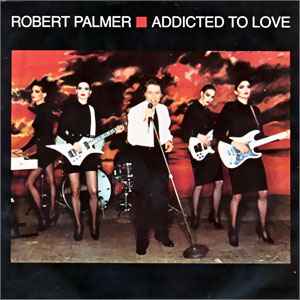
“Addicted to Love” is “funky and bluesy but very modern in its production – massive gated drums and a thunderous, if simple, hook line.” TC It gained a lot of attention for its video which featured Palmer dressed in a suit and backed by “an all girl band in little black dresses and classic cocktail styling.” TC It became “one of the most famous video clips ever made.” TC

The song was originally recorded as a duet with Chaka Khan. However, Palmer explained that, “Her people said ti was a conflict of interest. She’d have three singles out at the same time.” FB Her vocals were erased from the master.


Resources:


First posted 2/20/2024.