Saturday, June 28, 1980

Joy Division charted with “Love Will Tear Us Apart”

Love Will Tear Us Apart

Joy Divison

Writer(s): Ian Curtis (see lyrics here)


First Charted: June 28, 1980


Peak: 8 CL, 1 CO, 13 UK, 26 AU, 2 DF (Click for codes to charts.)


Sales (in millions): -- US, 0.6 UK, 0.6 world (includes US + UK)


Airplay/Streaming (in millions): -- radio, 46.5 video, 319.94 streaming

Awards:

Click on award for more details.

About the Song:

Joy Division was a band built on irony and contradiction. Despite the happy sound of their moniker, they specialized in music that was “gothic, dark and brooding.” LW In addition, their name, taken from the novel House of Dolls, referenced Nazi concentration-camp prostitutes. Despite the built-in controversy of such a name, the group failed to gain widespread publicity. Then again, as darlings of the British indie scene, commercial success would threaten their cred.

Nonetheless, lead singer Ian Curtis was reportedly devastated when “Love Will Tear Us Apart” failed to nick the UK pop charts, although it did top the independent charts. HL True to the band’s disparate nature, it was “most definitely a pop single, albeit a rather dark, forlorn” TB one which was “clearly the work of a troubled soul.” BBC In Telegraph, Neil McCormick described it as “romantic fear and self-loathing wrapped up in a post-punk torch song.” MC

Released in April 1980, it emerged during a rocky time for the band. Curtis, who suffered from epilepsy, was experiencing deteriorating health which forced numerous cancellations of European tour dates HL and threatened to destroy the band. RS500

Right before the group was headed to America for a tour, Curtis hung himself. Amidst stories of the singer’s failed relationships with his wife and a lover, the song’s already fragile and desperate tone took on even greater poignancy. LW A re-release of “Love Will Tear Us Apart” in a “tombstone-style sleeve” LW shamelessly capitalized on the press devoted to the dead rock star. Now the song reached #13 on the UK charts.

The remaining members retired the name Joy Division and continued as New Order. However, “Love” would not go away. It recharted twice in the UK – in 1983 and in 1995 – both times reaching #19.


Resources:


Related Links:


First posted 6/28/2011; last updated 2/3/2023.

Friday, June 27, 1980

Xanadu soundtrack released

Xanadu

Olivia Newton-John/
Electric Light Orchestra


Released: June 27, 1980


Peak: 4 US, 2 UK, 4 CN, 16 AU


Sales (in millions): 2.0 US, -- UK, 3.07 world (includes US and UK)


Genre: pop


Tracks:

Song Title (Performer) (date of single release, chart peaks) Click for codes to singles charts.

  1. Magic (Olivia Newton-John) (5/23/80, 1 US, 1 AC, 32 UK, 1 CN, 4 AU, gold single)
  2. Suddenly (Olivia Newton-John with Cliff Richard) (10/24/80, 20 US, 4 AC, 15 UK, 6 CN, 37 AU)
  3. Dancin’ (Olivia Newton-John with the Tubes)
  4. Suspended in Time (Olivia Newton-John)
  5. Whenever You’re Away from Me(Olivia Newton-John with Gene Kelly)
  6. I’m Alive (Electric Light Orchestra) (5/24/80, 16 US, 20 UK, 10 CN, 27 AU, gold single)
  7. The Fall (Electric Light Orchestra)
  8. Don’t Walk Away (Electric Light Orchestra) (11/22/80, 21 UK)
  9. All Over the World (Electric Light Orchestra) (8/2/80, 13 US, 11 UK, 16 CN, 78 AU)
  10. Xanadu (Olivia Newton-John and Electric Light Orchestra) (6/6/80, 8 US, 2 AC, 1 UK, 6 CN, 2 AU)


Total Running Time: 41:34

Rating:

3.529 out of 5.00 (average of 10 ratings)


Quotable: --


Awards: (Click on award to learn more).

About the Album:

I turned 13 in 1980. That meant, among other things, that my musical tastes were just beginning to form and that my hormones were just beginning to stir. Even in my early adolescence, I was able to see that a roller-skating fantasy movie starring Olivia Newton-John was a laughable idea. After the monstrous success of Grease, it was a no-brainer to put ONJ in another music-fuelled movie, but this was not the right choice.

Regardless of how bad the movie was, I was head-over-heels infatuated with ONJ. I also was just becoming enamored with pop radio and becoming one of the record-buying public. As a child of the ‘80s, I started out with eight-tracks before moving to cassettes and eventually CDs, but the soundtrack to Xanadu held a special place in my personal music history as my first cassette purchase.

Musically, the soundtrack sounded like an idea as bad as the movie. Half were songs by Olivia Newton-John and half by Electric Light Orchestra. What act of lunacy drove anyone to think it was a good idea to pair an Australian country-turned-pop singer with a prog-rock-oriented British rock band? Critical reviews aside, the record-buying public anointed the project with its approval. Five singles from the album reached the top 20 in the U.S., including the #1 song Magic. Six songs hit the top 40 in the UK, including the #1 title song, which paired ONJ and ELO.

In addition to that collaboration, Olivia duets with “British luminary Cliff Richard” AMG on Suddenly, a song which “seems better than most love themes.” AMG Whenever You’re Away from Me puts her together with Gene Kelly, who gave his final film performance in this movie, capping an outstanding career with a career lowlight. The oddest mix, however, is “the doomed swing/rock hybrid Dancin’,” AMG which the “appearance of the Tubes almost saves…but the two styles should never meet.” AMG

In addition to the title cut, ELO served up three more charting singles with I’m Alive, All Over the World, and Don’t Walk Away. The latter song and “The Fall stand as two of Jeff Lynne’s finest.” AMG

This was definitely a work tied to a specific era and it doesn’t hold any long-term value beyond nostalgia. However, if you were 13-years-old and in love with pop radio and Olivia Newton-John, this is a work which, however laughable, will always hold a special place.

Resources and Related Links:

First posted 10/14/2020; last updated 6/7/2021.

Monday, June 23, 1980

Pink Floyd released “Comfortably Numb”

Comfortably Numb

Pink Floyd

This post has been moved here.

Saturday, June 14, 1980

Eric Clapton “Cocaine” charted

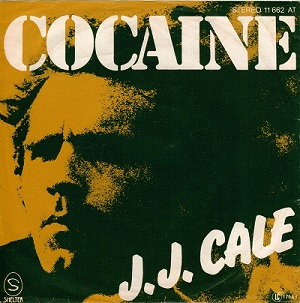
Cocaine

J.J. Cale

Writer(s): J.J. Cale (see lyrics here)


Released: September 1976


First Charted: September 1976


Peak: 45 AU (Click for codes to singles charts.)


Sales (in millions): --


Airplay/Streaming (in millions): -- radio, 6.75 video, 42.32 streaming

Cocaine

Eric Clapton


Released: November 1977 (B-side)


First Charted: June 14, 1980 (live version)


Peak: 30 US, 36 CB, 35 HR, 1 CL, 3 CN, 57 AU, 2 DF (Click for codes to singles charts.)


Sales (in millions): -- US, 0.2 UK, 0.45 world (includes US + UK)


Airplay/Streaming (in millions): -- radio, 108.63 video, 351.12 streaming

Awards (Clapton):

Click on award for more details.

About the Song:

J.J. Cale was an American singer/songwriter and guitarist who became best known through covers of his songs done by Lynyrd Skynyrd (“Call Me the Breeze”) and Eric Clapton (“Cocaine,” “After Midnight”). Cale’s original version of “Cocaine” was released on his fourth album, Troubadour, in 1976. The song was a #1 hit in New Zealand.

The better-known version, however, was by Eric Clapton. He recorded the song for his 1977 album Slowhand. The album “marked a resurgence of sorts for Clapton, arriving after a string of releases failed to live up to the promise heard on 1974’s 461 Ocean Boulevard.” UCR Clapton’s version was “driven by a relatively laid-back blues beat,” UCR “maintaining the same relaxed vibe as the original.” UCR It “wasn’t so much a lyrically based song as it was a somewhat understated showcase of Clapton’s superior skill with the guitar.” UCR

Clapton has described it as “quite cleverly anti-cocaine.” WK He said, “It’s no good to write a deliberate anti-drug song…because…it would disturb them to have someone else shoving something down their throat. So the best thing to do is offer something that seems ambiguous – that on study or on reflection can be seen to be anti.” WK

The song was released as the B-side of “Lay Down Sally” in November 1977. However, a live version of “Cocaine” was released as a single in June 1980 in support of Clapton’s live album Just One Night. All Music Guide’s Richar Gilliam called it one of Clapton’s “most enduringly popular hits.” AMG It is “arguably one of his finest moments, and a staple of his set list decades after its release.” UCR


Resources:


Related Links:


First posted 7/31/2022.

Tuesday, June 10, 1980

Bob Marley & The Wailers released Uprising

Uprising

Bob Marley & the Wailers


Released: June 10, 1980


Peak: 45 US, 41 RB, 6 UK, 36 AU


Sales (in millions): 0.5 US, 0.1 UK, 5.0 world (includes US and UK)


Genre: reggae


Tracks:

Song Title (date of single release, chart peaks) Click for codes to singles charts.

  1. Coming in from the Cold
  2. Real Situation
  3. Bad Card
  4. We and Dem
  5. Work
  6. Zion Train
  7. Pimpers Paradise
  8. Could You Be Loved (5/80, 5 UK, 56 RB)
  9. Forever Loving Jah
  10. Redemption Song (10/80, --)


Total Running Time: 35:53


The Players:

  • Bob Marley (vocals, guitar)
  • Aston “Family Man” Barrett (bass)
  • Carlton “Carlie” Barrett (drums, percussion)
  • Tyrone Downie (keyboards)
  • Alvin “Seeco” Patterson (percussion)
  • Junior Marvin (electric guitar)
  • Al Anderson (lead guitar)
  • Earl “Wire” Lindo (keyboards)
  • Carlton “Santa” Davis (drums)
  • Rita Marley, Judy Mowatt, Griffiths (backing vocals)

Rating:

4.012 out of 5.00 (average of 21 ratings)

About the Album:

After Marley collapsed during a jog in Central Park, he was diagnosed with cancer. He succumbed less than a year after the release of Uprising, making it the last studio album released in his lifetime.

“Prophetically, it also contains some of the band's finest crafted material, as if they were cogent that this would be their final outing. The album's blend of religious and secular themes likewise creates a very powerful and singular quest for spirituality in a material world. Although it is argued that an album's graphic design rarely captures the essence of the work inside, the powerful rebirthing image of a rock solid Marley emerging with his arms raised in triumph could not be a more accurate visual description of the musical jubilation within.” AMG

“Musically, the somewhat staid rhythms often synonymous with reggae have been completely turned around to include slinky and liquid syncopation. Work, Pimper's Paradise, and the lead-off track Coming in from the Cold are all significant variations on the lolloping Rasta beat. The major difference is the sonic textures that manipulate and fill those patterns. The inventive and unique guitar work of Al Anderson — the only American member of the original Wailers — once again redefines the role of the lead electric guitar outside of its standard rock & roll setting. Zion Train is awash in wah-wah-driven patterns creating an eerie, almost ethereal backdrop against Marley's lyrics, which recollect images from Peter Tosh's ‘Stop That Train’ all the way back on Marley & the Wailers' international debut Catch a Fire.” AMG

There’s also “the album’s vibrant single Could You Be LovedQM and, most notably, Redemption Song, which is “the final track on the original pressing of Uprising.” AMG “The stark contrast from the decidedly electric and group-oriented album to this hauntingly beautiful solo acoustic composition is as dramatic as it is visionary.” AMG “Never has an artist unknowingly written such a beautiful and apropos living epitaph;” AMG “this simple folk song, reminiscent of Bob Dylan, sounds like a farewell: ‘All I ever had…these songs of freedom.’” QM


Notes: The 2001 "Definitive Remaster" version of Uprising contains the band version of "Redemption Song" and the 12" mix of "Could You Be Loved."

Resources and Related Links:

  • DMDB encyclopedia entry for Bob Marley
  • AMG All Music Guide review by Lindsay Planer
  • QM Q Magazine (7/04) review by Paul Elliott. No longer online.

First posted 3/26/2008; last updated 5/10/2021.