Showing posts with label iPod. Show all posts

Tuesday, October 23, 2001

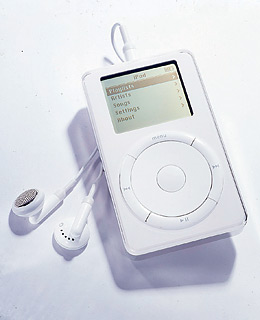
Apple released the first iPod.

October 23, 2001

Apple released the first iPod.

Almost 50 years earlier, the transistor radio introduced portability to music. Later, portable cassette players and then CD players gave the listener control over what music they took with them. However, with the advent of digitized music the possibilities extended far beyond the number of songs limited to what could fit on a single cassette or CD.

The Apple iPod introduced the idea of carrying 1000 songs in a “clean, white box the size of a deck of cards.” TM It weighed six and a half ounces and had a ten-hour battery life. AP As Greg Joswiak, Apple’s senior vice president of Worldwide Marketing, said in 2022, it “redefined how music is discovered, listened to, and shared.” AP

It wasn’t the first digital audio player, though. As far back as 1979, a British inventor named Kane Kramer created the IXI, but it could only play one song. It was shelved when he couldn’t market it successfully and, in 1988, the patent expired. After the success of the iPod, Kramer said, “I was just so pleased that finally something that I had done which has been a huge success and changed the music industry was being acknowledged.” PC

When the iPod debuted in 2001, there were six MP3 players already on the market but they “had a calculator aesthetic” TM and only held about eight songs. TM In the first promo video for the iPod, the musician Moby said he owned three earlier MP3 players but couldn’t figure out how to use them. By contrast, he said about the iPod, “I held it, and 45 seconds later, I knew how to use it.” PC

It didn’t really catch on until the third generation. By 2005, over 80% of digital music players sold were iPods. TM However, as with all technology, the iPod and MP3 technology would eventually be supplanted by the rise of streaming services such as Spotify.


For more important days in music history, check out the Dave’s Music Database history page.

Resources and Related Links:


First posted 10/7/2023.

Sunday, July 1, 1979

The Sony Walkman was introduced: July 1, 1979

Originally posted July 1, 2012.

the Walkman TPS-L2, image from Wikipedia.org

The blue-and-silver Walkman pictured above was the first model introduced, going on sale in Japan on July 1, 1979. It hit the U.S. in June 1980. Today the idea of a device at least twice the size of an iPod which held 60-90 minutes of music may seem positively quaint, but at the time the Walkman marked a new era for music on the move. The Walkman represented individual portability; listeners no longer had to rely on big bulky ghetto blasters which shared one’s music with the world, whether they wanted to hear it or not. Suddenly a person could pop in a favorite cassette, plug in a pair of lightweight headphones, and the music could travel with them wherever they went and as long as a pair of AA batteries could take them.

Walkman was a brand tradename used by Sony to mark their portable audio cassette players. The company is still around today, marketing portable audio and video players as well as mobile phones. The prototype for the first one was built by Sony engineer Nobutoshi Kihara in 1978. Sony co-chairman Akio Morita reportedly wanted to listen to operas during long plane trips.

the Stereobelt, image from thenutgraph.com

However, the Walkman owes a debt to a predecessor known as Stereobelt which was invented in 1972 by Andreas Pavel, a German-Brazilian. He had the device patented in Italy in 1977. When Sony began selling its Walkman, it agreed to pay Pavel royalties, but only for sales in Germany. Lawsuits followed over the years, finally endingin a multi-million dollar settlement in 2003.

Eventually the Walkman would see the cassette market disintegrate and portable CD players (including Sony’s Discman, introduced in 1984) would take over. Once the digital age hit, there was no need for music to be stored on a device such as a cassette or disc, opening up the possibilities even more. However, every owner of an iPod or other digital music device owes thanks to the original portable music player.


Resources and Related Links: