Tuesday, September 30, 2003

Lyle Lovett released My Baby Don’t Tolerate

My Baby Don’t Tolerate

Lyle Lovett


Released: September 30, 2003


Peak: 63 US, 7 CW


Sales (in millions): --


Genre: alt-country/Americana


Tracks:

Song Title (Writers) [time] (date of single release, chart peaks) Click for codes to singles charts.

  1. Cute As a Bug [3:39]
  2. My Baby Don’t Tolerate [3:42] (10/25/03, 19 AA)
  3. The Truck Song [2:56]
  4. In My Own Mind [5:36]
  5. Nothing But a Good Ride [4:28]
  6. Big Dog [3:37]
  7. You Were Always There (Lyle Lovett, Viktor Krauss) [5:56]
  8. Wallisville Road [5:06]
  9. Working Too Hard [3:46]
  10. San Antonio Girl [3:31]
  11. On Saturday Night [3:23]
  12. Election Day (Blaze Foley) [3:02]
  13. I’m Going to Wait [4:41]
  14. I’m Going to the Place [3:22]

All songs written by Lyle Lovett unless noted otherwise.


Total Running Time: 56:52

Rating:

3.955 out of 5.00 (average of 13 ratings)


Awards: (Click on award to learn more).

About the Album:

“Lyle Lovett is many things, but prolific is not one of them. Yes, at the outset of his career, he released an album every year or two, but by the time he became a star in the early '90s, he slowed down quite a bit. Between 1992’s Joshua Judges Ruth and 2003’s My Baby Don’t Tolerate, his first release on Lost Highway, he only released one album of new original material: The Road to Ensenada, in 1996, which followed 1994’s I Love Everybody, a clearing-house of songs he wrote before his first album. So, My Baby Don’t Tolerate is his first album of new songs in seven years, and two of its 14 songs – The Truck Song and San Antonio Girl – were previously released on 2001’s Anthology, Vol. 1 (which is bound to frustrate fans that bought that uneven collection just for the new tunes), leaving this as a collection of 12 new songs.” STE

Tolerate “is very similar to The Road to Ensenada, sharing that album’s clean, unadorned production, directness, and preponderance of straight-ahead country songs.” STE In fact, “several songs sound like retreads from Lovett’s earlier efforts, even as a listener welcomes the reprised syncopated, hep cat, Louis Jordan-meets-Sister Rosetta Tharpe signatures that help define his quirky style.” AN

“Given the long wait between albums and since the record is so firmly in the tradition of The Road to Ensenada that it could be branded a sequel, there may be an initial feeling of anticlimax, since there’s not that many songs and they all feel familiar. Such is the complication of a long wait – it invariably raises expectations – but judged as a collection of songs against Lovett’s other albums, My Baby Don’t Tolerate holds its own very well” STE as Lovett “still fuses country, blues, jazz, folk, big band, and pop like no one else on the planet.” AN

“While long-time fans were reportedly disappointed with the album’s pop-flavored opening track Cute as a Bug,” WK “a by-now formulaic song of hottie lust,” AN “many of the other songs demonstrated his strengths as a storyteller.” WK

In My Own Mind, which “was nominated for a 2004 Grammy in the category Best Male Country Vocal Performance,” WK tells the tale of “a family man who seeks solace from a busy household, drawing restorative power from nature (‘no rain, just the sunshine’).” AN

“The album finds itself when Lovett begins revisiting dark places in his mind. and get right to the bleak antagonist who narrates the confused loss of the elegantly jazzy You Were Always There, the snaky blues of the title song, the pointy-toed send-up of bygone Music City hillbillies (Nashville), and the sly portrayal of the bribes of luckless blacks (Election Day) in the old-time South.” AN

“Oddly, the album ends with two gospel songs with remarkably similar names, which some critics decried as an overly precious attempt at enforced quirkiness.” WK “As the infectious, if repetitious gospel numbers prove, the man with Eraserhead hair isn’t breaking any new ground.” AN

Overall “many of his eccentricities are toned down…Even the handful of ballads are lighter, lacking the somber introspection of Joshua Judges Ruth or the subtleness of I Love Everybody. Everything here is out in the open, and it’s the better for it; musically, it may offer no surprises, but its directness is appealing, particularly because Lovett simply sounds good singing country songs. And that’s what My Baby Don’t Tolerate offers – Lovett singing good country songs and sounding good. It’s not a complicated pleasure, but it doesn’t need to be, and after a long dry spell, it sure is nice to have a new collection of songs from this reliable songwriter.” STE

Resources and Related Links:


Other Related DMDB Pages:


First posted 9/14/2009; last updated 5/20/2022.

Monday, September 29, 2003

Sting released Sacred Love

Sacred Love

Sting


Released: September 29, 2003


Peak: 3 US, 3 UK, 3 CN, 13 AU


Sales (in millions): 1.0 US, 0.1 UK, 3.5 world (includes US and UK)


Genre: rock > adult alternative


Tracks:

Song Title [time] (date of single release, chart peaks) Click for codes to singles charts.

  1. Inside [4:46]
  2. Send Your Love [4:38] (with Vicente Amigo) (9/1/03, 29 A40, 3 AA, 30 UK, 44 AU)
  3. Whenever I Say Your Name [5:25] (with Mary J. Blige) (12/20/03, 77 RB, 60 UK)
  4. Dead Man’s Rope [5:44]
  5. Never Coming Home [4:58]
  6. Stolen Car (Take Me Dancing) [3:55] (4/26/04, 14 AA, 60 UK)
  7. Forget about the Future [5:12]
  8. This War [5:29]
  9. The Book of My Life [6:14] (with Anoushka Shankar)
  10. Sacred Love [5:43] (2/7/04, 2 AA)

All songs written by Sting.


Total Running Time: 52:37

Rating:

3.453 out of 5.00 (average of 22 ratings)


Awards: (Click on award to learn more).

About the Album:

“Sting scored a moderate comeback success greater than most had imagined possible with 1999’s Brand New Day, re-establishing himself as a viable commercial artist instead of merely settling for living legend status. Part of this success was due to ‘Desert Rose,’ featuring vocalist Farhat Bougallagui's careening cadences that garnered attention, particularly when they were showcased in a car commercial that kicked the album into high commercial gear.” AMG

“Sting picks up on this, adding three guest vocalists to the ten-track Sacred Love album (the 11th track is a remix of the lead single, Send Your Love – which happens to be better, since it eliminates the rather annoying Indian-styled hook) – Vincente Amigo and Anoushaka Shankar are paired with Mary J. Blige, who in this context is presented as a world music artist.” AMG

“None of the guests makes much of an impression here, but neither does Sting, since this is an album that puts sound over song or performance. Sacred Love is to Brand New Day what Mercury Falling was to Ten Summoner’s Tales – a fussy, overworked stab at maturity, one that has impeccable craft but is obscured by its own meticulousness. It is professional to a fault, using its maturity and preciseness to obscure the fact that the songs don't really work.” AMG

“Sting isn’t always hemmed-in, even ending Inside with a hysterical rant that makes him seem like a madman, but it has the effect of making the rest of the album seeming too deliberate and far from adventurous. It’s far from a bad listen, nor is it embarrassing, but it’s entirely too predictable, coming across as nothing more than well-tailored, expensive mood music, which is certainly far less than what Sacred Love could have been.” AMG


Notes: Multiple editions of the albums were issue with bonus tracks, such as a remix of “Send Your Love,” a live version of “Shape of My Heart,” a remix of “Moon Over Bourbon Street,” and the song “Like a Beautiful Smile. “

Resources and Related Links:


Other Related DMDB Pages:


First posted 3/29/2008; last updated 11/17/2021.

Monday, September 22, 2003

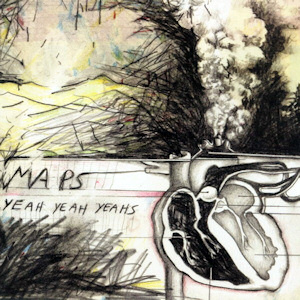
Yeah Yeah Yeahs “Maps” released

Maps

Yeah Yeah Yeahs

Writer(s): Brian Chase, Karen Lee Orzolek, Nick Zinner (see lyrics here)


Released: September 22, 2003


First Charted: October 31, 2003


Peak: 87 BB, 9 MR, 26 UK, 11 DF (Click for codes to charts.)


Sales (in millions): -- US, 0.2 UK


Airplay/Streaming (in millions): -- radio, 109.25 video, 268.48 streaming

Awards:

Click on award for more details.

About the Song:

The indie-rock band the Yeah Yeah Yeahs formed in 2000 in New York City “peddling a punky, garage-rock-derived sound.” TB Like the White Stripes, they didn’t have a bassist, “but they more than make up for this with the effects-laden guitar work of Nick Zinner and Brian Chase’s sturdy backbeat. The real star of the show is vocalist Karen O, a mutant cross-breed of PJ Harvey and Chrissie Hynde.” TB

They released their debut album, Fever to Tell, in 2003. It has sold a million copies worldwide. The lead single, “Date with the Night,” has been the band’s highest charting song to date, reaching #16 in the UK. However, it was the third single, “Maps,” which became the band’s best known song. It’s “an outlier for the band; the rest of the…album…is much more aggressive.” SF

The “art-punk ballad” WK is about Karen O’s relationship with then-boyfriend Angus Andrew, frontman of the Liars. WK In 2006, she told Rolling Stone that their hectic touring schedules caused a rift in their relationship. WK She called it “the ultimate ‘you are always on my mind’-type song.” SF The band has never confirmed it, but some believe the song’s title stands for “My Angus Please Stay.” WK

BeyoncĂ©’s 2014 song “Hold Up” includes an interpolation of the line “they don’t love you like I love you” from “Maps.” The members of Yeah Yeah Yeahs were given a writing credit. WK Similarly, Kelly Clarkson’s 2004 hit “Since U Been Gone” uses “a precise replica of this song’s guitar break.” SF Songwriter Dr. Luke loved the song “Maps” but writing partner Max Martin complained that it built up to a chorus that was a let down. Luke said, “’Why don't we do that, but put a big chorus on it?’ It worked.” WK

In a 2022 countdown, listeners of Kansas City’s 90.9 The Bridge voted “Maps” the #1 song of the decade. In 2009, New Musical Express (NME), ranked it as the “greatest alternative love song” of all time. WK


Resources:


Related Links:


First posted 7/6/2025.

Tuesday, September 16, 2003

David Bowie Reality released

Reality

David Bowie


Released: September 16, 2003


Peak: 29 US, 3 UK, 9 CN, 13 AU


Sales (in millions): 0.15 US, 0.1 UK, 1.0 world (includes US and UK)


Genre: glam rock/classic rock veteran


Tracks:

Song Title (Writers) [time] (date of single release, chart peaks) Click for codes to singles charts.

  1. New Killer Star [4:40] (9/29/03, --)
  2. Pablo Picasso (Richman) [4:05] (12/25/03, --)
  3. Never Get Old [4:24] (2/04, --)
  4. The Loneliest Guy [4:11]
  5. Looking for Water [3:28]
  6. She’ll Drive the Big Car [4:35]
  7. Days [3:18]
  8. Fall Dog Bombs the Moon [4:04]
  9. Try Some, Buy Some (Harrison) [4:24]
  10. Reality [4:23]
  11. Bring Me the Disco King [7:45]

Songs written by David Bowie unless indicated otherwise.


Total Running Time: 49:25


The Players:

  • David Bowie (vocals, guitar, keyboards, synthesizer, saxophone, stylophone, percussion)
  • Tony Visconti (guitar, keyboards, bass, backing vocals)
  • Gerry Leonard, Earl Slick, David Torn (guitar)
  • Mark Plati (bass, guitar)
  • Sterling Campbell (drums)
  • Mike Garson (piano)
  • Gail Ann Dorsey, Catherine Russell (backing vocals)

Rating:

3.415 out of 5.00 (average of 25 ratings)


Awards: (Click on award to learn more).

About the Album:

“Instead of being a one-off comeback, 2002's Heathen turned out to be where David Bowie settled into a nice groove for his latter-day career, if 2003's Reality is any indication. Working once again with producer Tony Visconti, Bowie again returns to a sound from the past, yet tweaks it enough to make it seem modern, not retro. Last time around, he concentrated on his early-'70s sound, creating an amalgam of Hunky Dory through Heroes. With Reality, he picks up where he left off, choosing to revise the sound of Heroes through Scary Monsters, with the latter functioning as a sonic blueprint for the album.” AMG

“Basically, Reality is a well-adjusted Scary Monsters, minus the paranoia and despair — and if those two ingredients were key to the feeling and effect of that album, it's a credit to Bowie that he's found a way to retain the sound and approach of that record, but turn it bright and cheerful and keep it interesting. Since part of the appeal of Monsters is the creeping sense of unease and its icy detachment, it would seem that a warmer, mature variation on that would not be successful, but Bowie and Visconti are sharp record-makers, retaining what works — layers of voices and guitars, sleek keyboards, coolly propulsive rhythms — and tying them to another strong set of songs.” AMG

Like Heathen, the songs deliberately recall classic Bowie by being both tuneful and adventurous, both hallmarks of his '70s work. If this isn't as indelible as anything he cut during that decade, that's merely the fate of mature work by veteran rockers. So, Reality doesn't have the shock of the new, but it does offer some surprises, chief among them the inventive, assured production and memorable songs. It's a little artier than Heathen, but similar in its feel and just as satisfying. Both records are testaments to the fact that veteran rockers can make satisfyingly classicist records without resulting in nostalgia or getting too comfortable. With any luck, Bowie will retain this level of quality for a long time to come.” AMG


Notes: There is also a version of this album that includes a bonus disc with songs “Fly,” “Queen of All the Tarts (Overture),” and a rerecording of “Rebel Rebel” (originally on Diamond Dogs.

Resources and Related Links:


Other Related DMDB Pages:


First posted 2/20/2008; last updated 8/9/2021.