Tuesday, June 27, 1972

Led Zeppelin recorded for live box set, How the West Was Won (June 25 and 27)

June 1972: Led Zeppelin How the West Was Won box set recorded
First posted 11/16/2020.

How the West Was Won

Led Zeppelin


Released: May 27, 2003


Recorded: live June 25 and 27, 1972


Peak: 11 US, 5 UK, 11 CN, -- AU


Sales (in millions): 1.0 US, -- UK, 2.0 world (includes US and UK)


Genre: classic rock


Tracks:

Song Title [time] (date of single release, chart peaks for original studio releases) Click for codes to singles charts. The raised numbers after the song indicate the original studio album from which the album is taken.

Disc 1:

  1. LA Drone [0:14]
  2. Immigrant Song [3:42] (11/14/70, 16 US, 8 CB, 10 HR, 1 CL, 4 CN, 16 AU) 3
  3. Heartbreaker [7:25] (3/4/70, 65 US, 1 CL) 2
  4. Black Dog [5:41] (12/18/71, 15 US, 9 CB, 10 HR, 1 CL, 11 CN, 9 AU) 4
  5. Over the Hills and Far Away [5:08] (6/9/73, 51 US, 28 CB, 31 HR, 1 CL, 63 CN) 5
  6. Since I’ve Been Loving You [8:02] (9 CL) 3
  7. Stairway to Heaven [9:38] (11/24/07, 30 US, 1 CL, 37 UK, 17 CN) 4
  8. Going to California [5:37] (1 CL) 4
  9. That’s the Way [5:54] (11 CL) 3
  10. Bron-Yr-Aur Stomp [4:55] (13 CL) 3

Disc 2:

  1. Dazed and Confused / (1 CL) 1
    Walter’s Walk /
    The Crunge (18 CL) 5 [25:25]
  2. What Is and What Should Never Be [4:41] (3 CL) 2
  3. Dancing Days [3:42] (6 CL) 5
  4. Moby Dick [19:20] (14 CL) 2

Disc 3:

  1. Whole Lotta Love / (11/15/69, 4 US, 2 CB, 4 HR, 1 CL, 21 UK, 2 CN, 1 AU) 2
    Boogie Chillun/Let’s Have a Party/Hello Mary Lou/Going Down Slow [23:07]
  2. Rock and Roll [3:56] (3/11/72, 47 US, 42 CB, 38 HR, 1 CL, 38 CN, 51 AU) 4
  3. The Ocean [4:21] (2 CL) 5
  4. Bring It on Home/Bring It on Back [9:30] (9 CL)

1 Led Zeppelin I (1969)
2 Led Zeppelin II (1969)
3 Led Zeppelin III (1970)
4 Led Zeppelin IV (1971)
5 Houses of the Holy (1973)


Total Running Time: 150:27


The Players:

  • Robert Plant (vocals, harmonica)
  • Jimmy Page (guitar, mandolin, backing vocals)
  • John Paul Jones (bass, keyboards, mandolin, backing vocals)
  • John Bonham (drums, percussion, backing vocals)

Rating:

4.221 out of 5.00 (average of 16 ratings)


Quotable: “For anybody who really loves hard rock & roll, it doesn’t get much better than this.” – Stephen Thomas Erlewine, All Music Guide


Awards:

About the Album:

This recording was made from two live shows in California in 1972 – one at the L.A. Forum on June 25 and the other from the Long Beach Arena two days later. The two shows were bootlegged for years, but this was the first chance fans had to heard official soundboard recordings of the concerts. WK

“The end result is worth the wait.” AMG Jimmy Page, the band’s guitarist and the album’s producer, “has assembled a killer live album that captures the full, majestic sweep of Zeppelin.” AMG Page says in the liner notes that he considered the band to be at their artistic peak at this time. “For anybody who really loves hard rock & roll, it doesn’t get much better than this.” AMG This is an “absolutely essential” AMG “priceless souvenir.” AMG

Throughout the album, “songs that have grown familiar through years of play seem fresh and new because of these vigorous, muscular performances.” AMG The long numbers – Dazed and Confused, Whole Lotta Love, and Moby Dick – “are alternatingly fascinating and indulgent, yet even when they meander there is a real sense of grandeur, achieving a cinematic scale attempted by few of their peers.” AMG

However, “the real power of the band comes through on the shorter songs, where etheir sound is distilled to its essence.” AMG “Witness how Black Dog goes straight for the gut here, while the studio version escalates into a veritable guitar army – it’s the same song, but the song has not remained the same.” AMG

How the West Was Won debuted at #1 on the Billboard album chart, demonstrating the lasting power of Led Zeppelin that a three-decades old recordings could still reach the pinnacle.

It also showed how much Led Zep fans wanted a good, official live album from the band. The Song Remains the Same was a live soundtrack released while the band was still active, but “it was a choppy, uneven performance, lacking the majesty of the group at its peak.” AMG In 1997, a double-disc album of BBC sessions from 1969 was released, but it wasn’t recorded in front of a live audience.

Resources and Related Links:

Saturday, June 24, 1972

Eagles chart with debut album

First posted 3/26/2008; updated 10/17/2020.

Eagles

Eagles


Charted: June 24, 1972


Peak: 22 US, -- UK, 13 CN, -- AU


Sales (in millions): 1.92 US, 0.06 UK, 3.0 world (includes US and UK)


Genre: country rock


Tracks: Click for codes to singles charts.

  1. Take It Easy (6/3/72, 12 US, 1 CL, 12 AC, 8 CN, 49 AU)
  2. Witchy Woman (9/9/72, 9 US, 5 CL, 8 CN, 81 AU)
  3. Chug All Night
  4. Most of Us Are Sad
  5. Nightingale
  6. Train Leaves Here This Morning
  7. Take the Devil
  8. Early Bird
  9. Peaceful, Easy Feeling (12/30/72, 22 US, 5 CL, 20 AC, 35 CN)
  10. Tryin’


Total Running Time: 36:43


The Players:

  • Glenn Frey (vocals, guitar)
  • Don Henley (vocals, drums)
  • Bernie Leadon (guitar, vocals, banjo)
  • Randy Meisner (bass, vocals)

Rating:

3.681 out of 5.00 (average of 19 ratings)


Awards:

About the Album:

“Balance is the key element of the Eagles’ self-titled debut album, a collection that contains elements of rock & roll, folk, and country, overlaid by vocal harmonies alternately suggestive of doo wop, the Beach Boys, and the Everly Brothers.” AMG

“If the group kicks up its heels on rockers like Chug All Night, Nightingale, and Tryin’, it is equally convincing on ballads like Most of Us Are Sad and Train Leaves Here This Morning.” AMG

“The album is also balanced among its members, who trade off on lead vocal chores and divide the songwriting such that Glenn Frey, Bernie Leadon, and Randy Meisner all get three writing or co-writing credits. Fourth member Don Henley, with only one co-writing credit and two lead vocals, falls a little behind, while Jackson Browne, Gene Clark, and Jack Tempchin also figure in the writing credits.” AMG

“The album’s overall balance is worth keeping in mind because it produced three Top 40 hit singles…that do not reflect that balance. Take It Easy and Peaceful Easy Feeling are similar-sounding mid-tempo folk-rock tunes sung by Frey that express the same sort of laid-back philosophy, as indicated by the word ‘easy’ in both titles, while Witchy Woman, a Henley vocal and co-composition, initiates the band’s career-long examination of supernaturally evil females.” AMG

“These are the songs one remembers from Eagles, and they look forward to the eventual dominance of the band by Frey and Henley. But the complete album from which they come belongs as much to Leadon’s country-steeped playing and singing and to Meisner’s melodic rock & roll feel, which, on the release date, made it seem a more varied and consistent effort than it did later, when the singles had become overly familiar.” AMG

Resources and Related Links:

Wednesday, June 7, 1972

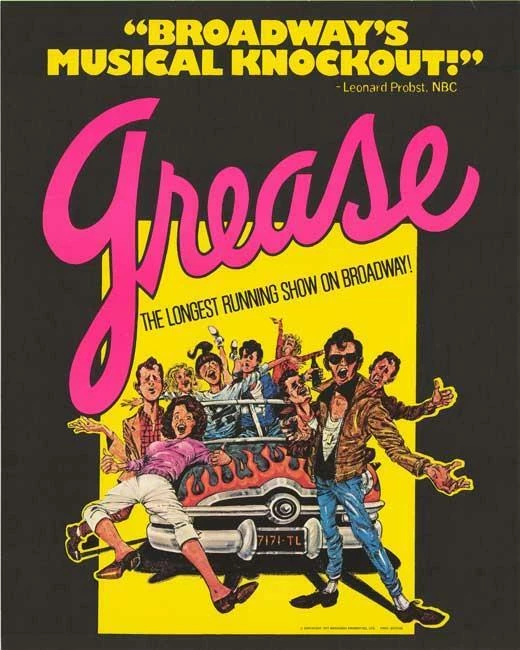
Grease opened on Broadway

Grease

Warren Casey & Jim Jacobs (composers)

The Musical


Opened on Broadway: June 7, 1972


Number of Performances: 3388


Opened in London: June 26, 1973


Number of Performances: 236


Movie Release: June 16, 1978


Cast Album


Released: 1972


Peak: -- US, -- UK, -- CN, -- AU


Sales (in millions): -- US, 0.3 UK, 0.3 world (includes US and UK)


Genre: show tunes


Soundtrack


Released: April 14, 1978


Peak: 112 US, 113 UK, 17 CN, 114 AU


Sales (in millions): 14.0 US, 2.37 UK, 40.4 world (includes US and UK), 54.1 EAS


Genre: show tunes


Tracks (cast album):

Song Title (Writers) (PERFORMERS) (date of single release, chart peaks) Click for codes to charts.

  1. Alma Mater
  2. Alma Mater (Parody)
  3. Summer Nights
  4. Those Magic Changes
  5. Freddy, My Love
  6. Greased Lightnin’
  7. Mooning
  8. Look at Me, I’m Sandra Dee
  9. We Go Together
  10. It’s Raining on Prom Night
  11. Born to Hand Jive
  12. Beauty School Dropout
  13. Alone at a Drive-In Movie
  14. Rock ‘N’ Roll Party Queen
  15. There Are Worse Things I Could Do
  16. Look at Me, I’m Sandra Dee (Reprise)
  17. All Choked Up
  18. We Go Together (Reprise)
All songs written by Warren Casey and Jim Jacobs.


Total Running Time: 46:38


Tracks (soundtrack):

  1. Grease (Barry Gibb) (FRANKIE VALLI) (5/27/78, 1 US, 3 UK, 13 AC, 40 RB, sales: 1.0 m)
  2. Summer Nights (OLIVIA NEWTON-JOHN / JOHN TRAVOLTA / CAST) (8/5/78, 5 US, 1 UK, 21 AC, sales: 0.5 m)
  3. Hopelessly Devoted to You (John Farrar) (OLIVIA NEWTON-JOHN) (7/8/78, 3 US, 2 UK, 7 AC, 20 CW, sales: 0.5 m)
  4. You’re the One That I Want (John Farrar) (OLIVIA NEWTON-JOHN / JOHN TRAVOLTA) (4/1/78, 1 US, 1 UK, 23 AC, sales: 1.0 m)
  5. Sandy(Louis St. Louis, Scott Simon) (JOHN TRAVOLTA) (10/7/78, 2 UK)
  6. Beauty School Dropout (FRANKIE AVALON)
  7. Look at Me, I’m Sandra Dee (STOCKARD CHANNING)
  8. Greased Lightnin’ (JOHN TRAVOLTA) (9/30/78, 47 US, 11 UK)
  9. It’s Raining on Prom Night (CINDY BULLENS)
  10. Alone at a Drive-in Movie (BILL OAKES)
  11. Blue Moon (Richard Rodgers, Lorenz Hart) (SHA NA NA)
  12. Rock & Roll Is Here to Stay (David White) (SHA NA NA)
  13. Those Magic Changes (SHA NA NA)
  14. Hound Dog (Jerry Leiber, Mike Stoller) (SHA NA NA)
  15. Born to Hand Jive (SHA NA NA)
  16. Tears on My Pillow (Sylvester Bradford, Al Lewis) (SHA NA NA)
  17. Mooning (LOUIS SAINT LOUIS / CINDY BULLENS)
  18. Freddy, My Love (CINDY BULLENS)
  19. Rock & Roll Party Queen (LOUIS SAINT LOUIS)
  20. Look at Me, I’m Sandra Dee (OLIVIA NEWTON-JOHN)
  21. We Go Together (OLIVIA NEWTON-JOHN / JOHN TRAVOLTA)
  22. Love Is a Many Splendored Thing (Samm Fain, Paul Francis Webster) (BILL OAKES)
  23. Grease (Reprise) (Barry Gibb) (FRANKIE VALLI)
Songs are written by Jim Jacobs and Warren Casey unless noted otherwise.


Total Running Time: 61:14

Rating (cast album):

3.514 out of 5.00
(average of 8 ratings)

Rating (soundtrack):

4.452 out of 5.00
(average of 27 ratings)

Awards (Cast Album):

(Click on award to learn more).


Awards (Soundtrack):

(Click on award to learn more).

About the Broadway Show

Jim Jacobs and Warren Casey’s show was named after the working-class youth subculture known as greasers. It “was an affectionate little musical about the teenage lifestyle of the late 1950s — when rock and roll was aborning, the cool boys sported heavily gelled hair and motorcycle jackets, and their girls favored beehive hairdos and pedal pushers.” CA Set at the fictional Rydell High School in 1959, the story follows a group of adolescents navigating issues such as peer pressure, friendship, love, sex, teen pregnancy, and rebellion. “Grease skillfully walks the line between parody and homage.” CA

Jacobs explained that the basic plot in which the female lead transforms from a sensitive character into a more rebellious one was a “subversion of common tropes of 1950s cinema” W-C in which the tough male lead would become a more sympathetic character.

The show was first performed in Chicago in the Kingston Mines nightclub in 1971. On February 14, 1972, it opened Off-Broadway at the Eden Theatre in New York. On June 7, 1972, it moved to Broadway, first at the Broadhurst Theatre and then the Royale Theatre, where it ran until January 27, 1980. W-C Its 3,388-performance run there was the longest in history, until it was surpassed in 1983 by A Chorus Line. W-C

About the Cast Album

A cast recording was made in 1972 which featured the original Broadway cast. “Barry Bostwick is terrific as lead greaser Danny, and Carole Demas sounds just right as Danny’s sweet girlfriend, Sandy. Among the other standouts in the cast are Katie Hanley, Walter Bobbie, and Kathi Moss.” CA

“The melodies, rhythms, harmonies, and arrangements of the songs are clever knockoffs of popular ’50s hits, very catchy and buoyed by some clever lyrics. (Example, from Freddy, My Love: ‘I treasure every giftie / The ring was really nifty / You said it cost you fifty / So you’re thrifty / I don’t mind.’).” CA

“Other highlights include Summer Nights, which amusingly presents a boy’s and a girl’s different descriptions of their summer romance; the infectious Those Magic Changes, sung by a kid who’s thrown himself wholeheartedly into guitar lessons; It’s Raining on Prom Night, an oddly touching, funny lament over a lost high-school love (sample lyric: ‘I don’t even have my corsage, oh gee / It fell down a sewer with my sister’s I.D.’),” CA and “We Go Together, ”a bouncy anthem of teenage unity.” CA

“The score does contain one serious number, and it’s a good one: There Are Worse Things I Could Do, sung by Rizzo, whose outward toughness masks her vulnerability. Adrienne Barbeau gives the song a moving, well sung performance.” CA

“This is a show for people who lived through the ‘50s and would now like to remember it only for its high school fashions, teenage emotional concerns, and bouncy rock & roll tunes.” AM-C

About the Movie

“The movie is a 1970s take on 1950s musicals, providing all the kitsch anyone could hope for.” AZ “Grease was a huge success as a Broadway musical prior to hitting the big screen in 1978. That was the version that transformed Grease into a phenomenon – it was a runaway box office success, and then became a TV, cable, and video favorite.” AM-S

Released in the summer of 1978, Grease starred John Travolta (fresh off the success of the blockbuster movie Saturday Night Fever which spawned a monster soundtrack of its own) and Olivia Newton-John. It became the highest-grossing musical film.

About the Soundtrack

“Grease will always be the word for hopelessly devoted generations of girls who wore out their record players partying with their own Pink Ladies to this soundtrack.” ZS The “high-camp classic” ZS whisked listeners away “to the ‘50s teeny-bopper days” ZS by boasting “summer-loving hits that will be on karaoke playlists until the end of time.” ZS

The soundtrack, the sixth best-selling of all time, W-S “rivaled its film counterpart as a pop culture perennial, and it’s not hard to see why – its good-natured pastiche of doo wop and early rock & roll is infectious and charming, due in no small part to John Travolta and Olivia Newton-John’s charismatic, engaging performances.” AM-S

They actually only appear on 7 of the 24 tracks on the album, but “they sing the majority of the originals… which were the reason why the film and soundtrack became blockbusters.” AM-S The pair duet on You’re the One That I Want and sing with the cast on Summer Nights. Both sangs hit #1 in the UK and rank in the 20 best-selling singles of all-time in the UK. W-S

Olivia Newton-John and John Travolta took solo turns on Hopelessly Devoted to You and Sandy respectively. They were also hugely successful in the UK, both hitting #2. The former was a #3 hit in the US as well.

Songs by other cast members include Look at Me, I’m Sandra Dee, in which “actress Stockard Channing struts her, um, versatility.” AZ The rest of the soundtrack is filled out by “workmanlike performances” AM-S of 1950s’ chestnuts from Sha Na Na. While they are “over-represented,” AZ the soundtrack’s original songs, which “hold up better than the ‘50s tunes,” AM-S “are so giddily enjoyable…that everything works.” AM-S

Most of the songs from the original show are retained, but the hits which propelled the soundtrack into the stratosphere were largely new editions. That includes a pair of John Farrar contributions, including “You’re the One That I Want” and “Hopelessly Devoted to You.” The soundtrack also includes some rock and roll chestnuts such as Hound Dog, Blue Moon, and Tears on My Pillow performed by Sha Na Na.

The title song was sung by ‘50s heartthrob Frankie Valli and penned by Barry Gibb of the Bee Gees, fresh from his success from Saturday Night Fever. In that movie, Travolta became an internationally-known star strutting his disco white-suit-wearing stuff while dancing to four chart-topping songs penned by Gibb. In Grease, Travolta strutted his jeans-and-T-shirt-wearing stuff while dancing with Olivia Newton-John – and four more top-five US hits.

This soundtrack bears several interesting connections to that one. Only three weeks after Fever ended its six-month residency at the top of the US charts, the Grease soundtrack moved in for a summer-long stay. Fever was the best-selling album of 1977; Grease held the title for 1978. Both rank in the all-time top 100 worldwide best-selling albums with estimates as high as 40 million. Both soundtracks are also in the DMDB’s list of the top 50 soundtracks and rank amongst the biggest #1 albums in U.S. and U.K. chart history. Both albums are also in the Rock and Roll Hall of Fame/NARM’s Definitive Albums list.

“The sleek pop production the movie’s soundtrack boasts and the cast’s enthusiastic performances go a long way in making this Grease the definitive Grease.” AM-S “This has become a touchstone in American culture.” AZ

Resources:

  • AM-C AllMusic.com review of cast album by William Ruhlmann
  • AM-S AllMusic.com review of soundtrack by Stephen Thomas Erlewine
  • AZ Amazon.com review by Scott Wilson of soundtrack
  • CA CastAlbumReviews.com (cast album and soundtrack)
  • W-C Wikipedia (Broadway show and cast recording)
  • W-S Wikipedia (soundtrack)
  • ZS Zagat Survey (2003). Music Guide: 1,000 Top Albums of All Time. Coordinator: Pat Blashill. Music Editor: Holly George-Warren. Editors: Betsy Andrews and Randi Gollin. Zagat Survey, LLC: New York, NY. Page 115. (soundtrack)


Related DMDB Pages:


First posted 2/24/2008; last updated 12/8/2024.

Tuesday, June 6, 1972

David Bowie released Ziggy Stardust

The Rise and Fall of Ziggy Stardust and the Spiders from Mars

David Bowie

Released: June 6, 1972


Peak: 21 US, 5 UK, 22 CN, 11 AU, 16 DF Click for codes to charts.
Sales (in millions): 0.5 US, 1.5 UK, 7.5 world (includes US and UK)
Genre: glam rock

Tracks:

Click on a song title for more details.
  1. Five Years [4:43]
  2. Soul Love [3:33]
  3. Moonage Daydream [4:39]
  4. Starman [4:13]
  5. It Ain’t Easy [2:57]
  6. Lady Stardust [3:21]
  7. Star [2:46]
  8. Hang on to Yourself [2:38]
  9. Ziggy Stardust [3:13]
  10. Suffragette City [3:25]
  11. Rock & Roll Suicide [2:58]

Total Running Time: 38:29


The Players:

  • David Bowie (vocals, guitar, saxophone)
  • Mick Ronson (guitar, keyboards, backing vocals)
  • Trevor Bolder (bass, trumpet)
  • Mick Woodmansey (drums)
  • Rick Wakeman (harpsichord on “It Ain’t Easy”)
  • Dana Gillespie (backing vocals on “It Ain’t Easy”)

Rating:

4.605 out of 5.00 (average of 35 ratings)


Quotable:

“This is the definitive glam-rock record.” – Consequence.net

Awards:

(Click on award to learn more).

About the Album

“David Bowie may have kicked off his career with a folky pop-rock sound, but he officially touched down on his visionary artistic planet with his first foray into glam rock” PM on The Rise and Fall of Ziggy Stardust and the Spiders from Mars. “After flirting with heavy guitar rock (The Man Who Sold the World)” AZ and “classic song-writing structure” AD and “lighter pop [Hunky Dory), Bowie found middle ground on Ziggy Stardust.” AZ

it was a “glitzy array of riffs, hooks, melodrama, and style” AM that allowed Bowie to pair his “arty, theatrical ambitions with crunching, arena-ready rock.” TL Mixed into his “off-kilter metallic mix” AM were “dramatic strings, swaggering saxophones, jagged guitars, and theatrical arrangements.” AZ “With all its funk, glam, rock, pop, and soul, [it] was unlike anything anyone had heard at that point, and it has never been replicated since.” CQ

Not only was it “a cornerstone of glittery rock excellence” PM but it “served as inspiration for Bowie’s rotating cast of flamboyant characters that would define the eras of his legendary career.” PM The album “established David Bowie as a major force in music.” RV With Ziggy, Bowie creates “an otherworldly sound that influenced every new genre that followed, establishing Bowie himself as a hero of punk, new wave, heavy metal, progressive rock, and avant-garde music for decades to come.” TM

Definitive Glam:

It all resulted in “the logical culmination of glam;” AM in fact, “this is the definitive glam-rock record.” CQ Of course, Bowie didn’t invent glam and “there are plenty more great ones, from T. Rex’s Electric Warrior to Mott the Hoople’s All the Young Dudes but no one did it quite as well as David Bowie.” CQ Here his “glam period is in full bloom, with chunky riff-laden guitars comparable to T-Rex, preening vocals, and sexually-charged imagery.” PK Ziggy expertly blended “Marc Bolan’s glam rock and the future shock of A Clockwork Orange,” AM effectively “setting in motion the glam rock movement that echoed from Alice Cooper to Marilyn Manson.” TL

Ziggy “ isn’t so much a musical quantum leap as an artistic one on the level of performance, staging and image.” AD It is “an artful display of Bowie’s innovative artistry and boundless creativity.” PM “It offered “a grand sense of staged drama previously unheard of in rock & roll.” AM Bowie’s “lyrical vision, coupled with music drawn from many different styles and influences, created an unforgettable listening experience.” TM “There isn’t a weak moment on this album. It was christened the Sgt Peppers of the seventies. “AD

Theatrics:

David Bowie “never really considered himself a musician – or at least he considered his music secondary to his performance.” TM “As a struggling folk musician and cabaret artist in the 1960s, Bowie developed an ability to remove himself from the performance, thinking of the man on stage as a character rather than a performer.” TM By integrating his background in theater and mime, he went beyond just employing outlandish costumes and elaborate stage sets for his live shows.

“His performance method gave rise to character-driven songs,” TM most notably 1969’s “Space Oddity” about “an astronaut looking down on his home planet and asking questions about his place in the grander scheme of things. This sense of alienation…became a significant element in Bowie’s music.” TM

The Concept:

Three years after making his name with “Space Oddity,” David Bowie “turned himself into one. As Ziggy Stardust, Bowie embodied the kind of alien rock god he’d himself become – a boundary-pushing, truly out-of-this-world archetype of pop excess.” EW’12 This is “one of the best concept records ever.” CQ

It was “about an androgynous alien rock star named Ziggy Stardust” AM “whose mission is to offer sex and salvation to earthlings” TL “just as the earth enters the last five years of its existence.” AD The character “conveys the panic and paranoia of a coming apocalypse in glitzy, theatrical glam-rock with a heavy undertow.” UT Who else could make such and album “and make it one of the most loved and revered albums ever? The correct answer is no one.” CQ

“Ziggy” was inspired by British rock singer Vince Taylor, who, after a breakdown, believed he was “a cross between a god and an alien.” WK Bowie looked the part with his bright orange hair and different colored eyes, the result of a childhood injury. The persona allowed Bowie to to “explore and flaunt his own hunger for stardom.” JI

“The story falls apart quickly” AM but “what sets this album apart from most of Bowie’s albums is the thematic cohesiveness of the songs.” PK “Bowie’s fractured, paranoid lyrics are evocative of a decadent, decaying future, and the music echoes an apocalyptic, nuclear dread.” AM However, the “Ziggy Stardust persona would live on well after Bowie shed the alien skin.” AZ As Bowie himself said, “I became Ziggy Stardust…David Bowie went totally out the window...I got hopelessly lost in the fantasy.’” TL

“That self-conscious sense of theater is part of the reason why Ziggy Stardust sounds so foreign. Bowie succeeds not in spite of his pretensions but because of them.” AM This “is the first time his vision and execution met in such a grand, sweeping fashion.” AM

Sexuality:

The androgynous Ziggy character wasn’t Bowie’s first foray into playing with sex and gender roles. “The artwork for The Man Who Sold the World featured…Bowie looking extremely feminine and wearing a dress.” AD However, in the early ‘70s, such behavior was still shocking. It “was considered career suicide for any gay performer ‘to come out.’” AD “The fact that David Bowie wasn’t even gay, or perhaps even bi-sexual, seems to be besides the point. It was the gesture, the thrill the signals gave out to fans across the country.” AD “Such a simple gesture changed the rock scene forever, at least in England and Europe. It’s hard to imagine such ‘80s acts as Boy George’s Culture Club without…[Bowie’s] groundbreaking work.” AD

Notes:

The 1990 Rykodisc reissue added an unreleased mix of non-album single “John, I’m Only Dancing,” B-side “Velvet Goldmine,” the unreleased “Sweet Head,” and previously unreleased demo versions of “Ziggy Stardust” and “Lady Stardust.”

In 2002, EMI/Virgin released a 2-disc package. The second disc contained the above tracks as well as alternate versions of “Moonage Daydream,” “Hang on to Yourself,” and “The Supermen” along with “Amsterdam,” “Round and Round,” and a re-recording of “Holy Holy.” The three latter cuts were all released as B-sides, but were intended at one time to be on the album.

The Songs

Here’s a breakdown of each of the individual songs.

Five Years

David Bowie

Writer(s): David Bowie


Released: The Rise and Fall of Ziggy Stardust and the Spiders from Mars (1972)
Peak: 18 CL, 36 CO, 11 DF Click for codes to charts.
Sales (in millions): --
Airplay/Streaming (in millions): -- radio, -- video, 73.01 streaming

About the Song

The “desperate, doomsayer opening track Five Years” TM “works as introduction,” AD laying out how Ziggy and his band have come to Earth to save it from its impending demise in a half-decade’s time.

Soul Love

David Bowie

Writer(s): David Bowie


Released: The Rise and Fall of Ziggy Stardust and the Spiders from Mars (1972)
Peak: 33 DF Click for codes to charts.
Sales (in millions): --
Airplay/Streaming (in millions): -- radio, -- video, 43.85 streaming

About the Song

Critic Adrian Denning says, “Soul Love contains Bowie vocals that always sends chills beautifully all through my body.” AD

Moonage Daydream

David Bowie

Writer(s): David Bowie


Recorded: 2/25/1971 at Radio Luxembourg Studio in London (Arnold Corns version)
Released: 5/7/1971 (single as The Arnold Corns), The Rise and Fall of Ziggy Stardust and the Spiders from Mars (1972), Sound + Vision (box set: 1969-80), Nothing Has Changed (compilation: 1969-2014), Legacy: The Very Best of (compilation: 1969-2015)
Peak: 12 CL, 23 CO, 11 DF Click for codes to charts.
Sales (in millions): --
Airplay/Streaming (in millions): -- radio, -- video, 297.79 streaming

Awards:

(Click on award to learn more).

About the Song:

“Ronson plays with a maverick flair that invigorates rockers like ‘Suffragette City,’ Moonage Daydream, and ‘Hang on to Yourself.’” AM The “solo during ‘Moonage Daydream’ in particular is a stellar moment” AD marked by “absurdist lyricism.” PM

Starman

David Bowie

Writer(s): David Bowie


Recorded: 2/4/1972 at Trident Studios in London
Released: 4/28/1972 (single), The Rise and Fall of Ziggy Stardust and the Spiders from Mars (1972), Changes Two Bowie (compilation: 1971-80), The Best of 1969/74 (compilation: 1969-74), Sound + Vision (box set: 1969-80), Best of Bowie (compilation: 1969-2002), Nothing Has Changed (compilation: 1969-2014), Legacy: The Very Best of (compilation: 1969-2015)
B-Side: “Suffragette City”
Peak: 65 BB, 64 CB, 61 HR, 3 CL, 3 CO, 10 UK, 37 AU, 5 DF Click for codes to charts.
Sales (in millions): --
Airplay/Streaming (in millions): -- radio, -- video, 851.69 streaming

Awards:

(Click on award to learn more).

About the Song:

On the album’s first single, Starman, Bowie sounds a “hopeful call for inter-planetary peace.” PM He sings, “There’s a Starman waiting in the sky / He’d like to come and meet us / But he thinks he’d blow our minds.” “Bowie is absolutely right.” RV

It “is a brilliant song” AD that “revealed an androgynous glam creation to a generation of young dudes eager for flamboyant imagery and hard-edged pop. The new fans lapped up such gestures as the key Top of the Pops appearance when Bowie, vermilion-haired in a skintight jumpsuit and painted nails, camply slung a provocative arm around Mick Ronson during the guitarist’s solo.” JI

It was similar to “the kind of material that appeared on Hunky Dory, only with a more prominent role guitar-wise for Mick Ronson. The strings combine with his crushing guitar riffs. Bowie re-visits his preoccupations with all things outer space. A classic song and a classic Bowie moment, no question.” AD

It Ain’t Easy

David Bowie

Writer(s): Ron Davies


Released: The Rise and Fall of Ziggy Stardust and the Spiders from Mars (1972)
Peak: 29 DF Click for codes to charts.
Sales (in millions): --
Airplay/Streaming (in millions): -- radio, -- video, 27.60 streaming

About the Song

Songs like “Suffragette City,” “Moonage Daydream,” “Hang on to Yourself,” and It Ain’t Easy “serve as solid excursions into the future (then and now) of rock.” AZ

Lady Stardust

David Bowie

Writer(s): David Bowie


Released: The Rise and Fall of Ziggy Stardust and the Spiders from Mars (1972)
Peak: 21 DF Click for codes to charts.
Sales (in millions): --
Airplay/Streaming (in millions): -- radio, -- video, 45.44 streaming

About the Song

“The gorgeous Lady Stardust is another song that could have fitted easily on Hunky Dory and works as a kind of tribute to on/off Bowie friend/rival, Marc Bolan of T.Rex.” AD

Star

David Bowie

Writer(s): David Bowie


Released: The Rise and Fall of Ziggy Stardust and the Spiders from Mars (1972)
Peak: 25 DF Click for codes to charts.
Sales (in millions): --
Airplay/Streaming (in millions): -- radio, -- video, 23.66 streaming

About the Song

“The dreamy Star” AZAD

Hang on to Yourself

David Bowie

Writer(s): David Bowie


Recorded: 2/25/1971 at Radio Luxembourg Studio in London (Arnold Corns version)
Released: 5/7/1971 (B-side of “Moonage Daydream” as The Arnold Corns), The Rise and Fall of Ziggy Stardust and the Spiders from Mars (1972)
Peak: 11 DF Click for codes to charts.
Sales (in millions): --
Airplay/Streaming (in millions): -- radio, -- video, 23.49 streaming

About the Song

“While the album does have a sense of gloom” AZ songs like “Star” and “the buoyant Hang on to Yourself” AZ “offer hints of optimism in Ziggy’s bleak world.” AZ The latter “is a guitar riff-monster.” AD

Ziggy Stardust

David Bowie

Writer(s): David Bowie (see lyrics here)


Released: 11/24/1972 (B-side of “The Jean Genie”), The Rise and Fall of Ziggy Stardust and the Spiders from Mars (1972), The Best of 1969/74 (compilation: 1969-74), Changes One Bowie (compilation: 1969-76), Sound + Vision (box set: 1969-80), Changes Bowie (compilation: 1969-90), The Singles Collection (compilation: 1969-93), Best of Bowie (compilation: 1969-2002), Nothing Has Changed (compilation: 1969-2014), Legacy: The Very Best of (compilation: 1969-2015)
Peak: 2 CL, 4 CO, 2 DF Click for codes to charts.
Sales (in millions): -- US, 0.2 UK
Airplay/Streaming (in millions): -- radio, 53.10 video, 191.81 streaming

Awards:

(Click on award to learn more).

About the Song:

David Bowie’s fifth album, The Rise and Fall of Ziggy Stardust and the Spiders from Mars, was the one that made him a superstar. He conceived Ziggy Stardust as a bisexual rock star sent to Earth to stave off an impending apocalyptic disaster. Bowie drew inspiration for the character from Vince Taylor. Bowie met the English singer after he’d had a breakdown and thought he was a cross between a god and an alien. WK

The name of the character was inspired by Norman Carl Odam, a performer known as the Legendary Stardust Cowboy. Bowie also drew inspiration for the character from American singer Iggy Pop and fashion designer Yamamoto Kansai. WK Bowie based the character’s clothing on the Malcom McDowell character in the film version of A Clockwork Orange as well as William Burroughs book Wild Boys. SF The persona became a huge influence on the development of glam rock with its flamboyant costumes and singers who presented themselves as sexually ambiguous. SF

The song “Ziggy Stardust” was written in early 1971 before Bowie even began recording sessions for the Hunky Dory album which preceded Ziggy. It served as the centerpiece of the album. While the character had been introduced earlier in the album, this song focused on his rise and fall. Ziggy wins over fans but falls from grace because he becomes too conceited and egotistical. Bowie said it was “about the ultimate rock superstar destroy by the fanaticism he creates.” SF

The song references Jimi Hendrix with the line “he played it left hand.” Of course, “Bowie had his own guitar god in the making with Mick Ronson.” AD

The song wasn’t released as a single but did appear as the B-side of “The Jean Genie,” the lead single from the follow-up album, Aladdin Sane, which also drew from the Ziggy Stardust persona. A 1972 live version of the song was released as a single in France in 1994 to promote the bootleg album, Santa Monica ‘72.

The goth-rock group Bauhaus recorded the song in 1982 and took it to #15 on the UK charts.

Suffragette City

David Bowie

Writer(s): David Bowie


Recorded: 2/4/1972 at Trident Studios in London
Released: 4/14/1972 (B-side of “Starman”), The Rise and Fall of Ziggy Stardust and the Spiders from Mars (1972), The Best of 1969/74 (compilation: 1969-74), Changes One Bowie (compilation: 1969-76), Sound + Vision (box set: 1969-80), Changes Bowie (compilation: 1969-90), The Singles Collection (compilation: 1969-93), Best of Bowie (compilation: 1969-2002)
Peak: 3 CL, 7 CO, 3 DF Click for codes to charts.
Sales (in millions): --
Airplay/Streaming (in millions): -- radio, -- video, 90.80 streaming

Awards:

(Click on award to learn more).

About the Song:

“Both Suffragette City and ‘Moonage Daydream’ are perfect rock/pop songs.” AD While this was never a single (it appeared on the B-side of “Starman”) it has become a staple of rock radio, even eclipsing “Starman” in terms of recognizability in America.

Rock & Roll Suicide

David Bowie

Writer(s): David Bowie


Recorded: 2/4/1972 at Trident Studios in London
Released: 4/11/1974 (single), The Rise and Fall of Ziggy Stardust and the Spiders from Mars (1972), The Best of 1969/74 (compilation: 1969-74), Sound + Vision (box set: 1969-80), The Singles Collection (compilation: 1969-93)
Peak: 27 CL, 11 CO, 22 UK, 9 D
B-Side: “Quicksand” Click for codes to charts.
Sales (in millions): --
Airplay/Streaming (in millions): -- radio, -- video, 64.47 streaming

Awards:

(Click on award to learn more).

About the Song:

“The end, in more ways than one, arrives with Rock & Roll Suicide.” AD It “is a dramatic climax in which “Ziggy is torn apart by the fans he inspired.” TL It is “the only possible, doomed conclusion for a messiah figure.” TM In The Review, Clarke Speicher calls it “one of the greatest songs ever to close an album.” RV Paste magazine echoes a similar sentiment, proclaiming it “one of the most prolific closing tracks in rock history.” PM

Resources/References:


Other Related DMDB Pages:


First posted 2/20/2008; last updated 11/18/2026.