Friday, October 29, 2004

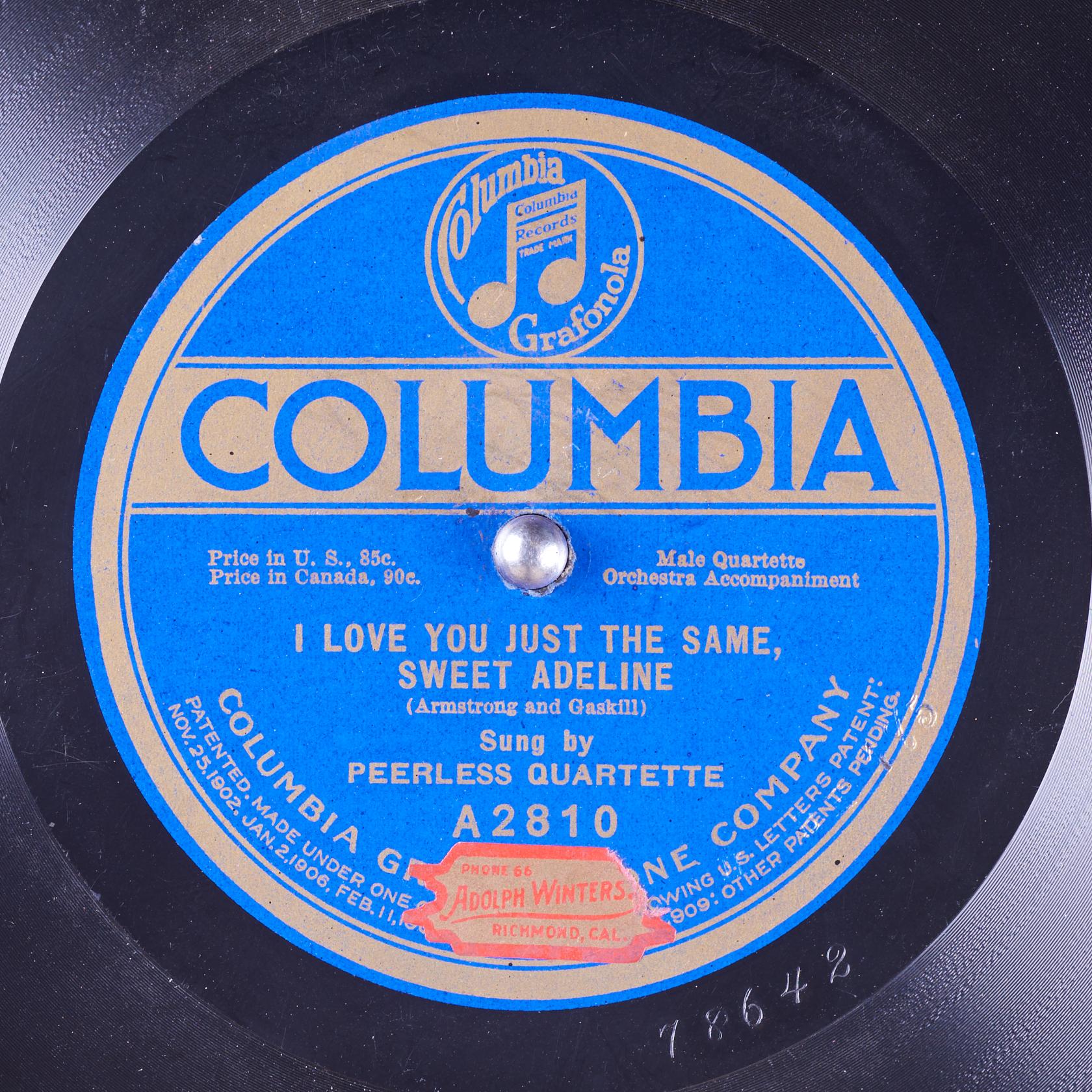
100 years ago: The Haydn Quartet hit #1 with "Sweet Adeline"

Sweet Adeline (You’re the Flower of My Heart)

Haydn Quartet

Writer(s): Richard H. Gerard/Harry Armstrong (see lyrics here)


First Charted: October 15, 1904


Peak: 110 US, 2 GA (Click for codes to singles charts.)


Sales (in millions): --


Airplay/Streaming (in millions): -- radio, 0.1 video, -- streaming

Sweet Adeline (You’re the Flower of My Heart)

Peerless Quartet (as Columbia Male Quartet)


First Charted: November 19, 1904


Peak: 13 US, 2 GA (Click for codes to singles charts.)


Sales (in millions): --


Airplay/Streaming (in millions): -- radio, -- video, -- streaming

Awards (Haydn Quartet):

Click on award for more details.


Awards (Peerless Quartet):

About the Song:

As “the signature barbershop song,” DS “Sweet Adeline” may represent the sound of the first decade of the 20th century, WHC maybe even the first two decades, DS more than any other song. WHC The term wasn’t used until the 1920s, LW but the format of four-part male harmony with little or no musical accompaniment was introduced in the late 19th century. LW

The song began life in 1896 WK as an instrumental called “Down Home in New England.” The composer, Henry W. Armstrong, was a barbershop quartet enthusiast and tapped Richard Gerard to add lyrics, resulting in “You’re the Flower of My Heart Sweet, Rosalie.” RCG When they couldn’t find a publisher, they changed the title to “Sweet Adeline,” reportedley inspired by the “legendarily beautiful” LW opera singer Adelina Patti, although prima donna Adeline Gerard has also been cited as an inspiration. RCG Gerad later said the song was inspired by a girl who worked at the music counter at a department store in New York. TY2

The Quaker City Four introduced the song in vaudeville DJ in 1903 at the Hammerstein’s Victoria Theater in New York City. TY2 It was common for barbershop songs of the day to drift into “minstrel or vaudeville shtick,” DS but the Haydn Quartet, who scored their sixth #1 with “Sweet Adeline,” generally stuck to more straightforward harmony. DS The song was the biggest hit of 1904. WHC The Columbia Quartet and the duo of Albert Campbell & James F. Harrison also charted with versions that year, taking the song to #1 and #2 respectively. The Mills Brothers had a top 10 with it in 1939. The song also became identified with Boston Mayor John F. “Honey” Fitzgerald PM who used it as his campaign song in 1906.

“Sweet Adeline” established the foundation for vocal groups for decades to come. The Everly Brothers; The Beach Boys; Crosby, Stills & Nash; and even The Beatles’ penchant for “tight harmony singing” can all be traced back to the barbershop movement. LW


Resources:


Related Links:


First posted 4/12/2020; last updated 12/14/2022.

Monday, October 18, 2004

Today in Music (1904): Gustav Mahler Symphony No. 5 premiered.

Symphony No. 5 in C-sharp minor

Gustav Mahler


Premiered: October 18, 1904


Composed: 1901-02


Peak: --


Sales (in millions): --


Genre: classical > symphony


Movements/Parts:

  1. Trauermarsch (Funeral march)
  2. Stürmisch bewegt, mit größter Vehemenz (Moving stormily, with the greatest vehemence)
  3. Scherzo. Kräftig, nicht zu schnell(Strong and not too fast) D major
  4. Adagietto. Sehr langsam (Very slow) F major
  5. Rondo-Finale. Allegro – Allegro giocoso. Frisch(Fresh) D major


Average Duration: 75:00

Rating:

3.919 out of 5.00 (average of 3 ratings)


Awards:

(Click on award to learn more).

About the Work:

Gustav Mahler “emerged as a crucial bridge between the musical Romanticism of the 19th century and the modernism of the 20th, a composer who simultaneously summed up the achievements of his predecessors and pointed the way forward.” LP His fifth symphony was composed during the summers of 1901 and 1902, “during his annual holiday from his job as director of the Vienna Court Opera.” LP It was his first purely instrumental symphony since his first symphony. LP He composed it

The symphony, “with its trajectory from mourning to triumph,” LP reflects Mahler’s relationship with Alma Schindler, “the beautiful daughter of a famous landscape painter.” LP He met her in Vienna the winter before he started writing the symphony and proposed to her in the fall of 1901. They were married and expecting their first child by the summer of 1902. WK

The First Movement:

The symphony “opens with a funeral march that starts with a trumpet fanfare whose rhythm dominates the movement. The march contrasts with two trio sections, the first bursting out of the near-silence like some sort of terrifying, demonic carnival music, the second a more somber, restrained passage for the strings.” LP

The Second Movement:

“The second movement builds on the material of that demonic first trio of the opening march. This is intense, raw music, with Mahler whipping up a frenzy from comparatively modest material. The only respite comes with the appearance of a D-major chorale, a joyous, hymn-like passage that finds the sun temporarily piercing the charged gray hues of the surrounding storm clouds.” LP

The Third Movement:

The third movement is the longest. “The mood abruptly shifts from the pessimism and storminess of the first two movements to a lighter, affirmative disposition, aided by the dance rhythms.” WK Mahler “balances the tone of folksy Austrian country dances and the more cultivated elegance of the Viennese waltz.” LP The “shadowy writing for the orchestra, has much in common with the ‘night music’ movements of Mahler’s Seventh Symphony.” LP

The Fourth Movement:

The fourth movement, “Adagietto,” was Mahler’s “declaration of love to Alma" LP and maybe Mahler’s greatest hit.” LP It “has often been performed as a stand-alone piece.” LP Leonard Bernstein conducted a performance of it on June 8 1968, at St. Patrick’s Cathedral in Manhattan for the funeral Mass for Robert F. Kennedy. WK

The Fifth Movement:

“Several of the themes evolve out of the fragments heard in the opening measures. The last movement also utilizes themes from the Adagietto as well as the chorale from the second movement.” WK

Resources and Related Links:


Other Related DMDB Pages:


First posted 10/5/2023.

Today in Music (1954): The transistor radio introduced.

October 18, 1954

The transistor radio was introduced.

“The idea of taking information and entertainment out of the living room all started with the transistor.” DTN The radio was once a large piece of furniture that took up the role eventually assumed by televisions in that it thrust news, entertainment, and other programming right into the family living room. Those radios used vacuum tubes which were large, cumbersome, and unreliable. DTN In 1945, Bell Laboratories started exploring a new way to amplify electrical current. They developed the transistor, which was patented on June, 30, 1948. DTN

It “revolutionized the field of consumer electronics by introducing small, but powerful, convenient hand-held devices.” WK At first, their value was mostly for the phone company and “a handful of scientists building computers” PBS but they found wide-spread commercial use when introduced in the first commercial transistor radio – the Regency TR1 – eight years later.

The first one was a joint project between Texas Instruments and the Regency Division of Industrial Development Engineering Associates. TI built the transistors while Regency built the radio. On October 18, 1954, the five-inch-high radio was introduced to the market. PBS It revolutionized how people could absorb music because it was now available to anyone, anywhere. Steve Wozniak, co-founder of Apple, said, “My first transistor radio…I loved what it could do; it brought me music; it opened my world up.” TH

However, at the time the invention wasn’t taken seriously by major radio manufacturers such as RCA. They thought transistors were just novel ideas which would appeal to hobbyists. TH While the Regency radio stopped production in the spring of 1955, it opened the door for other future-minded companies. A Japanese company called Tokyo Tsushin Kogyo decided to also make radios. Since their company name was unpronounceable to Americans, they renamed the company Sony because of the Latin word “sonus” which meant “sound,” and the phrase “sonny boys,” because it was a reference at the time to bright, young men. PBS Sony introduced their portable radio in 1957. TH


For more important days in music history, check out the Dave’s Music Database history page.

Resources and Related Links:


First posted 10/6/2023.

Saturday, October 16, 2004

Green Day hit charts with “Boulevard of Broken Dreams”

Boulevard of Broken Dreams

Green Day

Writer(s): Billie Joe Armstrong, Mike Dirnt, Tré Cool (see lyrics here)


Released: November 29, 2004


First Charted: October 16, 2004


Peak: 2 US, 14 RR, 30 AC, 111 A40, 18 AA, 114 AR, 116 MR, 5 UK, 1 CN, 5 AU, 1 DF (Click for codes to charts.)


Sales (in millions): 2.0 US, 0.2 UK, 7.0 world (includes US + UK)


Airplay/Streaming (in millions): 0.9 radio, 282.08 video, 581.91 streaming

Awards:

Click on award for more details.

About the Song:

Green Day formed in 1987 in East Bay, California. The punk-rock trio broke through in 1994 with Dookie, their major label debut. With 20 million copies sold worldwide, the album set a seemingly impossible standard for the band to follow. However, a decade later, the band experienced another monstrous success with American Idiot. The “surprisingly ambitious punk-rock opera” SS explored “the disillusionment and dissent of a generation that came of age in a period shaped by tumultuous events such as 9/11 and the Iraq War.” WK2 In Time magazine, Josh Tyrangiel said “there is almost no precedent for a band’s putting out six decent albums and then on its seventh delivering a masterpiece.” SS

The title track and lead single spewed the high-octane punk rock that drew the band’s fans in the first place. The follow-up, however, was the softer, “Boulevard of Broken Dreams.” The “sharply focused, intense rock ballad of emotional solitude” SS was “the group’s finest creation.” SS

The song barely missed topping the Billboard Hot 100, peaking at #2. It did, however, top multiple charts, including the Mainstream Rock, Alternative Rock, Adult Top 40, and Adult Album Alternative charts for a total of 49 weeks. The song set a then-record number of weeks on the UK top 100 chart. WK1

As to “Dreams” place in the concept album, it followed the main character from the song “Jesus of Suburbia” as he leaves town, walking around and contemplating whether it is the right decision. Lead singer Billie Joe Armstrong explained he got the idea for the song from the title of a Gottfried Helnwein painting of James Dean walking alone in a trench coat. SF Armstrong had traveled to New York City while working on songs and tapped into the idea about feeling alone. WK1

The video, which MTV gave its Video of the Year award, echoed the “walking” theme by following the band as they start walking down a desert road after their car breaks down. SF The song was voted Best Single of the ‘00s in the Rolling Stone decade-end readers’ poll, American Idiot was named best album, and Green Day were declared Top Artist of the Decade. SF It also won the Grammy for Record of the Year.


Resources:


Related Links:


Last updated 4/12/2023.